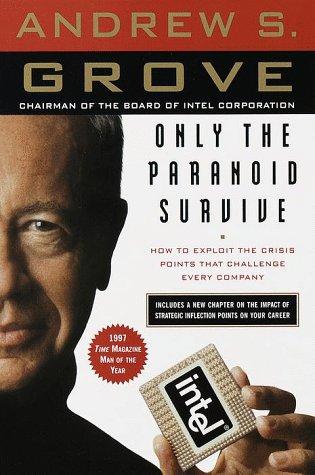
Only the Paranoid Survive by Andrew S. Grove is a 1996 business book about strategic inflection points, leadership, competitive dynamics. Strategic inflection points are moments when the fundamental competitive forces of an industry change so sharply that the old ways of operating no longer work.
Summary
Only the Paranoid Survive is Andrew Grove's account of how he understood and navigated the most dangerous moments in a company's life — what he calls strategic inflection points. Grove was CEO of Intel during its most consequential decade, and the book is grounded in experience rather than theory. The central claim is that every business will eventually encounter a force powerful enough to transform it, and that most companies fail not because the change was unpredictable but because management refused to acknowledge it clearly enough to act.
Grove introduces the concept of the strategic inflection point — a moment when the fundamental competitive dynamics of an industry change so sharply that the old rules no longer apply. The cause can be technology, regulation, a new competitor, a change in distribution, or a shift in customer behavior. What matters is recognizing when one has arrived. Grove's diagnostic tool is asking whether any of the six forces acting on a business — competitors, customers, suppliers, substitutes, potential entrants, or complementors — has changed in a way that now rates "ten times" stronger than it did before.
The book's most memorable section describes Intel's own inflection point in the mid-1980s: the transition out of memory chips into microprocessors. Grove recounts asking himself what a new CEO brought in from outside would do, then realizing the answer was already clear. The exercise of imagining an outsider's view gave him permission to act on what the evidence already indicated. This technique — the "walk out the door" thought experiment — has since become widely cited.
Grove is honest about the costs. Strategic inflection points require abandoning positions, products, and people that defined the previous era. Middle management often resists because their expertise and status are tied to the old model. Senior management often resists because the signals are ambiguous and the transformation feels premature. The book is essentially an argument that the paranoia of the title — a constant vigilance for disruptive change — is not a pathology but a prerequisite for leading a technology company through its growth.
Talk to Only the Paranoid Survive like its author wrote you back.
Get the ideas that fit your life — not generic summaries.
- Chat with the book
- Audiobook-style main ideas
- Adapts to your life and goals
- Helps you take action
Key takeaways
- 1.
Strategic inflection points are moments when the fundamental competitive forces of an industry change so sharply that the old ways of operating no longer work.
- 2.
The '10x force' test: if any one of your six competitive forces has become ten times stronger, you are likely at or entering a strategic inflection point.
- 3.
Middle managers often sense inflection points before senior leadership because they are closer to customers, suppliers, and competitors. Hearing those signals is a management discipline.
- 4.
The 'walk out the door' thought experiment: ask what a new CEO brought in from the outside would do. Then do that. It bypasses the sunk-cost thinking that traps incumbents.
- 5.
Denial is the normal first response to a strategic inflection point. The longer it persists, the less room remains to maneuver.
- 6.
Not all inflection points threaten survival. Some create opportunities for companies nimble enough to recognize and move toward them before competitors do.
- 7.
The valley of death is the period between recognizing an inflection point and successfully adapting to it — a period of confusion, experimentation, and internal resistance.
- 8.
Paranoia is a competitive asset in technology. Assuming that what made you successful today will be made obsolete by someone, somewhere, before you expect it.
Discussion questions
Use these on your own, with a book club, or as chat starters in Superbook. Book club version, ready to copy or print →
- 1.
Grove defines the moment an inflection point arrives as the time when the old strategic picture dissolves and a new one must be built. Has your industry had one of those moments recently?
- 2.
His 10x force test asks whether any competitive factor — a new entrant, a technology, a distribution shift — has become ten times more powerful. Apply that test to your industry right now.
- 3.
Grove says middle managers often see strategic inflection points before senior leadership does. How does your organization capture and act on signals from people closest to customers?
- 4.
Think of a company you know well that failed to navigate a strategic inflection point. At what stage did denial give way to recognition, and was it too late?
- 5.
The 'walk out the door' thought experiment strips away sunk cost and attachment. Apply it to your current organization: what would an outside CEO do differently?
- 6.
Grove argues that ambiguity in the early stages of an inflection point is normal and not an excuse for inaction. How does your organization make decisions under genuine strategic uncertainty?
- 7.
He is candid that leading Intel through the memory-to-microprocessor transition was disorienting and costly. What would that kind of pivot cost your organization in terms of expertise, relationships, and culture?
- 8.
Grove distinguishes between noise and signal in early warning signs. What processes does your team use to decide which trends deserve serious attention versus which should be monitored passively?
- 9.
He says paranoia is an asset. Is there a version of that vigilance that tips into dysfunction — where constant threat-scanning prevents an organization from executing well?
- 10.
Which of the six competitive forces in your industry seems most likely to produce a 10x shift in the next five years?
- 11.
Grove wrote this in 1996. Which of his examples from the computing industry feel prescient about later shifts — in mobile, cloud, AI — that he couldn't have seen?
- 12.
The book argues that the difference between companies that survive inflection points and those that don't is often speed of recognition, not quality of response. Do you agree with that emphasis?
Themes
Frequently asked questions
-
What is Only the Paranoid Survive about?
It's Grove's framework for recognizing and surviving strategic inflection points — moments when the competitive landscape of an industry changes so fundamentally that the old rules stop working. The book draws heavily on Intel's own transition from memory chips to microprocessors.
-
Is Only the Paranoid Survive still relevant?
Yes, arguably more so than when it was written. The pace at which industries face 10x competitive forces has accelerated. The framework for distinguishing noise from signal and for thinking about inflection points applies cleanly to software, AI, and platform businesses.
-
How long is the book?
Around 220 pages, which most readers finish in four to five hours. It reads quickly because Grove writes directly and the narrative is grounded in real events rather than abstracted into frameworks alone.
-
Who should read this book?
Executives and founders in industries where technology creates the potential for rapid competitive disruption. It's less applicable to stable, slow-moving industries, but almost every technology-adjacent business will recognize the inflection point dynamic.
-
What's the most actionable idea in the book?
The 'walk out the door' thought experiment. When you're stuck on a strategic decision, ask what a new CEO coming in cold would do — free of your commitments, your relationships, and your sunk costs. Then seriously consider doing that.
Similar books
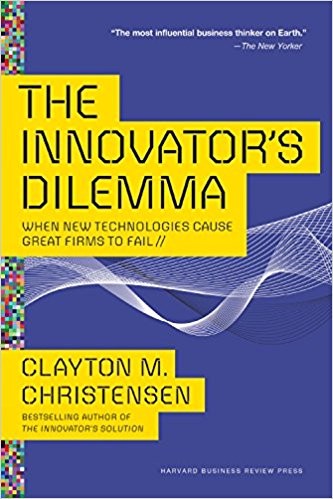
The Innovator's Dilemma
Clayton M. Christensen
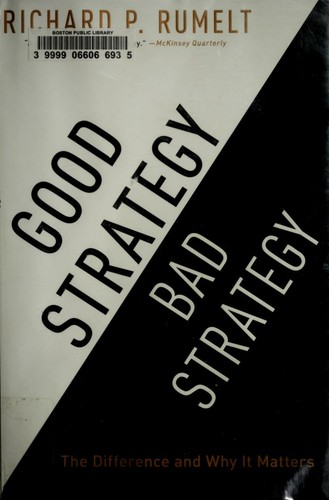
Good Strategy Bad Strategy
Richard Rumelt
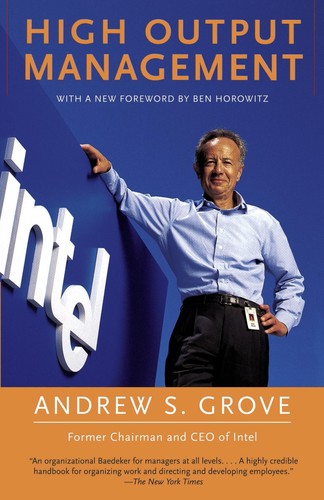
High Output Management
Andrew S. Grove

Blitzscaling: The Lightning-Fast Path to Building Massively Valuable Companies
Reid Hoffman and Chris Yeh
