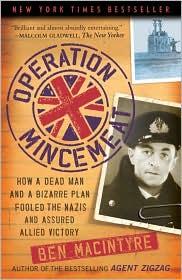
Talk to Operation Mincemeat: How a Dead Man and a Bizarre Plan Fooled the Nazis and Assured an Allied Victory like its author wrote you back.
Get the ideas that fit your life — not generic summaries.
- Chat with the book
- Audiobook-style main ideas
- Adapts to your life and goals
- Helps you take action
What it argues
In 1943, British intelligence planted a dead man on a Spanish beach carrying fabricated documents designed to convince the Germans that the Allied invasion of southern Europe would target Greece and Sardinia rather than Sicily. The plan worked. Operation Mincemeat is one of the most audacious and consequential intelligence deceptions in military history, and Ben Macintyre's account of it is both meticulously researched and compulsively readable.
The dead man was a homeless Welshman named Glyndwr Michael whose body was dressed as a Royal Marines officer named Major William Martin and given a fully fabricated life: identity papers, love letters, overdue bills, a photograph of a fiancée. The architects were a small group of eccentrics and obsessives in British intelligence, including the novelist Ian Fleming, who contributed to the initial brainstorming, and Ewen Montagu and Charles Cholmondeley, who drove the operation. Macintyre gives each of them a vivid character study.
What it gets right
- 1.
Successful deception requires deep knowledge of the target's psychology, not just the ability to fabricate evidence. The Germans accepted the documents partly because they fit what they already wanted to believe.
- 2.
The fabricated identity of Major William Martin was built from dozens of consistent, mundane details — overdue bills, love letters, club membership cards — that together created an illusion more convincing than any single grand gesture.
- 3.
Hitler's personal decision to redirect reinforcements based on Mincemeat intelligence directly weakened the defenses the Allies faced in Sicily, demonstrating how deception can shape strategy at the highest level.
What it covers
Who wrote it
Ben Macintyre is a journalist and author at The Times of London who has specialized in the history of espionage and World War II intelligence operations. He is the author of more than a dozen books, including Agent Zigzag, The Spy and the Traitor, and A Spy Among Friends, several of which have been adapted for television. His approach combines rigorous archival research with propulsive narrative style, making classified intelligence history accessible to general readers. He has also served as a foreign correspondent in New York, Paris, and Washington.
