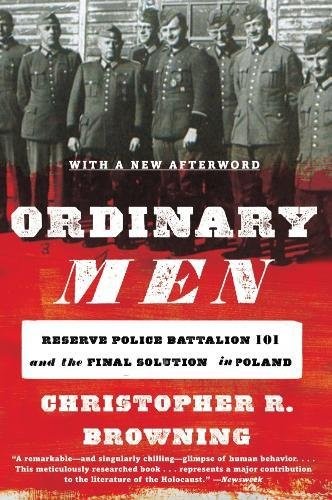
Talk to Ordinary Men: Reserve Police Battalion 101 and the Final Solution in Poland like its author wrote you back.
Get the ideas that fit your life — not generic summaries.
- Chat with the book
- Audiobook-style main ideas
- Adapts to your life and goals
- Helps you take action
What it argues
Ordinary Men is Christopher Browning's study of Reserve Police Battalion 101, a unit of middle-aged German men — not hardened SS officers but Hamburg policemen with civilian lives and families — who between 1942 and 1943 shot approximately 38,000 Jewish men, women, and children in occupied Poland and deported another 45,000 to the Treblinka death camp. Browning draws on postwar judicial testimonies given by the men themselves to reconstruct in precise detail how ordinary people became mass killers.
The central finding, established in the book's opening chapters, is that the men were given a choice. On the morning of the first mass shooting at Józefów, the battalion commander told his men that older soldiers who did not feel up to the task could step aside. Only a handful did. Over time, as the killings continued, the social and psychological mechanisms that kept men killing became more complex and harder to escape — but the initial opportunity to refuse was real, and almost no one took it. Browning resists the conclusion that coercion fully explains the participation.
What it gets right
- 1.
The members of Reserve Police Battalion 101 were ordinary men — middle-aged, working-class, with no prior record of ideological extremism. Their participation in mass murder cannot be explained by pre-selection for fanaticism.
- 2.
The battalion commander offered his men a choice at the first shooting. Almost no one stepped aside. Browning argues this demonstrates that something other than direct coercion was operative.
- 3.
Conformity and careerism were more powerful than ideology in sustaining participation. Men kept killing because stepping aside would mean breaking from their comrades, not because they feared punishment.
What it covers
Who wrote it
Christopher R. Browning is Frank Porter Graham Professor of History Emeritus at the University of North Carolina at Chapel Hill. He is the author of several books on the Holocaust and Nazi Germany, including The Origins of the Final Solution and Nazi Policy, Jewish Workers, German Killers. He has been an expert witness in Holocaust trials and denial proceedings. Ordinary Men, first published in 1992, is considered one of the foundational texts in the study of Holocaust perpetrators and has been in continuous print for over three decades.
