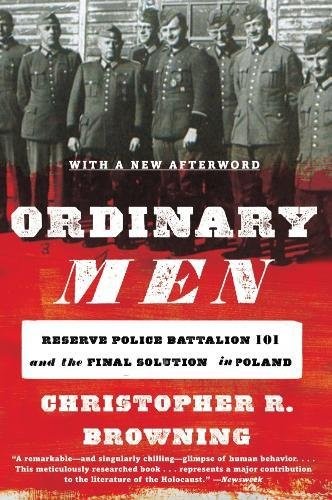
Ordinary Men: Reserve Police Battalion 101 and the Final Solution in Poland by Christopher R. Browning is a 1992 history book about the holocaust, perpetrators, conformity. The members of Reserve Police Battalion 101 were ordinary men — middle-aged, working-class, with no prior record of ideological extremism. Their participation in mass murder cannot be explained by pre-selection for fanaticism.
Summary
Ordinary Men is Christopher Browning's study of Reserve Police Battalion 101, a unit of middle-aged German men — not hardened SS officers but Hamburg policemen with civilian lives and families — who between 1942 and 1943 shot approximately 38,000 Jewish men, women, and children in occupied Poland and deported another 45,000 to the Treblinka death camp. Browning draws on postwar judicial testimonies given by the men themselves to reconstruct in precise detail how ordinary people became mass killers.
The central finding, established in the book's opening chapters, is that the men were given a choice. On the morning of the first mass shooting at Józefów, the battalion commander told his men that older soldiers who did not feel up to the task could step aside. Only a handful did. Over time, as the killings continued, the social and psychological mechanisms that kept men killing became more complex and harder to escape — but the initial opportunity to refuse was real, and almost no one took it. Browning resists the conclusion that coercion fully explains the participation.
What does explain it, Browning argues, is a combination of factors: careerism, conformity, deference to authority, the normalization of incremental steps, and the social pressure of not wanting to stand apart from one's comrades. He draws on Stanley Milgram's obedience experiments and Philip Zimbardo's work on situational influences to frame his analysis. His argument is that the perpetrators were not selected for ideological fanaticism; they were selected by circumstances that any group of otherwise normal men might have found themselves in.
Browning's conclusions were challenged by Daniel Goldhagen, who in Hitler's Willing Executioners (1996) argued that the men's antisemitism was the essential factor and that Browning underweighted it. The debate between the two books has been one of the most productive in Holocaust historiography. Ordinary Men does not exonerate anyone; it implicates a much larger human population than the view of perpetrators as uniquely evil monsters would require.
Talk to Ordinary Men: Reserve Police Battalion 101 and the Final Solution in Poland like its author wrote you back.
Get the ideas that fit your life — not generic summaries.
- Chat with the book
- Audiobook-style main ideas
- Adapts to your life and goals
- Helps you take action
Key takeaways
- 1.
The members of Reserve Police Battalion 101 were ordinary men — middle-aged, working-class, with no prior record of ideological extremism. Their participation in mass murder cannot be explained by pre-selection for fanaticism.
- 2.
The battalion commander offered his men a choice at the first shooting. Almost no one stepped aside. Browning argues this demonstrates that something other than direct coercion was operative.
- 3.
Conformity and careerism were more powerful than ideology in sustaining participation. Men kept killing because stepping aside would mean breaking from their comrades, not because they feared punishment.
- 4.
The escalation of violence was incremental. Each step made the next step easier. Men who had initially been disturbed by the killings became capable of carrying them out routinely within weeks.
- 5.
Milgram's obedience experiments and Zimbardo's situational research provide a social-psychological framework for understanding how ordinary people can be induced to perform extreme acts by authority structures and group pressure.
- 6.
Browning's argument implicates a much wider range of human beings than the view of perpetrators as uniquely evil requires. This is disturbing but historically important.
- 7.
The testimonies on which the book is based were given decades later in legal proceedings, with obvious incentives to minimize personal responsibility. Browning reads them with appropriate skepticism but finds them reliable on the core facts.
- 8.
The question of why people did not refuse is, in Browning's telling, less interesting than the question of what would have been required for them to do so — and how rarely those conditions are met.
Discussion questions
Use these on your own, with a book club, or as chat starters in Superbook. Book club version, ready to copy or print →
- 1.
Browning argues that the men had a genuine choice and that almost none took it. What conditions — social, institutional, psychological — would have made refusal more likely?
- 2.
The book draws on Stanley Milgram's obedience experiments. Do you find that framework convincing as an explanation for what the battalion did, or does it inadequately account for the specific ideological context?
- 3.
Browning and Goldhagen reached different conclusions about the role of antisemitism from largely similar evidence. What does this disagreement tell us about how historical interpretation works?
- 4.
The escalation model suggests that each small step made the next step easier. Can you identify analogous escalation dynamics in institutional settings you know, even far removed from violence?
- 5.
The men gave testimonies in legal proceedings decades later. How should historians weigh evidence from people who had strong incentives to minimize their own responsibility?
- 6.
Browning's conclusion — that ordinary people in the right circumstances can become mass killers — is disturbing. Does it change how you think about human nature, or does it confirm something you already believed?
- 7.
Several of the men expressed distress at the killings but continued anyway. What does the gap between emotional response and behavior tell us about the limits of empathy as a moral brake?
- 8.
The battalion was given an opportunity to refuse at the beginning. Why do you think so few people took it? What would you need to know about yourself to have confidence you would have been different?
- 9.
Browning resists using the word 'evil' to describe the perpetrators. Is this restraint historically useful, morally appropriate, or both?
- 10.
The men were not ideologically screened for the task they were given. Does this suggest something about the relationship between ideology and action, or does it simply reflect the practical limitations of wartime manpower?
- 11.
What are the institutional and social conditions most likely to produce ordinary perpetrators? Can those conditions be identified in advance and disrupted?
- 12.
How does Ordinary Men change the question the Holocaust asks of us? Does it make the event seem more explicable, less exceptional, or both?
Themes
Frequently asked questions
-
What is the main argument of Ordinary Men?
That ordinary middle-aged German men with no prior record of extremism became mass killers through conformity, careerism, obedience to authority, and incremental escalation — not through ideological fanaticism — and that they had opportunities to refuse that almost none of them took.
-
How does Ordinary Men differ from Hitler's Willing Executioners?
Browning argues that situational factors — conformity, authority, peer pressure — were the primary drivers of participation. Goldhagen argues that specifically German antisemitic ideology was the essential factor. Both use similar evidence and reach strikingly different conclusions.
-
Is Ordinary Men appropriate for general readers?
Yes. Browning writes clearly and accessibly. The material is disturbing but the analysis is careful and humane. It is shorter than most major Holocaust histories and can be read in a few hours.
-
What does the title Ordinary Men mean?
It refers to the finding that the perpetrators were not selected or pre-screened for ideological extremism. They were average working-class men who had been too old for regular military service. The title is also an implicit argument against the view that mass murder requires unusual people.
-
Is Ordinary Men worth reading alongside Bloodlands or Black Earth?
Yes. The three books complement each other well. Bloodlands and Black Earth focus on the geography and structure of mass killing; Ordinary Men focuses on the individual perpetrators and the mechanisms of their participation.