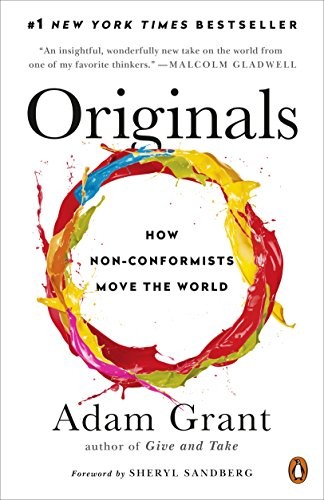
Talk to Originals: How Non-Conformists Move the World like its author wrote you back.
Get the ideas that fit your life — not generic summaries.
- Chat with the book
- Audiobook-style main ideas
- Adapts to your life and goals
- Helps you take action
Originals: How Non-Conformists Move the World, in detail
Originals is Adam Grant's examination of how people champion new ideas without losing their jobs, their relationships, or their nerve. The central paradox the book tries to resolve is that the people who generate and drive change are rarely the wildest risk-takers — they're people who manage uncertainty carefully, diversify their bets, and time their actions strategically. Grant is an organizational psychologist and draws heavily on research in creativity, social psychology, and organizational behavior.
The book opens with a counterintuitive finding: the entrepreneurs who kept their day jobs while testing their businesses had higher survival rates than those who quit immediately. Original thinkers aren't fearless; they're better at managing fear. Grant examines how the timing of a new idea matters enormously — being too early is as dangerous as being too late — and how the best originators often procrastinate productively, letting half-formed ideas incubate while continuing to refine the central problem.
Grant also explores how originals get others to adopt their ideas. He examines the role of familiarity (ideas that feel slightly familiar are easier to accept than completely alien ones), the value of leading with weaknesses in a pitch rather than hiding them, and the counterintuitive observation that expressing uncertainty about a presentation often increases its persuasiveness. On coalition building, he examines why effective advocates identify the most open-minded potential allies rather than trying to convert entrenched opponents.
The weakest section is on parenting and raising original children, which sits awkwardly with the organizational material. But the book's core contribution — that originality is a strategy, not a personality type, and that it requires managing risk rather than ignoring it — is well-made and grounded in evidence. Grant's gift for surfacing non-obvious research and explaining it without jargon is on full display throughout.
The big ideas
- 1.
Originals aren't fearless; they feel the same doubts as everyone else but act anyway. The difference is how they manage uncertainty — through diversification and staged commitment rather than all-in bets.
- 2.
Keeping a day job while testing an idea reduces risk and often leads to better outcomes than quitting immediately. The most creative people typically have backup plans.
- 3.
Timing is a competitive advantage. Being the first mover is less important than being the fast follower who learns from earlier entrants and arrives when the market is ready.
