Originals: How Non-Conformists Move the World by Adam Grant is a 2016 psychology book about creativity, innovation, risk-taking. Originals aren't fearless; they feel the same doubts as everyone else but act anyway. The difference is how they manage uncertainty — through diversification and staged commitment rather than all-in bets.
Summary
Originals is Adam Grant's examination of how people champion new ideas without losing their jobs, their relationships, or their nerve. The central paradox the book tries to resolve is that the people who generate and drive change are rarely the wildest risk-takers — they're people who manage uncertainty carefully, diversify their bets, and time their actions strategically. Grant is an organizational psychologist and draws heavily on research in creativity, social psychology, and organizational behavior.
The book opens with a counterintuitive finding: the entrepreneurs who kept their day jobs while testing their businesses had higher survival rates than those who quit immediately. Original thinkers aren't fearless; they're better at managing fear. Grant examines how the timing of a new idea matters enormously — being too early is as dangerous as being too late — and how the best originators often procrastinate productively, letting half-formed ideas incubate while continuing to refine the central problem.
Grant also explores how originals get others to adopt their ideas. He examines the role of familiarity (ideas that feel slightly familiar are easier to accept than completely alien ones), the value of leading with weaknesses in a pitch rather than hiding them, and the counterintuitive observation that expressing uncertainty about a presentation often increases its persuasiveness. On coalition building, he examines why effective advocates identify the most open-minded potential allies rather than trying to convert entrenched opponents.
The weakest section is on parenting and raising original children, which sits awkwardly with the organizational material. But the book's core contribution — that originality is a strategy, not a personality type, and that it requires managing risk rather than ignoring it — is well-made and grounded in evidence. Grant's gift for surfacing non-obvious research and explaining it without jargon is on full display throughout.
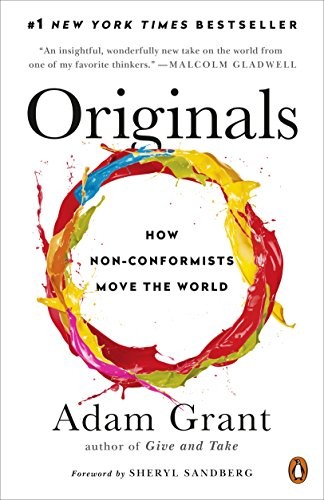
Talk to Originals: How Non-Conformists Move the World like its author wrote you back.
Get the ideas that fit your life — not generic summaries.
- Chat with the book
- Audiobook-style main ideas
- Adapts to your life and goals
- Helps you take action
Key takeaways
- 1.
Originals aren't fearless; they feel the same doubts as everyone else but act anyway. The difference is how they manage uncertainty — through diversification and staged commitment rather than all-in bets.
- 2.
Keeping a day job while testing an idea reduces risk and often leads to better outcomes than quitting immediately. The most creative people typically have backup plans.
- 3.
Timing is a competitive advantage. Being the first mover is less important than being the fast follower who learns from earlier entrants and arrives when the market is ready.
- 4.
Productive procrastination — letting an idea incubate while still working on other things — allows for synthesis and perspective that focused sprints don't provide.
- 5.
Pitching ideas with acknowledged weaknesses is more persuasive than hiding them. It signals confidence and honesty, and lets you frame the tradeoffs on your own terms.
- 6.
Familiar-but-different is the sweet spot for new ideas. Complete novelty triggers rejection; slight familiarity creates the cognitive ease that helps people accept change.
- 7.
When building coalitions for change, target the most open-minded potential allies first, not the most powerful or most resistant. Social proof from early adopters shifts the center of gravity.
- 8.
Strategic impatience and tactical patience: be urgent about defining the problem and the goal, but patient about how and when you push for the solution.
Discussion questions
Use these on your own, with a book club, or as chat starters in Superbook. Book club version, ready to copy or print →
- 1.
Grant argues that originals aren't reckless — they diversify risk rather than ignore it. Does that match the people you've seen successfully drive change in your own field?
- 2.
Have you ever had an idea you were confident in but failed to act on? Looking back, was it timing, coalition, or your own hesitation that held it back?
- 3.
The data shows first movers often lose to fast followers. Can you think of examples from your own industry where the first-mover was overtaken?
- 4.
Grant's finding that procrastination can be creative — letting ideas incubate — is uncomfortable for people who pride themselves on execution. How do you distinguish productive delay from avoidance?
- 5.
Have you ever led with your weaknesses in a pitch or proposal? What happened?
- 6.
The book argues that familiar-but-different is the sweet spot for new ideas. Where have you seen an idea fail because it was too unfamiliar, or get stolen because it wasn't different enough?
- 7.
When advocating for a change in an organization, Grant recommends starting with the most open-minded people rather than the most powerful. Have you seen that strategy work? Fail?
- 8.
Originals, Grant argues, express doubt strategically rather than hiding it. Where in your own life does projecting certainty when you feel uncertain seem to help you? Where does it hurt?
- 9.
The research on birth order suggests later-borns tend to be more rebellious and first-borns more conventional. Does that match your own family? Does it hold in organizations — do people who joined earlier act more defensively?
- 10.
Grant examines people who raised dissent in time to prevent organizational disasters and were ignored. What makes those situations so common? What would have to change for the dissenter to be heard?
- 11.
If you had to generate ten new ideas in a field you care about, how would you do it — and which of them would you expect to be worth developing?
- 12.
Grant says that strategic impatience (urgency about the goal) combined with tactical patience (flexibility about approach) characterizes effective originals. Where are you currently impatient when you should be patient, and vice versa?
Themes
Frequently asked questions
-
What is Originals about?
It examines how people generate and champion new ideas without being reckless. Grant argues that original thinkers manage risk strategically — keeping backup plans, timing their moves, building coalitions — rather than acting on pure conviction. Originality is treated as a set of learnable strategies, not a personality trait.
-
Is Originals worth reading?
Yes, especially for people who have ideas they want to advance but feel constrained by institutional inertia or their own risk aversion. The research is well-curated and the examples are concrete. Some chapters feel more loosely connected than others, but the core argument is sound and the tools are actionable.
-
Who should read Originals?
People trying to drive change in organizations without blowing up their careers, entrepreneurs testing new ideas, and anyone curious about why some genuinely good ideas succeed while equally good ones fail. The book is also useful for managers trying to create cultures where dissent and novelty survive.
-
What is the most counterintuitive idea in Originals?
That keeping your day job while building something new is often a better strategy than quitting. The entrepreneurs in Grant's research who kept their income and health insurance while testing their businesses had significantly higher survival rates than those who went all in immediately.
-
How does Originals differ from the other Adam Grant books?
Give and Take is about generosity; Think Again is about intellectual humility; Originals is about creativity and change. The books share a research-grounded approach and an interest in behavior that runs counter to standard career advice, but Originals is the most specifically focused on innovation and dissent.
Similar books
Think Again: The Power of Knowing What You Don't Know
Adam Grant
Give and Take: Why Helping Others Drives Our Success
Adam Grant
Mindset: The New Psychology of Success
Carol S. Dweck
Drive: The Surprising Truth About What Motivates Us
Daniel H. Pink
