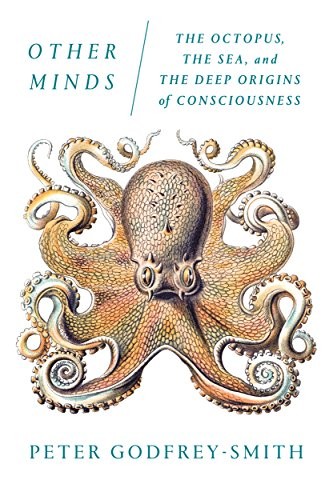
Talk to Other Minds: The Octopus, the Sea, and the Deep Origins of Consciousness like its author wrote you back.
Get the ideas that fit your life — not generic summaries.
- Chat with the book
- Audiobook-style main ideas
- Adapts to your life and goals
- Helps you take action
What it argues
Peter Godfrey-Smith is a philosopher of science and a scuba diver who began spending time with octopuses off the coast of Sydney, and Other Minds is the result of that dual perspective. The book uses cephalopods — octopuses, squid, and cuttlefish — to ask one of the deepest questions in biology: how and why did subjective experience evolve, and what does it look like in a lineage that diverged from ours more than 500 million years ago?
The key fact Godfrey-Smith establishes early is that octopuses and humans evolved complex nervous systems independently. Our last common ancestor was a simple flatworm with minimal neural structure. That means if an octopus has something like inner experience, it got there by a completely different route. The octopus is therefore what he calls an "independent experiment in the evolution of mind" — a second data point that could tell us something fundamental about what minds require, rather than just what human brains happen to do.
What it gets right
- 1.
Octopuses and humans evolved complex nervous systems independently. Their intelligence is a second experiment in what minds can look like, shaped by entirely different evolutionary pressures.
- 2.
An octopus has two-thirds of its neurons in its arms, not its central brain. This distributed architecture may support a fundamentally different kind of embodied cognition.
- 3.
The Cambrian explosion — roughly 540 million years ago — may have been driven partly by the co-evolution of eyes and the nervous systems needed to process visual information.
What it covers
Who wrote it
Peter Godfrey-Smith is a philosopher of science at the University of Sydney and the Graduate Center of the City University of New York. He is also a recreational scuba diver with a long-standing interest in cephalopod behavior in the wild. His previous books include Darwinian Populations and Natural Selection and Philosophy of Biology. Other Minds brought his academic work in philosophy of mind to a general audience and won the Phi Beta Kappa Award in Science. He splits his time between Australia and the United States.
