Other Minds: The Octopus, the Sea, and the Deep Origins of Consciousness by Peter Godfrey-Smith is a 2016 science book about consciousness, evolution, animal cognition. Octopuses and humans evolved complex nervous systems independently. Their intelligence is a second experiment in what minds can look like, shaped by entirely different evolutionary pressures.
Summary
Peter Godfrey-Smith is a philosopher of science and a scuba diver who began spending time with octopuses off the coast of Sydney, and Other Minds is the result of that dual perspective. The book uses cephalopods — octopuses, squid, and cuttlefish — to ask one of the deepest questions in biology: how and why did subjective experience evolve, and what does it look like in a lineage that diverged from ours more than 500 million years ago?
The key fact Godfrey-Smith establishes early is that octopuses and humans evolved complex nervous systems independently. Our last common ancestor was a simple flatworm with minimal neural structure. That means if an octopus has something like inner experience, it got there by a completely different route. The octopus is therefore what he calls an "independent experiment in the evolution of mind" — a second data point that could tell us something fundamental about what minds require, rather than just what human brains happen to do.
The book weaves together evolutionary history, neuroscience, and philosophy of mind. Godfrey-Smith explains how cephalopods evolved from shelled mollusks into free-moving predators with arms, color-changing skin, and neurons distributed throughout their bodies — an octopus has more neurons in its arms than in its central brain. He explores how experience might arise from neural complexity, why animals evolved the capacity to have subjective states at all, and why the boundary between animate and inanimate is harder to draw than it looks.
The writing is careful and honest about uncertainty. Godfrey-Smith does not claim to know that octopuses are conscious; he argues that the evidence makes it reasonable to take the question seriously, and that taking it seriously illuminates something about consciousness that pure human-brain research cannot. The final chapters, partly memoir, describe his encounters with specific animals in the wild and the uncanny sense of being observed by a creature whose evolutionary history diverged from ours before complex eyes existed.
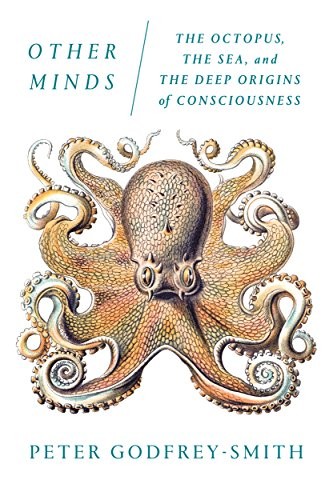
Talk to Other Minds: The Octopus, the Sea, and the Deep Origins of Consciousness like its author wrote you back.
Get the ideas that fit your life — not generic summaries.
- Chat with the book
- Audiobook-style main ideas
- Adapts to your life and goals
- Helps you take action
Key takeaways
- 1.
Octopuses and humans evolved complex nervous systems independently. Their intelligence is a second experiment in what minds can look like, shaped by entirely different evolutionary pressures.
- 2.
An octopus has two-thirds of its neurons in its arms, not its central brain. This distributed architecture may support a fundamentally different kind of embodied cognition.
- 3.
The Cambrian explosion — roughly 540 million years ago — may have been driven partly by the co-evolution of eyes and the nervous systems needed to process visual information.
- 4.
Godfrey-Smith defines consciousness not as a single thing but as a family of capacities — sensation, integration, memory, self-modeling — that may be present in different degrees and combinations.
- 5.
Cephalopods can change color in milliseconds despite being colorblind, suggesting their skin may perform a kind of distributed perceptual processing separate from central vision.
- 6.
The question of what subjective experience requires cannot be answered by studying human brains alone; genuinely alien nervous systems like the octopus provide irreplaceable comparative data.
- 7.
Behaviorism's refusal to attribute inner states to animals was not just philosophically wrong — it blocked decades of productive research on non-human minds.
- 8.
Aging in octopuses is rapid and programmed: most die within two years. Godfrey-Smith reflects on what it means to have a rich cognitive life packed into so short a span.
Discussion questions
Use these on your own, with a book club, or as chat starters in Superbook. Book club version, ready to copy or print →
- 1.
Godfrey-Smith argues that the octopus is an 'independent experiment in mind.' What would it mean for consciousness research if all the species with complex inner lives turned out to be closely related to us?
- 2.
Octopuses have most of their neurons in their arms. How does that challenge the assumption that mind and body are clearly separate, with the brain in charge?
- 3.
The book suggests that subjective experience may have evolved because it was useful — that experiencing the world is better than just processing it. Do you find that argument convincing?
- 4.
Godfrey-Smith is both a philosopher and a diver who spent time with specific octopuses. How does the personal observation change the book's argument compared to a purely theoretical account?
- 5.
If an octopus is conscious in some meaningful sense, what does that require of how we treat it — in the wild, in aquariums, in cooking?
- 6.
The Cambrian explosion produced most of the major animal body plans in a relatively short period. What does that suggest about whether complex animal life was likely or improbable on Earth?
- 7.
Godfrey-Smith is careful not to over-claim consciousness for cephalopods. At what point do you think the evidence would be strong enough to say with confidence that a non-human animal has inner experience?
- 8.
Octopuses don't live long enough to transmit learned behavior across generations. What does the absence of culture suggest about what culture requires?
- 9.
The book distinguishes between different components of consciousness — sensation, memory, self-modeling. Is there a single one of those you'd point to as the most essential? Why?
- 10.
How does reading about an animal as alien as an octopus change how you think about the inner lives of animals you're more familiar with — dogs, fish, birds?
- 11.
The final chapters are partly memoir. Does mixing personal observation with scientific argument strengthen or weaken the book's case for you?
- 12.
If consciousness evolved independently in cephalopods and vertebrates, does that make it more or less likely that consciousness exists elsewhere in the universe?
Themes
Frequently asked questions
-
Is Other Minds worth reading?
Yes. It's one of the clearest book-length explorations of consciousness written for a general audience, and the octopus lens is genuinely illuminating rather than just clever. Godfrey-Smith is honest about what is known and what isn't, which is rarer than it should be in popular science.
-
Do I need a science background to read Other Minds?
No. Godfrey-Smith writes for general readers and defines technical terms carefully. Some familiarity with evolutionary biology helps, but isn't required. The philosophy of mind sections are accessible and largely jargon-free.
-
What is the book actually about?
Ostensibly about octopuses, but really about the deep origins of consciousness and what studying an alien nervous system can teach us about what minds require. The octopus is the entry point; the question is what subjective experience is and how it evolved.
-
How does Other Minds compare to The Soul of an Octopus?
Sy Montgomery's book is a personal, emotional account of relationships with individual octopuses at an aquarium. Godfrey-Smith's is more philosophical and scientific, using cephalopods to argue about the nature of consciousness. They complement each other well.
-
Who should read this book?
Anyone interested in consciousness, philosophy of mind, evolutionary biology, or marine life. It also works well for readers who want to think seriously about animal cognition without a specialist background.
Similar books
Are We Smart Enough to Know How Smart Animals Are?
Frans de Waal
The Soul of an Octopus: A Surprising Exploration into the Wonder of Consciousness
Sy Montgomery
A Short History of Nearly Everything
Bill Bryson
The Selfish Gene
Richard Dawkins
