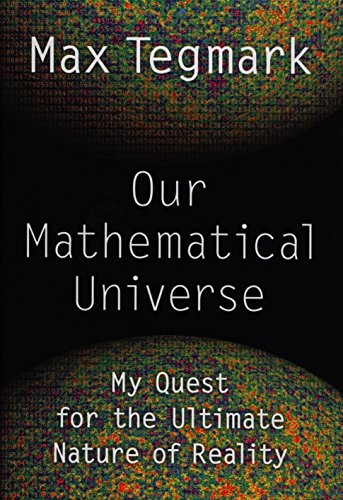
Talk to Our Mathematical Universe like its author wrote you back.
Get the ideas that fit your life — not generic summaries.
- Chat with the book
- Audiobook-style main ideas
- Adapts to your life and goals
- Helps you take action
What it argues
Our Mathematical Universe is Max Tegmark's argument for what he calls the Mathematical Universe Hypothesis: the bold claim that the universe is not merely described by mathematics but is a mathematical structure. This is not the familiar claim that mathematics is a useful language for physics — everyone agrees with that. Tegmark's claim is stronger: physical reality is identical to a mathematical structure, and the two are not merely analogous but the same thing.
The book builds to this conclusion through a survey of cosmological multiverse theories. Tegmark identifies four levels of multiverse, each arising from established or plausible physics. Level I is the space beyond our observable universe — regions causally disconnected from us but in the same inflationary expansion. Level II is the bubble universes that arise from eternal inflation, with different effective physical constants. Level III is the many-worlds branching of quantum mechanics. Level IV is the most radical: all mathematically consistent structures exist, not just our particular universe.
What it gets right
- 1.
The Mathematical Universe Hypothesis holds that physical reality is not just described by mathematics but is a mathematical structure. The universe has no properties beyond its mathematical relations.
- 2.
Four levels of multiverse arise from physics: the region beyond our observable universe (Level I), bubble universes with different physical constants from eternal inflation (Level II), quantum many-worlds branches (Level III), and all mathematically consistent structures (Level IV).
- 3.
If all mathematical structures exist, the question 'why does anything exist?' is dissolved: existence is mathematical consistency, and there is nothing special about our particular universe needing external explanation.
What it covers
Who wrote it
Max Tegmark is a physicist and cosmologist at MIT who has made significant contributions to observational cosmology, particularly improved measurements of the cosmic microwave background and large-scale structure. Born in Sweden, he studied at Stockholm and Berkeley. His other major book is Life 3.0, on artificial intelligence. Tegmark cofounded the Future of Life Institute and has been active in AI safety advocacy. He is known for his willingness to defend controversial physical and philosophical positions — the Mathematical Universe Hypothesis and his work on the multiverse — that mainstream physics regards skeptically.
