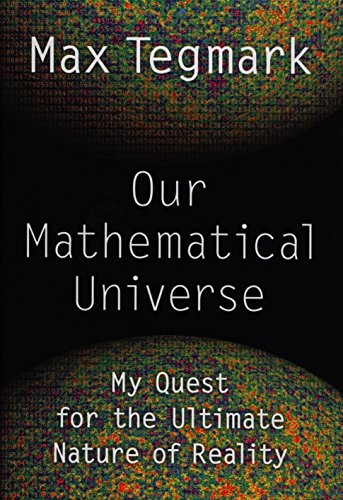
Our Mathematical Universe by Max Tegmark is a 2014 science book about cosmology, mathematics, multiverse. The Mathematical Universe Hypothesis holds that physical reality is not just described by mathematics but is a mathematical structure. The universe has no properties beyond its mathematical relations.
Summary
Our Mathematical Universe is Max Tegmark's argument for what he calls the Mathematical Universe Hypothesis: the bold claim that the universe is not merely described by mathematics but is a mathematical structure. This is not the familiar claim that mathematics is a useful language for physics — everyone agrees with that. Tegmark's claim is stronger: physical reality is identical to a mathematical structure, and the two are not merely analogous but the same thing.
The book builds to this conclusion through a survey of cosmological multiverse theories. Tegmark identifies four levels of multiverse, each arising from established or plausible physics. Level I is the space beyond our observable universe — regions causally disconnected from us but in the same inflationary expansion. Level II is the bubble universes that arise from eternal inflation, with different effective physical constants. Level III is the many-worlds branching of quantum mechanics. Level IV is the most radical: all mathematically consistent structures exist, not just our particular universe.
The Mathematical Universe Hypothesis is Tegmark's answer to the question of why anything exists at all. If existence is determined by mathematical consistency — if a mathematical structure exists by virtue of being a coherent structure — then we don't need a separate creation event or cause. The question shifts from "why does this particular universe exist" to "why do we find ourselves in this type of universe rather than another" — an anthropic question.
Tegmark writes accessibly and with personal narrative: his career arc, his collaborations, and the specific conversations that shaped his thinking. The book is part cosmology survey, part autobiography, part philosophical manifesto. The Mathematical Universe Hypothesis itself is highly speculative and not widely accepted, but the multiverse survey that leads to it is a competent account of contemporary cosmological thinking.
Talk to Our Mathematical Universe like its author wrote you back.
Get the ideas that fit your life — not generic summaries.
- Chat with the book
- Audiobook-style main ideas
- Adapts to your life and goals
- Helps you take action
Key takeaways
- 1.
The Mathematical Universe Hypothesis holds that physical reality is not just described by mathematics but is a mathematical structure. The universe has no properties beyond its mathematical relations.
- 2.
Four levels of multiverse arise from physics: the region beyond our observable universe (Level I), bubble universes with different physical constants from eternal inflation (Level II), quantum many-worlds branches (Level III), and all mathematically consistent structures (Level IV).
- 3.
If all mathematical structures exist, the question 'why does anything exist?' is dissolved: existence is mathematical consistency, and there is nothing special about our particular universe needing external explanation.
- 4.
The fine-tuning of physical constants — values that seem suspiciously suited for life — is explained anthropically in a multiverse: we observe life-permitting constants because we could not exist to observe the others.
- 5.
Eternal inflation provides a physical mechanism for generating a Level II multiverse: different bubble universes nucleate in an eternally inflating background and can have different symmetry-breaking outcomes producing different effective physical constants.
- 6.
Consciousness and subjective experience are, in Tegmark's account, properties of certain types of information processing — a substrate-independent view that has implications for AI and for what survives in a mathematical universe.
- 7.
The observable consequences of the multiverse are limited but not zero: eternal inflation makes specific predictions about the statistics of cosmic microwave background fluctuations.
- 8.
The transition from current physics to the Mathematical Universe Hypothesis requires only accepting that mathematics is not invented but discovered, that it has external existence independent of human minds.
Discussion questions
Use these on your own, with a book club, or as chat starters in Superbook. Book club version, ready to copy or print →
- 1.
The Mathematical Universe Hypothesis says reality is a mathematical structure. Can you state the strongest objection to that claim?
- 2.
Tegmark distinguishes 'described by mathematics' from 'is mathematics.' Does that distinction seem meaningful or like wordplay?
- 3.
Level IV multiverse says all mathematically consistent universes exist. Does that strike you as explanatory or as the maximal possible multiplication of entities?
- 4.
The anthropic principle says we observe life-permitting constants because we couldn't exist to observe others. Is that a real explanation or a tautology?
- 5.
Tegmark argues the multiverse is parsimonious — simpler to assert all mathematical structures than to specify one. Do you find the parsimony argument convincing?
- 6.
If physical reality is a mathematical structure, what is the status of qualia — subjective experiences like the redness of red? Do they exist as mathematical properties?
- 7.
How does the Mathematical Universe Hypothesis relate to Platonism — the view that mathematical objects have independent existence?
- 8.
The book mixes cosmology science with speculative philosophy. Does that combination feel like a strength or a category mistake?
- 9.
Tegmark's Level I and II multiverses arise from accepted physics (inflation). Does that make the Level IV multiverse seem more plausible by association?
- 10.
What would it take to falsify the Mathematical Universe Hypothesis? If it can't be falsified, should it count as science?
- 11.
The book is partly autobiographical. Does the personal narrative help or distract from the scientific argument?
Themes
Frequently asked questions
-
Is the Mathematical Universe Hypothesis accepted physics?
No. It is Tegmark's personal hypothesis, treated skeptically by most physicists and philosophers. The multiverse levels I and II arise from more mainstream physics (inflation); Level III is controversial (many-worlds interpretation); Level IV is Tegmark's own contribution and is not accepted by the mainstream.
-
What is the difference between the four levels of multiverse?
Level I: regions beyond our observable universe in the same inflationary space. Level II: bubble universes from eternal inflation with different physical constants. Level III: quantum branching universes from many-worlds. Level IV: all mathematically consistent universes. Each level is less observationally accessible and more speculative than the previous.
-
Do I need a physics background?
No, but the book is demanding in places. Tegmark explains the physics from scratch and the personal narrative makes it accessible. Readers without physics backgrounds may find the cosmology survey the most challenging section.
-
What is the main difference from Tegmark's Life 3.0?
Our Mathematical Universe is a cosmology book with a philosophical hypothesis at its center. Life 3.0 is about artificial intelligence. The two books are thematically connected through Tegmark's interest in consciousness and mathematical structure, but they address different audiences and different topics.
-
Is this the same multiverse as in The Elegant Universe?
Related but distinct. Greene's Elegant Universe focuses on the string theory landscape — the enormous number of possible universes arising from the geometry of extra dimensions. Tegmark's multiverse levels are different categories arising from different physical mechanisms. Both books contribute to the broader multiverse discussion.
Similar books

The Elegant Universe
Brian Greene
The Fabric of Reality
David Deutsch

Life 3.0: Being Human in the Age of Artificial Intelligence
Max Tegmark
The Grand Design
Stephen Hawking and Leonard Mlodinow
