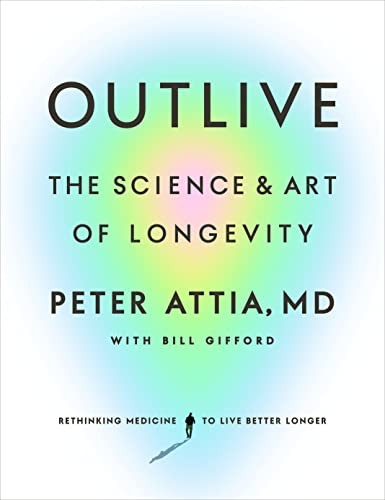
Talk to Outlive: The Science and Art of Longevity like its author wrote you back.
Get the ideas that fit your life — not generic summaries.
- Chat with the book
- Audiobook-style main ideas
- Adapts to your life and goals
- Helps you take action
Outlive: The Science and Art of Longevity, in detail
Peter Attia's Outlive is a book about how most people approach longevity backwards. They think about not dying from disease when they should be thinking about how well they want to live at seventy, eighty, and ninety — and working backward from that picture. Attia calls this the difference between Medicine 2.0, which reacts to illness once it appears, and Medicine 3.0, which tries to prevent it decades before symptoms show up. The gap between these two frameworks is where most premature death and disability live. He opens with a striking observation: the risk calculators medicine uses to evaluate cardiovascular health are mostly calibrated to prevent death in the next ten years, which is far too short a time horizon for a fifty-year-old who still has three or four decades ahead of them.
The book's backbone is what Attia calls the Four Horsemen: heart disease, cancer, Alzheimer's and other neurodegenerative diseases, and metabolic dysfunction. These four conditions kill or disable the vast majority of people who die before they should, and Attia argues that all of them share deep risk factors — insulin resistance, chronic inflammation, elevated ApoB — that are measurable and modifiable long before a diagnosis arrives. He draws on primary research and his own clinical practice to explain what the evidence actually says, including where it diverges from standard-of-care advice. The chapter on cardiovascular disease alone rewards careful reading for anyone who has been told their standard lipid panel looks acceptable.
The second half is organized around what Attia calls the five tactical domains: exercise, nutrition, sleep, emotional health, and exogenous molecules. Exercise gets the longest treatment and the most emphatic case. Attia argues that VO2 max and muscle mass are the two strongest predictors of longevity that most people completely ignore, and that most exercise choices optimize neither. He describes what he calls the Centenarian Decathlon — picking the physical tasks you want to still be performing at eighty or eighty-five and then training backward from them today. On nutrition he is deliberately agnostic about any single dietary ideology, focusing instead on protein adequacy and avoiding the metabolic dysfunction that precedes most chronic disease. The chapters on sleep and emotional health feel genuinely essential rather than included out of obligation.
The emotional health section is worth calling out separately. Attia describes his own admission to a psychiatric intensive outpatient program and the toll that years of driven, achievement-focused behavior took on his relationships and sense of self. It is the most personal section of the book and, for many readers, the most memorable — a reminder that lifespan and healthspan both depend on more than biomarkers. Outlive is long, and the chapters on lipid biochemistry and mTOR signaling require patience from readers without a science background. But the core message is accessible and, for most people, genuinely actionable: the biggest lever on how long and how well you live is almost certainly not your genetics or your access to advanced medical care. It is what you do with your body and mind in the decades before anything goes wrong.
The big ideas
- 1.
Medicine 3.0 focuses on preventing the Four Horsemen — heart disease, cancer, neurodegeneration, and metabolic dysfunction — decades before symptoms appear, rather than treating them once they arrive.
- 2.
ApoB, not total LDL cholesterol, is the most important lipid marker for cardiovascular risk. Standard lipid panels miss high-risk patients whose ApoB is elevated while LDL looks normal.
- 3.
VO2 max is the single strongest predictor of all-cause mortality Attia identifies. A person in the bottom quartile has roughly five times the mortality risk of someone in the top quartile.
