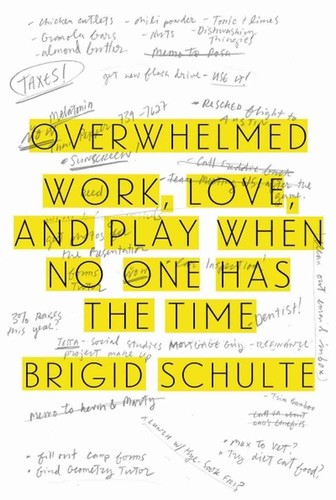
Talk to Overwhelmed: Work, Love, and Play When No One Has the Time like its author wrote you back.
Get the ideas that fit your life — not generic summaries.
- Chat with the book
- Audiobook-style main ideas
- Adapts to your life and goals
- Helps you take action
What it argues
Overwhelmed is Washington Post journalist Brigid Schulte's investigation into why so many people — particularly women with children — feel perpetually time-starved in an era when labor-saving technology is more abundant than at any point in history. Schulte begins from a personal place: she was told by time researcher John Robinson that her time diaries showed thirty hours of leisure per week, a finding she found impossible to believe given how overwhelmed she felt. The book is her attempt to reconcile that data with her experience, and the investigation takes her through the sociology, economics, neuroscience, and feminist history of time.
One of the central findings is what Schulte calls "time confetti" — the fragmentation of leisure into scraps too small to actually restore or satisfy. Even when people technically have free time, it arrives in five-minute increments between demands, or is contaminated by anxiety about uncompleted work, or is structured around children's activities rather than genuinely restorative for the adult. The total leisure hours might be there on a time diary; the actual experience of leisure is not.
What it gets right
- 1.
Time confetti — leisure fragmented into pieces too small to restore — explains why people feel overwhelmed even when time diaries suggest they have adequate free time. The experience of time matters, not just the quantity.
- 2.
The 'ideal worker' norm — the assumption that a committed employee has no non-work demands on their time — is a structural source of time poverty for anyone with caregiving responsibilities.
- 3.
Busyness has become a status signal in American culture. Admitting you have leisure time signals low status; performing exhaustion signals commitment and importance.
What it covers
Who wrote it
Brigid Schulte is an award-winning journalist and author who spent two decades at The Washington Post, where she covered a range of topics including politics, policy, and social issues. She is a fellow at the New America Foundation and the director of the Better Life Lab, a work-family policy initiative. Overwhelmed, published in 2014, won the Washing Post's Helen Bernstein Book Award for Excellence in Journalism and was a New York Times bestseller. Schulte has also written about time, gender, and work for The New Yorker, Time, and National Geographic.
