Overwhelmed: Work, Love, and Play When No One Has the Time by Brigid Schulte is a 2014 self-help book about time, work-life balance, gender. Time confetti — leisure fragmented into pieces too small to restore — explains why people feel overwhelmed even when time diaries suggest they have adequate free time. The experience of time matters, not just the quantity.
Summary
Overwhelmed is Washington Post journalist Brigid Schulte's investigation into why so many people — particularly women with children — feel perpetually time-starved in an era when labor-saving technology is more abundant than at any point in history. Schulte begins from a personal place: she was told by time researcher John Robinson that her time diaries showed thirty hours of leisure per week, a finding she found impossible to believe given how overwhelmed she felt. The book is her attempt to reconcile that data with her experience, and the investigation takes her through the sociology, economics, neuroscience, and feminist history of time.
One of the central findings is what Schulte calls "time confetti" — the fragmentation of leisure into scraps too small to actually restore or satisfy. Even when people technically have free time, it arrives in five-minute increments between demands, or is contaminated by anxiety about uncompleted work, or is structured around children's activities rather than genuinely restorative for the adult. The total leisure hours might be there on a time diary; the actual experience of leisure is not.
Schulte traces the cultural and structural roots of busyness through several threads: the American ideal of the "ideal worker" (someone with no life outside work), the unequal distribution of domestic labor even in dual-income households, the collapse of boundaries between work and personal time enabled by smartphones, and a cultural association between busyness and status that makes people reluctant to admit they have downtime. She draws on research from Denmark, where fathers take substantial parental leave and leisure is a cultural value, as a comparison case for what different structural choices produce.
The book is reported rather than prescriptive. Schulte is a journalist, not a productivity guru, and she's more interested in diagnosing the problem than prescribing a personal fix. She does arrive at some practical observations — the research on the neuroscience of play, the importance of "contaminated time" recognition, the structural nature of most solutions — but the book is most valuable as an account of why the problem is hard to solve through individual effort alone. The systemic dimensions of time poverty receive more honest attention here than in most books on the subject.
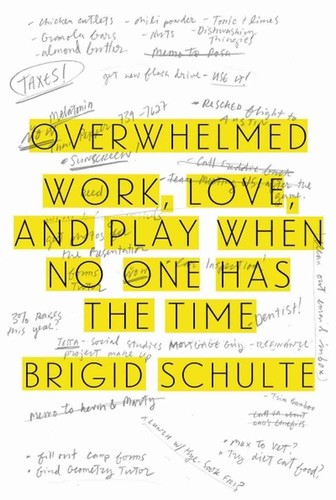
Talk to Overwhelmed: Work, Love, and Play When No One Has the Time like its author wrote you back.
Get the ideas that fit your life — not generic summaries.
- Chat with the book
- Audiobook-style main ideas
- Adapts to your life and goals
- Helps you take action
Key takeaways
- 1.
Time confetti — leisure fragmented into pieces too small to restore — explains why people feel overwhelmed even when time diaries suggest they have adequate free time. The experience of time matters, not just the quantity.
- 2.
The 'ideal worker' norm — the assumption that a committed employee has no non-work demands on their time — is a structural source of time poverty for anyone with caregiving responsibilities.
- 3.
Busyness has become a status signal in American culture. Admitting you have leisure time signals low status; performing exhaustion signals commitment and importance.
- 4.
The unequal distribution of domestic and caregiving labor in dual-income households is a persistent driver of women's time poverty, even when both partners believe they share equally.
- 5.
Leisure is not optional — it is neurologically necessary. Research on play shows that rest and unstructured time are required for creativity, emotional regulation, and cognitive restoration.
- 6.
Smartphones enabled the collapse of the boundary between work and personal time. Constant availability is not the same as productive availability, but it creates the chronic low-level activation state that generates the feeling of overwhelm.
- 7.
Individual solutions to time poverty have structural limits. Most sustainable solutions involve changes to workplace norms, parental leave policy, and shared domestic expectations — not personal optimization.
- 8.
Countries that treat leisure as a cultural value and support it through policy (parental leave, vacation norms, limits on work hours) produce workers who are more productive per hour, not less.
Discussion questions
Use these on your own, with a book club, or as chat starters in Superbook. Book club version, ready to copy or print →
- 1.
Schulte describes 'time confetti' — leisure that arrives in fragments too small to restore. Does that description match your own experience of free time? What would genuine leisure look like for you?
- 2.
She was told she had thirty hours of leisure a week but couldn't recognize it. How does that gap between measured time and experienced time show up in your own life?
- 3.
The busyness-as-status phenomenon is well documented. Where do you see it in your workplace or social circle? Do you participate in it yourself, knowingly or not?
- 4.
Schulte traces much of women's time poverty to the unequal distribution of domestic labor. How do the couples you know — including yourself if you're in a partnership — actually divide the invisible domestic load?
- 5.
The ideal worker assumption — that committed people have no non-work demands — is built into many organizational cultures. How explicit or implicit is it in yours? Who pays the biggest cost for it?
- 6.
She compares American time culture to Denmark's, where leisure is genuinely valued. What would it take to change the norms in your organization, and what would you be giving up?
- 7.
The book argues that individual optimization can't solve a structural problem. Where do you agree with that framing, and where do you think personal choices still matter?
- 8.
She covers the neuroscience of play and unstructured rest. When did you last have unstructured time that was genuinely restorative? What made it possible?
- 9.
Smartphones collapsed the boundary between work and personal time. How do you manage that boundary, and how satisfied are you with how it's working?
- 10.
The book is reported rather than prescriptive. Did you find the absence of a clear personal-fix framework frustrating or refreshing? What kind of reader wants what, and which are you?
- 11.
Schulte focuses heavily on women's experience of time poverty. To what extent does her diagnosis translate to men who are also overwhelmed, and where does it diverge?
- 12.
If you could change one structural thing about your work environment to reduce time fragmentation, what would it be? Is it actually changeable, and what would it take?
Themes
Frequently asked questions
-
Is Overwhelmed worth reading?
Yes, especially for working parents and anyone who suspects their time problem is structural rather than personal. Schulte's journalistic approach is more rigorous and more honest about the limits of individual solutions than most books on busyness. It's not a productivity book — it's an investigation into why productivity culture often fails.
-
How long does it take to read Overwhelmed?
About six to seven hours for the roughly 350-page book. Schulte writes in a narrative, reported style that moves quickly. Some of the academic research sections are denser, but the personal and narrative threads make the book engaging throughout.
-
What is 'time confetti' and why does it matter?
Schulte's term for leisure time that arrives in fragments too small to be restorative — a five-minute gap here, ten minutes there, but no sustained block of genuinely free time. Even people who technically have adequate leisure hours can feel persistently overwhelmed because the time never arrives in usable form.
-
Is Overwhelmed just about women's time, or is it broader?
The book centers women's experience because the data on time poverty and domestic labor is most striking there, but the analysis of busyness culture, ideal-worker norms, and structural time fragmentation applies broadly. Male readers consistently find significant sections of it relevant to their own experience.
-
What's the main difference between Overwhelmed and a standard productivity book?
Most productivity books treat time poverty as a personal management problem and offer individual solutions. Schulte argues it's primarily a structural and cultural problem — built into how workplaces are organized, how domestic labor is distributed, and how busyness is valued socially. Individual optimization helps at the margin; the bigger levers are structural.
Similar books
Essentialism: The Disciplined Pursuit of Less
Greg McKeown
Deep Work
Cal Newport
Indistractable: How to Control Your Attention and Choose Your Life
Nir Eyal

The One Thing
Gary Keller and Jay Papasan
