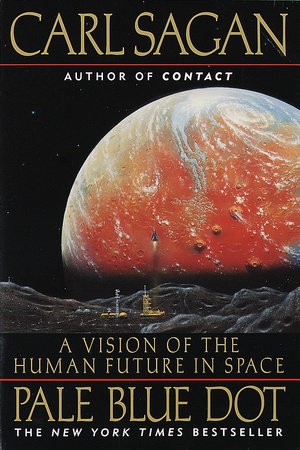
Talk to Pale Blue Dot: A Vision of the Human Future in Space like its author wrote you back.
Get the ideas that fit your life — not generic summaries.
- Chat with the book
- Audiobook-style main ideas
- Adapts to your life and goals
- Helps you take action
What it argues
Pale Blue Dot takes its title from a photograph taken by Voyager 1 in 1990, as it left the solar system, at Sagan's request. In it, Earth appears as a tiny bright speck against the black — a pale blue dot in a sunbeam, as Sagan described it. The book is structured around that image and the meditation Sagan wrote in response: that there is no hint in the photograph that the speck is the only home humanity has ever known, and that the perspective forces a reassessment of every human conflict, every hierarchy, every certainty.
The first part of the book is a survey of the solar system through the lens of the unmanned space probes that had explored it by the early 1990s — Voyager, Mariner, Viking, Pioneer. Sagan describes Venus's runaway greenhouse effect and what it implies for climate change, Mars's thin atmosphere and the fading hope for life there, the gas giants and their moons, and the outer solar system. Throughout, he connects planetary science to questions about Earth: Venus as a cautionary tale about greenhouse gases, Mars as a lesson about atmospheric loss, the moons of the outer planets as potential sites for life.
What it gets right
- 1.
The Pale Blue Dot photograph — Earth as a tiny dot in a sunbeam photographed by Voyager 1 from beyond Neptune — provides a perspective that makes terrestrial conflicts seem small without making them seem unimportant.
- 2.
Venus demonstrates a runaway greenhouse effect: its atmosphere is mostly CO2, its surface temperature hot enough to melt lead, and it warns what happens when feedback loops in a planetary atmosphere are pushed too far.
- 3.
Long-term human survival requires multi-planetary presence. No single world is safe against large asteroid impact, nearby supernovas, or the eventual death of the sun.
What it covers
Who wrote it
Carl Sagan (1934–1996) was an American astronomer, cosmologist, and science communicator who spent most of his career at Cornell University. He contributed to understanding the surface conditions of Venus and Mars, helped design the messages on the Pioneer and Voyager probes, and was deeply involved in the search for extraterrestrial intelligence. His television series Cosmos: A Personal Voyage reached over 500 million viewers in sixty countries. He won the Pulitzer Prize in 1978 for The Dragons of Eden and wrote the novel Contact, later filmed with Jodie Foster. Sagan was a tireless advocate for both scientific literacy and nuclear disarmament.
