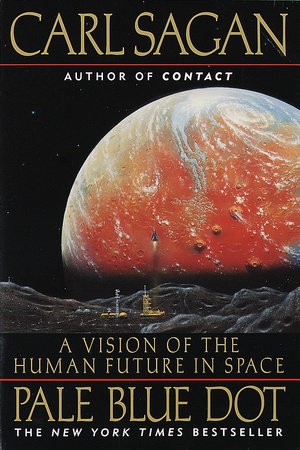
Pale Blue Dot: A Vision of the Human Future in Space by Carl Sagan is a 1994 science book about space exploration, astronomy, human perspective. The Pale Blue Dot photograph — Earth as a tiny dot in a sunbeam photographed by Voyager 1 from beyond Neptune — provides a perspective that makes terrestrial conflicts seem small without making them seem unimportant.
Summary
Pale Blue Dot takes its title from a photograph taken by Voyager 1 in 1990, as it left the solar system, at Sagan's request. In it, Earth appears as a tiny bright speck against the black — a pale blue dot in a sunbeam, as Sagan described it. The book is structured around that image and the meditation Sagan wrote in response: that there is no hint in the photograph that the speck is the only home humanity has ever known, and that the perspective forces a reassessment of every human conflict, every hierarchy, every certainty.
The first part of the book is a survey of the solar system through the lens of the unmanned space probes that had explored it by the early 1990s — Voyager, Mariner, Viking, Pioneer. Sagan describes Venus's runaway greenhouse effect and what it implies for climate change, Mars's thin atmosphere and the fading hope for life there, the gas giants and their moons, and the outer solar system. Throughout, he connects planetary science to questions about Earth: Venus as a cautionary tale about greenhouse gases, Mars as a lesson about atmospheric loss, the moons of the outer planets as potential sites for life.
The second part makes the case for continued human space exploration. Sagan argues that the long-term survival of any species requires expanding beyond a single planet: any world can be sterilized by asteroid impact, nearby supernova, or the eventual death of its star. The argument is partly existential risk — Earth is a fragile perch — and partly about human nature. Sagan believed that the drive to explore is one of our better impulses, that the overview effect experienced by astronauts — seeing Earth from outside as a fragile, whole, borderless world — has the potential to change human consciousness.
Sagan also argues for the intrinsic value of scientific exploration regardless of practical return, and makes a consistent case for space science funding in an era when it was being cut. The book's blend of astronomical wonder, political argument, and philosophical reflection on humanity's place in the cosmos is characteristic of Sagan's best work.
Talk to Pale Blue Dot: A Vision of the Human Future in Space like its author wrote you back.
Get the ideas that fit your life — not generic summaries.
- Chat with the book
- Audiobook-style main ideas
- Adapts to your life and goals
- Helps you take action
Key takeaways
- 1.
The Pale Blue Dot photograph — Earth as a tiny dot in a sunbeam photographed by Voyager 1 from beyond Neptune — provides a perspective that makes terrestrial conflicts seem small without making them seem unimportant.
- 2.
Venus demonstrates a runaway greenhouse effect: its atmosphere is mostly CO2, its surface temperature hot enough to melt lead, and it warns what happens when feedback loops in a planetary atmosphere are pushed too far.
- 3.
Long-term human survival requires multi-planetary presence. No single world is safe against large asteroid impact, nearby supernovas, or the eventual death of the sun.
- 4.
Unmanned probes have dramatically expanded knowledge of the solar system at a tiny fraction of the cost of human missions; Sagan argues for a balance rather than treating human and robotic exploration as competitors.
- 5.
The overview effect — the cognitive shift experienced by astronauts seeing the whole Earth from space — may be humanity's most accessible route to thinking globally about shared survival.
- 6.
Mars shows what happens when a planet loses its magnetic field and its atmosphere is stripped by solar wind; understanding Mars helps understand the fragility of Earth's protective systems.
- 7.
The moons of the outer solar system — Europa's subsurface ocean, Titan's hydrocarbon lakes — expanded the plausible range of environments where life might exist beyond anything anticipated before the Voyager missions.
- 8.
Investment in basic science and exploration has historically returned far more in economic and technological value than the initial outlay, though this case is rarely made effectively by scientists to politicians.
Discussion questions
Use these on your own, with a book club, or as chat starters in Superbook. Book club version, ready to copy or print →
- 1.
How do you respond emotionally to the Pale Blue Dot photograph and Sagan's meditation on it? Does that kind of cosmic perspective change anything practically for you?
- 2.
Sagan argues for multi-planetary survival as a long-term necessity. How do you weigh that very long-term argument against the immediate costs of space exploration funding?
- 3.
Venus as a runaway greenhouse is a lesson about Earth's climate. Does the planetary comparison make climate change feel more or less abstract?
- 4.
He distinguishes between the value of scientific knowledge for its own sake and its practical applications. Which argument for space funding do you find more compelling?
- 5.
The overview effect — astronauts saying they felt changed by seeing Earth whole and borderless — is often cited as evidence that space travel could change human consciousness. Do you believe it, and what would it take to scale that effect?
- 6.
Sagan was writing in 1994 before the Hubble Space Telescope had produced its iconic images. Which subsequent development in space science do you think would have most affected his thinking?
- 7.
He argues that the impulse to explore is one of humanity's better traits. Do you agree, or is it sometimes a displacement of energy that could go to solving problems on Earth?
- 8.
The book argues against defunding space science. How has the balance between unmanned science missions, human spaceflight, and commercial space activity changed since Sagan wrote, and is he vindicated?
- 9.
If you could direct one current or future space mission to answer one question, what would it be?
- 10.
Sagan's writing is famous for its combination of scientific precision and emotional resonance. Which passage affected you most?
- 11.
The argument that Earth is a fragile world that needs protection is sometimes used to argue against space exploration (we should fix here first) and sometimes for it (we need a backup). Which direction do you find more persuasive?
- 12.
Sagan died in 1996 before the discovery of thousands of exoplanets. How would that discovery have affected his case in this book?
Themes
Frequently asked questions
-
What is the Pale Blue Dot photograph?
A photograph taken by Voyager 1 on February 14, 1990, at Sagan's request, from a distance of about 6 billion kilometers. Earth appears as a tiny bright point — a pale blue dot — against a sunbeam in the otherwise black background. Sagan's meditation on the photograph became one of the most famous passages in popular science writing.
-
Is this book about space travel or astronomy?
Both, plus philosophy. It surveys what planetary science had learned by the early 1990s from unmanned probes, then makes a case for continued exploration, and throughout draws philosophical conclusions about human significance in the cosmos. It is accessible to readers with no astronomy background.
-
How does Pale Blue Dot compare to Cosmos?
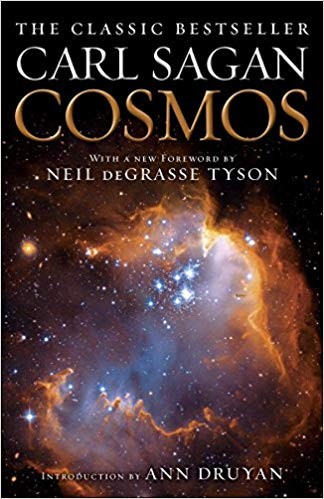
Cosmos is broader and more historical, covering the universe from ancient Greece to modern cosmology. Pale Blue Dot is more focused on the solar system and the case for space exploration. Both share Sagan's characteristic blend of science and humanism. Cosmos is the better starting point; Pale Blue Dot is the better follow-up.
-
Is it out of date?
Some specific planetary science has been updated by missions since 1994 — the Galileo probe at Jupiter, the Mars rovers, the Cassini mission to Saturn. But the book's arguments about perspective, long-term survival, and the value of exploration are as relevant as ever.
-
Who should read Pale Blue Dot?
Anyone who wants to think seriously about humanity's long-term future, or who is moved by the idea of understanding where we are in the universe. Also useful for people interested in the politics of science funding and the case for investment in basic research.