Talk to Pale Rider like its author wrote you back.
Get the ideas that fit your life — not generic summaries.
- Chat with the book
- Audiobook-style main ideas
- Adapts to your life and goals
- Helps you take action
What it argues
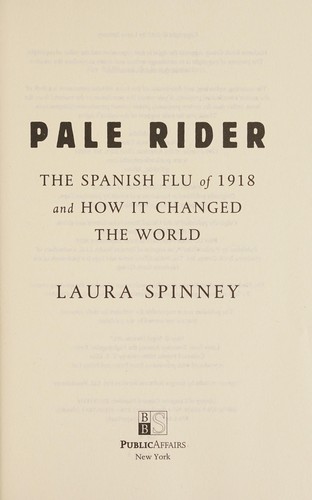
Pale Rider is Laura Spinney's account of the 1918–1919 influenza pandemic, with a distinctive emphasis on its global dimensions and on why the event so largely disappeared from collective memory. Where John Barry's The Great Influenza focuses primarily on the United States and on the political and scientific response, Spinney is more interested in the pandemic as a worldwide event whose effects were experienced radically differently in different places — from cities in Alaska to villages in South Africa to islands in the South Pacific.
The book opens with a demographic argument: influenza 1918 killed more people in a year than the Black Death killed in a century, and the range of credible estimates runs from 50 to 100 million, with more recent research pushing the upper end higher. Spinney is careful about these numbers, walking through the methodological problems with wartime mortality statistics and the particular difficulty of counting deaths in colonial territories where recordkeeping was minimal. That care is one of the book's strengths throughout.
What it gets right
- 1.
The 1918 influenza pandemic was a global event killing at least 50 million people, but its effects were radically unequal — Indigenous communities in Alaska and the Pacific suffered mortality rates that dwarfed those of urban centers.
- 2.
The pandemic's true death toll is still uncertain because wartime recordkeeping was poor and colonial territories were dramatically undercounted.
- 3.
Spanish flu was a misnomer: Spain was simply one of the few countries with a free press that reported on the epidemic honestly during wartime.
What it covers
Who wrote it
Laura Spinney is a British science journalist and author based in Paris. She has written for Nature, National Geographic, The Economist, and The Guardian, among others. Pale Rider, published in 2017, was shortlisted for the Wellcome Book Prize and brought significant renewed attention to the 1918 pandemic on the eve of its centennial. Spinney also writes fiction; her debut novel was published in 2004. Her nonfiction focuses on the intersection of science, history, and human behavior.
