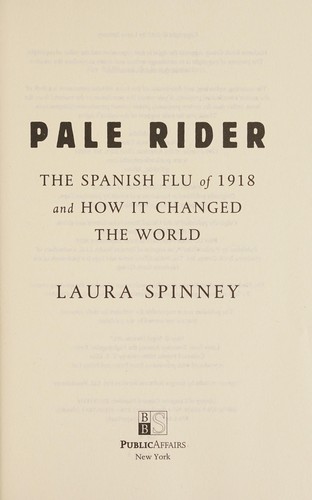
Pale Rider by Laura Spinney is a 2017 history book about pandemic, global health, memory. The 1918 influenza pandemic was a global event killing at least 50 million people, but its effects were radically unequal — Indigenous communities in Alaska and the Pacific suffered mortality rates that dwarfed those of urban centers.
Summary
Pale Rider is Laura Spinney's account of the 1918–1919 influenza pandemic, with a distinctive emphasis on its global dimensions and on why the event so largely disappeared from collective memory. Where John Barry's The Great Influenza focuses primarily on the United States and on the political and scientific response, Spinney is more interested in the pandemic as a worldwide event whose effects were experienced radically differently in different places — from cities in Alaska to villages in South Africa to islands in the South Pacific.
The book opens with a demographic argument: influenza 1918 killed more people in a year than the Black Death killed in a century, and the range of credible estimates runs from 50 to 100 million, with more recent research pushing the upper end higher. Spinney is careful about these numbers, walking through the methodological problems with wartime mortality statistics and the particular difficulty of counting deaths in colonial territories where recordkeeping was minimal. That care is one of the book's strengths throughout.
Spinney's global scope produces some of the most interesting material in the book. The pandemic hit Indigenous communities in Alaska and the Pacific with devastating asymmetry, in part because those populations had weaker prior immunity to influenza strains. Entire villages were depopulated. The aftermath reshaped political consciousness in some countries — South Africa, India, and New Zealand all saw pandemic-related shifts in how colonized populations thought about colonial governance and public health. These are stories that barely appear in American accounts.
The memory question is Spinney's final focus. She argues that the 1918 pandemic was systematically forgotten partly because its survivors were also survivors of World War I, and that war offered a more coherent narrative for grief. The pandemic was background noise to the foreground violence. Spinney uses that forgetting as a lens for thinking about how societies process catastrophe, and her conclusion — that suppressing memory of epidemic disease makes the next epidemic harder to manage — is quietly urgent without being preachy.
Talk to Pale Rider like its author wrote you back.
Get the ideas that fit your life — not generic summaries.
- Chat with the book
- Audiobook-style main ideas
- Adapts to your life and goals
- Helps you take action
Key takeaways
- 1.
The 1918 influenza pandemic was a global event killing at least 50 million people, but its effects were radically unequal — Indigenous communities in Alaska and the Pacific suffered mortality rates that dwarfed those of urban centers.
- 2.
The pandemic's true death toll is still uncertain because wartime recordkeeping was poor and colonial territories were dramatically undercounted.
- 3.
Spanish flu was a misnomer: Spain was simply one of the few countries with a free press that reported on the epidemic honestly during wartime.
- 4.
The pandemic accelerated political change in several colonized territories, as populations whose governments had failed to protect them drew conclusions about colonial legitimacy.
- 5.
Memory of the 1918 pandemic was suppressed partly because its horror was overshadowed by World War I — which provided a more legible narrative for collective grief.
- 6.
The W-shaped mortality curve of 1918, which killed young adults at unusually high rates, remains incompletely explained but is connected to immune system overreaction.
- 7.
Pandemic response varied dramatically by city and country depending on political culture and the capacity for honest public communication.
- 8.
Reconstructing the 1918 virus from preserved samples decades later confirmed the pandemic origin and opened new lines of research into pandemic influenza preparedness.
Discussion questions
Use these on your own, with a book club, or as chat starters in Superbook. Book club version, ready to copy or print →
- 1.
Spinney argues the 1918 pandemic was forgotten partly because World War I provided a more legible narrative for grief. What does this suggest about how we choose what to remember collectively?
- 2.
The pandemic had radically unequal effects across different populations. What were the structural reasons for that inequality, and which of them still exist today?
- 3.
Why was 'Spanish flu' a misnomer, and what does the naming tell you about wartime information control and its relationship to pandemic response?
- 4.
Spinney argues that suppressed collective memory of epidemic disease makes future epidemics harder to manage. Do you find that argument convincing?
- 5.
Some communities in Alaska and the Pacific lost majorities of their populations. How do you think about the relationship between that mortality and colonial infrastructure failure?
- 6.
The pandemic accelerated political movements in India, South Africa, and elsewhere. Can a disease event genuinely change political consciousness, or does it only accelerate changes already underway?
- 7.
How does Spinney's global account change how you understand the pandemic compared to U.S.-focused histories like Barry's?
- 8.
What's the difference between historical forgetting and historical suppression? Does Spinney make a clear case for which one happened with 1918?
- 9.
The W-shaped mortality curve — killing young adults disproportionately — is still not fully explained. What does it mean to live with that kind of scientific uncertainty?
- 10.
Spinney reconstructs dozens of individual experiences across many countries. Which one stayed with you most?
- 11.
How has reading Pale Rider changed how you think about COVID-19's place in history?
- 12.
Spinney writes that we can't afford to forget 1918. Who is the 'we' in that sentence, and what does remembering actually require?
Themes
Frequently asked questions
-
Is Pale Rider worth reading if I've already read The Great Influenza?
Yes. The two books are complementary rather than redundant. Barry focuses on the American political and scientific response in depth; Spinney's value is in the global scope and the analysis of why the event was forgotten. They ask different questions and reward being read together.
-
What is Pale Rider about?
It's a global history of the 1918–1919 influenza pandemic that emphasizes its unequal impact across different populations and countries, and asks why such a massive event largely disappeared from collective memory.
-
Is Pale Rider scientifically accurate?
Spinney is a science journalist with a rigorous approach to evidence. The book is careful about uncertainty, especially around mortality estimates, and the scientific claims are accurate to the state of the research at the time of publication.
-
Who should read Pale Rider?
Readers interested in the 1918 pandemic who want a more global and postcolonial perspective than American-focused accounts provide. Also useful for anyone interested in how societies process collective trauma and why certain historical events are remembered or forgotten.
-
How long does it take to read Pale Rider?
Around seven to eight hours at average pace. It's organized thematically and geographically, which means you can read sections out of sequence if you're drawn to specific regions or questions.