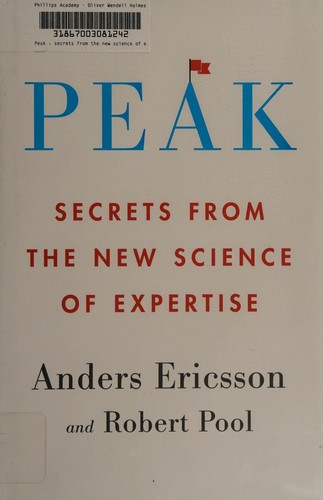
Talk to Peak: Secrets from the New Science of Expertise like its author wrote you back.
Get the ideas that fit your life — not generic summaries.
- Chat with the book
- Audiobook-style main ideas
- Adapts to your life and goals
- Helps you take action
Peak: Secrets from the New Science of Expertise, in detail
Peak is Anders Ericsson's definitive account of deliberate practice — the specific type of focused, feedback-driven training that, more than any other factor, determines how expert people become in demanding fields. Ericsson spent four decades studying expert performers across domains: chess grandmasters, concert violinists, elite athletes, memory champions, surgeons. His central finding, developed with science writer Robert Pool for a general audience, is that expertise is built, not born, and that the mechanism is deliberate practice rather than talent, intelligence, or accumulated experience.
The book's most important distinction is between naive practice (doing something repeatedly and hoping to improve), purposeful practice (structured repetition with specific goals and feedback), and deliberate practice (purposeful practice within a field that has an established body of expert knowledge and a tradition of effective training techniques). Most people plateau at "acceptable" performance because they rely on naive practice. Genuine experts engage in deliberate practice: working at the edge of their current ability, with immediate feedback, guided by a teacher or mental model of elite performance.
Ericsson directly challenges the popular myth of innate talent, which he traces partly to misreadings of his own research by Malcolm Gladwell and others. The 10,000-hour rule, popularized in Outliers, was a simplification of Ericsson's violin student research. The real finding was not that 10,000 hours of any practice produces expertise, but that the accumulation of deliberate practice — the hardest, most uncomfortable kind — does.
The second half covers how to design deliberate practice in domains without established training traditions, the role of mental representations in expertise, and how to sustain the motivation for long-term practice. Ericsson is clear that deliberate practice is not enjoyable in the conventional sense — it requires working at the uncomfortable edge — but argues that mastery is worth the cost.
The big ideas
- 1.
Deliberate practice — focused, feedback-driven, edge-of-ability training guided by mental representations of elite performance — is the primary mechanism of expertise, not innate talent.
- 2.
The 10,000-hour rule is a misreading of Ericsson's research. Hours of practice matter far less than the quality of practice. 10,000 hours of naive practice does not produce experts.
- 3.
Mental representations — detailed internal models of what good performance looks and feels like — are both the product of deliberate practice and the tool that enables further improvement.
