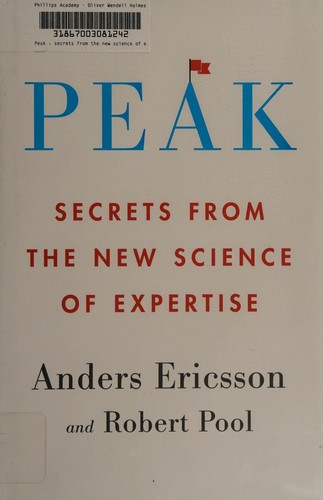
Peak: Secrets from the New Science of Expertise by Anders Ericsson and Robert Pool is a 2016 science book about deliberate practice, expertise, mastery. Deliberate practice — focused, feedback-driven, edge-of-ability training guided by mental representations of elite performance — is the primary mechanism of expertise, not innate talent.
Summary
Peak is Anders Ericsson's definitive account of deliberate practice — the specific type of focused, feedback-driven training that, more than any other factor, determines how expert people become in demanding fields. Ericsson spent four decades studying expert performers across domains: chess grandmasters, concert violinists, elite athletes, memory champions, surgeons. His central finding, developed with science writer Robert Pool for a general audience, is that expertise is built, not born, and that the mechanism is deliberate practice rather than talent, intelligence, or accumulated experience.
The book's most important distinction is between naive practice (doing something repeatedly and hoping to improve), purposeful practice (structured repetition with specific goals and feedback), and deliberate practice (purposeful practice within a field that has an established body of expert knowledge and a tradition of effective training techniques). Most people plateau at "acceptable" performance because they rely on naive practice. Genuine experts engage in deliberate practice: working at the edge of their current ability, with immediate feedback, guided by a teacher or mental model of elite performance.
Ericsson directly challenges the popular myth of innate talent, which he traces partly to misreadings of his own research by Malcolm Gladwell and others. The 10,000-hour rule, popularized in Outliers, was a simplification of Ericsson's violin student research. The real finding was not that 10,000 hours of any practice produces expertise, but that the accumulation of deliberate practice — the hardest, most uncomfortable kind — does.
The second half covers how to design deliberate practice in domains without established training traditions, the role of mental representations in expertise, and how to sustain the motivation for long-term practice. Ericsson is clear that deliberate practice is not enjoyable in the conventional sense — it requires working at the uncomfortable edge — but argues that mastery is worth the cost.
Talk to Peak: Secrets from the New Science of Expertise like its author wrote you back.
Get the ideas that fit your life — not generic summaries.
- Chat with the book
- Audiobook-style main ideas
- Adapts to your life and goals
- Helps you take action
Key takeaways
- 1.
Deliberate practice — focused, feedback-driven, edge-of-ability training guided by mental representations of elite performance — is the primary mechanism of expertise, not innate talent.
- 2.
The 10,000-hour rule is a misreading of Ericsson's research. Hours of practice matter far less than the quality of practice. 10,000 hours of naive practice does not produce experts.
- 3.
Mental representations — detailed internal models of what good performance looks and feels like — are both the product of deliberate practice and the tool that enables further improvement.
- 4.
Most people plateau because they stop engaging in deliberate practice. Competence becomes comfortable and automatic, and improvement stops. Leaving the comfort zone is required for continued growth.
- 5.
Purposeful practice requires specific goals, immediate feedback, concentration, and stepping outside your comfort zone. All four components are necessary.
- 6.
In domains without established training traditions, you can create deliberate practice by identifying the best performers, analyzing what makes them different, and designing practice to develop those specific capabilities.
- 7.
Short daily sessions of high-quality deliberate practice typically outperform long sessions of lower intensity. An hour of concentrated, uncomfortable practice usually beats three hours of comfortable repetition.
- 8.
Motivation for sustained deliberate practice depends on maintaining belief in the possibility of improvement, building a support network, and making the practice itself as engaging as possible.
Discussion questions
Use these on your own, with a book club, or as chat starters in Superbook. Book club version, ready to copy or print →
- 1.
Think of a skill you've practiced for years without major improvement. Which of Ericsson's criteria for deliberate practice is missing from how you practice it?
- 2.
Ericsson argues that talent is mostly a story we tell to explain differences that are actually the result of different amounts and types of practice. Where have you used talent as an explanation — for yourself or for others — that might not be accurate?
- 3.
What does your mental representation of expert performance look like in the domain most important to you? How detailed and accurate is it?
- 4.
What would it mean, specifically, to practice your most important skill at the edge of your current ability? What exactly is that edge?
- 5.
Ericsson describes the plateau effect: performance becomes automatic and ceases to improve. Where in your professional or personal skills are you plateaued?
- 6.
He says short, intense, concentrated practice sessions outperform long, comfortable ones. How does that compare to how you currently spend your practice time?
- 7.
What feedback mechanism do you have on your most important skill? If the feedback is slow, vague, or absent, what would you change to get better information sooner?
- 8.
Gladwell's 10,000-hour rule popularized Ericsson's research but oversimplified it. How has this misreading affected how people in your field think about developing expertise?
- 9.
In domains without training traditions — entrepreneurship, parenting, leadership — how would you design deliberate practice? What would the feedback look like?
- 10.
Ericsson says the discomfort of working at the edge of ability is necessary, not a sign that something is wrong. How do you distinguish productive discomfort from unproductive strain in your own learning?
- 11.
Who is the best performer in a domain you care about? What specifically can you observe about their performance that gives you a target for your own mental representation?
- 12.
The book argues that almost any ability is more trainable than we assume. What is something you've believed to be fixed in yourself that might actually be trainable?
Themes
Frequently asked questions
-
Is Peak worth reading?
Yes, especially if you've encountered deliberate practice only through Gladwell or popular summaries. The original research is richer than the popularization, and Ericsson's direct rebuttal of the talent myth and the 10,000-hour rule is important context. The book is denser than most self-help but rewards the investment.
-
How long does it take to read Peak?
About five to six hours at average pace for the roughly 320-page book. The early chapters are the most conceptually dense; the later chapters on practical application are more accessible.
-
What is the main idea of Peak?
Expertise comes from deliberate practice — focused, feedback-driven training at the edge of current ability — not from innate talent or accumulated experience. Anyone can improve at almost any skill by engaging in this type of practice.
-
How does Peak differ from Grit by Angela Duckworth?
Peak is about the mechanism of skill development — what type of practice builds expertise. Grit is about the disposition to persist in long-term goals. Ericsson and Duckworth's work complement each other: grit explains who keeps practicing; deliberate practice explains what that practice should look like.
-
Is the 10,000-hour rule debunked in Peak?
Substantially qualified, not fully debunked. Ericsson's point is that the number of hours matters far less than the quality and structure of practice. 10,000 hours of naive practice produces automaticity, not expertise. 10,000 hours of deliberate practice produces genuine mastery — but the hours are not the key variable.
Similar books

Peak vs.
Deciding between two books? Peak vs Outliers .
