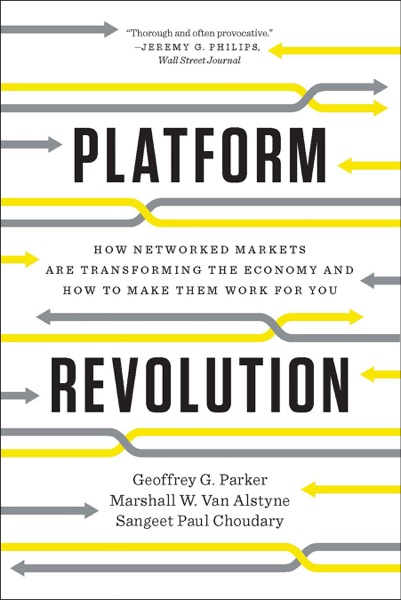
Talk to Platform Revolution like its author wrote you back.
Get the ideas that fit your life — not generic summaries.
- Chat with the book
- Audiobook-style main ideas
- Adapts to your life and goals
- Helps you take action
What it argues
Platform Revolution is the most systematic treatment available of how platform businesses — companies that facilitate interactions between two or more distinct groups — work differently from traditional pipeline businesses. Parker, Van Alstyne, and Choudary bring serious academic credentials: the first two are economists at MIT and Boston University who coined the term "two-sided network effects" in research published over a decade before this book. The result is rigorous without being dry, and the framework holds up across industries from health care to media to financial services.
The core distinction is between pipelines and platforms. A pipeline business (a car manufacturer, a publisher, a retailer) creates value by controlling a linear production process. A platform business creates value by facilitating interactions between producers and consumers, and its competitive moat comes from network effects: the more producers join, the more valuable the platform is to consumers, and vice versa. Platforms don't own the content or inventory — they own the rules and the marketplace.
What it gets right
- 1.
Platforms create value by facilitating interactions between external producers and consumers rather than by manufacturing goods or controlling a production pipeline.
- 2.
Network effects are the primary moat of platform businesses. Same-side effects (more users attracts more users) and cross-side effects (more producers attracts consumers) compound over time.
- 3.
The chicken-and-egg problem — launching a platform with no users on either side — is the central challenge. Solving it often requires subsidizing one side to seed the other.
What it covers
Who wrote it
Geoffrey G. Parker is a professor at Dartmouth's Thayer School of Engineering and a research fellow at MIT. Marshall W. Van Alstyne is a professor at Boston University's Questrom School of Business and a research associate at MIT. Together they co-authored the foundational 2006 article in the Harvard Business Review that introduced the academic framework for two-sided networks. Sangeet Paul Choudary is a Singapore-based entrepreneur and author who runs Platform Thinking Labs, an advisory firm focused on platform business models and digital ecosystem strategy.
