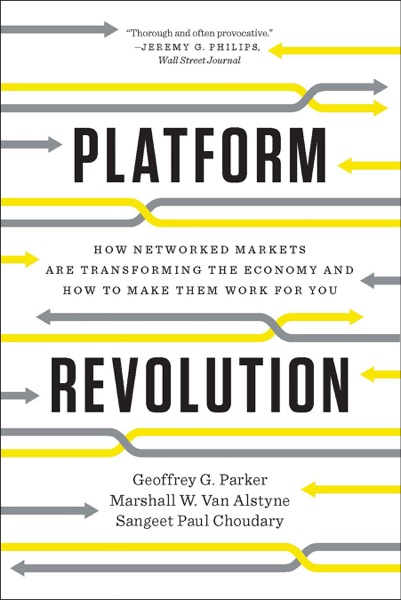
Platform Revolution by Geoffrey G. Parker, Marshall W. Van Alstyne, and Sangeet Paul Choudary is a 2016 business book about platform economics, network effects, digital business models. Platforms create value by facilitating interactions between external producers and consumers rather than by manufacturing goods or controlling a production pipeline.
Summary
Platform Revolution is the most systematic treatment available of how platform businesses — companies that facilitate interactions between two or more distinct groups — work differently from traditional pipeline businesses. Parker, Van Alstyne, and Choudary bring serious academic credentials: the first two are economists at MIT and Boston University who coined the term "two-sided network effects" in research published over a decade before this book. The result is rigorous without being dry, and the framework holds up across industries from health care to media to financial services.
The core distinction is between pipelines and platforms. A pipeline business (a car manufacturer, a publisher, a retailer) creates value by controlling a linear production process. A platform business creates value by facilitating interactions between producers and consumers, and its competitive moat comes from network effects: the more producers join, the more valuable the platform is to consumers, and vice versa. Platforms don't own the content or inventory — they own the rules and the marketplace.
The book is organized around the key challenges platform builders face: designing for the right kind of network effects, managing the chicken-and-egg problem of launching with no users, preventing disintermediation (participants bypassing the platform to transact directly), dealing with negative externalities like fraud or low-quality content, and governing the ecosystem without overreaching. Each challenge gets a chapter, and the authors draw on detailed case studies from Airbnb, YouTube, Apple's App Store, and health care.
The authors are direct about the implications for incumbent businesses: platforms can disrupt pipelines by redefining the value unit in an industry. When Airbnb turned spare rooms into inventory, it didn't compete with Hilton on hotel operations — it changed what a room meant. Understanding that dynamic is useful not only for platform builders but for anyone trying to anticipate where disruption will come from next.
Talk to Platform Revolution like its author wrote you back.
Get the ideas that fit your life — not generic summaries.
- Chat with the book
- Audiobook-style main ideas
- Adapts to your life and goals
- Helps you take action
Key takeaways
- 1.
Platforms create value by facilitating interactions between external producers and consumers rather than by manufacturing goods or controlling a production pipeline.
- 2.
Network effects are the primary moat of platform businesses. Same-side effects (more users attracts more users) and cross-side effects (more producers attracts consumers) compound over time.
- 3.
The chicken-and-egg problem — launching a platform with no users on either side — is the central challenge. Solving it often requires subsidizing one side to seed the other.
- 4.
Curation and governance are existential for platforms. A platform that fails to manage quality, safety, or fraud loses the trust of both producers and consumers and dies.
- 5.
Disintermediation — participants bypassing the platform to transact directly — is the key threat platforms must design against, through contracts, switching costs, or ongoing value delivery.
- 6.
Platforms that expand too quickly into adjacent markets can weaken their core network effects and face platform envelopment from larger, better-resourced competitors.
- 7.
The value unit is the fundamental atomic exchange on a platform — a post, a ride, a room listing. Designing the value unit correctly determines what interactions the platform can facilitate.
- 8.
Pipeline incumbents are most vulnerable to disruption by platforms when their value chain can be disaggregated and the inventory that drives their business can be defined more broadly.
Discussion questions
Use these on your own, with a book club, or as chat starters in Superbook. Book club version, ready to copy or print →
- 1.
What distinguishes a platform with strong network effects from one that merely connects buyers and sellers without creating lasting competitive advantage?
- 2.
Think of a platform you use daily. What keeps you from bypassing it to transact directly with producers? Is the platform's solution durable?
- 3.
How should a platform founder sequence the chicken-and-egg problem? Which side should be seeded first, and how do you know?
- 4.
The authors argue platforms must govern their ecosystems, but governance can antagonize participants. Where have you seen platforms get this balance wrong?
- 5.
What does a platform need to sacrifice in order to maintain trust and quality? What happens to platforms that sacrifice too much?
- 6.
How does the platform model change the nature of competition? Does winning a platform market require different skills than winning in a pipeline business?
- 7.
The book covers health care, education, and financial services as ripe for platform disruption. Which of these seems furthest along, and which seems most resistant?
- 8.
What is the difference between a positive and negative network effect, and how do platforms manage the transition when a negative effect appears?
- 9.
Airbnb redefined the value unit in travel from hotel rooms to any available space. What value units in industries you know could be redefined in a similar way?
- 10.
How does data change the dynamics of platform competition? Can a platform that doesn't own data still build a durable moat?
- 11.
The authors published this in 2016. Which predictions about platform disruption have played out, and which have not?
- 12.
What responsibilities do platforms have toward participants on their ecosystems that differ from responsibilities traditional employers have to employees?
Themes
Frequently asked questions
-
Is Platform Revolution worth reading?
Yes, particularly if you want a rigorous conceptual foundation for platform thinking rather than a popular account. It is one of the most analytically serious books on platform economics written for a general business audience.
-
How long does it take to read Platform Revolution?
Around five to six hours. The book is dense with frameworks and case studies, and readers who want to apply the ideas will benefit from taking notes rather than reading straight through.
-
What is the difference between a platform and a pipeline business?
A pipeline creates value through a controlled production process and sells the output. A platform creates value by facilitating interactions between external groups — producers and consumers — and earns revenue by enabling those interactions, not by owning the goods being exchanged.
-
Who should read Platform Revolution?
Founders building marketplace or platform businesses, executives at pipeline companies trying to understand platform disruption risk, and strategists and investors evaluating network-effect businesses. The academic authors make it unusually useful for graduate courses as well.
-
What is the chicken-and-egg problem and how do platforms solve it?
The chicken-and-egg problem is that a platform has no value to producers without consumers, and no value to consumers without producers. Solutions include seeding one side with subsidies or artificial supply, focusing on a narrow niche where both sides exist, or using a standalone tool that creates value before the network forms.
Similar books
Exponential Organizations
Salim Ismail
Zero to One: Notes on Startups, or How to Build the Future
Peter Thiel

Blitzscaling: The Lightning-Fast Path to Building Massively Valuable Companies
Reid Hoffman and Chris Yeh
Competing Against Luck
Clayton M. Christensen
