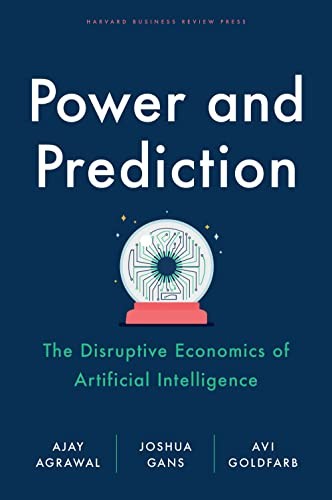
Talk to Power and Prediction: The Disruptive Economics of Artificial Intelligence like its author wrote you back.
Get the ideas that fit your life — not generic summaries.
- Chat with the book
- Audiobook-style main ideas
- Adapts to your life and goals
- Helps you take action
What it argues
Power and Prediction is the second book from Ajay Agrawal, Joshua Gans, and Avi Goldfarb — the economists behind Prediction Machines — and it takes a more pointed look at what cheap AI-driven prediction actually disrupts. Where Prediction Machines argued that AI reduces the cost of prediction, Power and Prediction asks what happens when that cost reduction starts threatening the rules, roles, and power structures that were built around expensive prediction.
The core argument is that AI creates disruption at the system level, not just at the task level. The authors introduce a distinction between point solutions — AI tools that improve a specific decision within an existing workflow — and system solutions — redesigns of entire decision-making architectures made possible by cheap prediction. Most current AI deployments are point solutions: they make an existing process faster or more accurate without changing the underlying structure. The disruptive wave comes when organizations and industries redesign their rules, roles, and workflows around what AI can now do cheaply.
What it gets right
- 1.
AI reduces the cost of prediction. The disruptive question is not what AI predicts, but what happens to the institutions and power structures built around expensive prediction.
- 2.
Most current AI is deployed as point solutions — improvements within existing workflows. The larger disruption comes from system solutions that redesign entire decision architectures.
- 3.
Power in many professions derives from controlling access to prediction. When prediction becomes cheap, that power base can erode or shift to new holders.
What it covers
Who wrote it
Ajay Agrawal, Joshua Gans, and Avi Goldfarb are economists at the University of Toronto's Rotman School of Management and co-founders of the Creative Destruction Lab. They are also the authors of Prediction Machines (2018), the first book in what became a trilogy on the economics of artificial intelligence. Their research focuses on the economics of innovation and the strategic implications of AI for firms and institutions. All three have advised governments and companies on technology policy and AI strategy.
