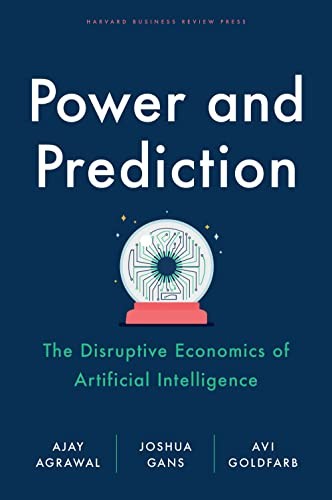
Power and Prediction: The Disruptive Economics of Artificial Intelligence by Ajay Agrawal, Joshua Gans, and Avi Goldfarb is a 2022 business book about artificial intelligence, decision-making, disruption. AI reduces the cost of prediction. The disruptive question is not what AI predicts, but what happens to the institutions and power structures built around expensive prediction.
Summary
Power and Prediction is the second book from Ajay Agrawal, Joshua Gans, and Avi Goldfarb — the economists behind Prediction Machines — and it takes a more pointed look at what cheap AI-driven prediction actually disrupts. Where Prediction Machines argued that AI reduces the cost of prediction, Power and Prediction asks what happens when that cost reduction starts threatening the rules, roles, and power structures that were built around expensive prediction.
The core argument is that AI creates disruption at the system level, not just at the task level. The authors introduce a distinction between point solutions — AI tools that improve a specific decision within an existing workflow — and system solutions — redesigns of entire decision-making architectures made possible by cheap prediction. Most current AI deployments are point solutions: they make an existing process faster or more accurate without changing the underlying structure. The disruptive wave comes when organizations and industries redesign their rules, roles, and workflows around what AI can now do cheaply.
This is where power enters the analysis. Existing institutions, professional bodies, and incumbents often have their power rooted in controlling prediction. Doctors decide treatment because diagnosis was expensive and required expert judgment. Judges sentence because predicting recidivism required interpretation. Managers allocate because forecasting outcomes required experience. When prediction becomes cheap and accurate, the distribution of decision-making authority can — and eventually will — change. The question is whether incumbents will capture the gains from AI or whether disruption will shift power to new entrants or directly to end users.
The authors are economists first and the writing reflects that: the argument is precise and the frameworks are clear, but the book is more analytical than narrative. It is less concerned with what AI will do at the task level than with who will benefit from AI at the institutional level. For strategists, policymakers, and anyone thinking about what AI does to competitive advantage, the analysis is sharper and less breathless than most of the genre.
Talk to Power and Prediction: The Disruptive Economics of Artificial Intelligence like its author wrote you back.
Get the ideas that fit your life — not generic summaries.
- Chat with the book
- Audiobook-style main ideas
- Adapts to your life and goals
- Helps you take action
Key takeaways
- 1.
AI reduces the cost of prediction. The disruptive question is not what AI predicts, but what happens to the institutions and power structures built around expensive prediction.
- 2.
Most current AI is deployed as point solutions — improvements within existing workflows. The larger disruption comes from system solutions that redesign entire decision architectures.
- 3.
Power in many professions derives from controlling access to prediction. When prediction becomes cheap, that power base can erode or shift to new holders.
- 4.
The transition from point solutions to system solutions is slow because it requires changing rules, incentives, roles, and sometimes regulation — not just technology.
- 5.
Incumbents often capture early AI gains as efficiency improvements, which can slow disruption by making the current system more competitive against challengers.
- 6.
The biggest barriers to AI-driven disruption are institutional, not technical. Professional associations, regulatory frameworks, and organizational habits resist redesign even when technology enables it.
- 7.
AI creates a split between decision-makers who own the AI model's output and those who own the judgment applied on top of it. Who controls which part will determine competitive dynamics.
- 8.
Industries where prediction is currently expensive and error-costly — medicine, law, finance — are most exposed to eventual system-level redesign as AI prediction becomes reliable and cheap.
Discussion questions
Use these on your own, with a book club, or as chat starters in Superbook. Book club version, ready to copy or print →
- 1.
The authors distinguish between point solutions and system solutions. Where in your industry is AI currently deployed as a point solution when the bigger opportunity is a system redesign?
- 2.
Which professional roles in your field derive their authority primarily from controlling access to prediction? How might cheap AI prediction affect that authority over time?
- 3.
The book argues incumbents often benefit first from AI efficiency gains, which can slow disruption. Is that a temporary advantage or a durable one?
- 4.
Think of a regulation or professional norm in your industry that was designed for a world of expensive prediction. Does it still make sense as AI makes prediction cheaper?
- 5.
The authors are optimistic that system-level AI disruption will eventually benefit end users. What would that look like in healthcare, law, or education specifically?
- 6.
Where do you see the transition from point solutions to system solutions already beginning in your industry or organization?
- 7.
They argue that the institutions resisting AI redesign are doing so for reasons that were once legitimate. Does that make the resistance more or less appropriate to challenge?
- 8.
The book is written by economists. Does the analytical framework of decision costs and prediction costs capture what feels most important about AI disruption, or does it miss something?
- 9.
What kind of organization — startup, incumbent, or regulator — is best positioned to drive system-level AI redesign in your sector?
- 10.
Cheap prediction doesn't eliminate the need for judgment. The authors are careful on this point. Where is human judgment most likely to remain valuable as prediction improves?
- 11.
Who in your professional network currently holds power because they control access to expensive prediction? How are they responding to AI tools in that domain?
- 12.
The authors wrote this in 2022, before the widespread deployment of large language models. Which of their predictions about system-level disruption seem most clearly confirmed now?
Themes
Frequently asked questions
-
What is Power and Prediction about?
It's an economic analysis of how cheap AI-driven prediction disrupts the institutions, professions, and power structures that were built around expensive prediction. The central argument is that AI's most significant disruption is at the system level — redesigning how decisions are made — not just at the task level.
-
Do I need to read Prediction Machines first?
No, but reading it first helps. Prediction Machines establishes the framework that AI reduces prediction costs; Power and Prediction builds on that to ask who benefits and who loses when that cost reduction reaches institutional scale.
-
Is this book too theoretical to be useful?
It is more analytical than prescriptive. Readers looking for implementation advice or case studies will find it abstract. Readers trying to think clearly about AI strategy at the organizational or industry level will find the frameworks genuinely useful.
-
Who should read Power and Prediction?
Executives, policymakers, and strategists who want an economic lens on AI disruption rather than a technology lens. It's particularly useful for anyone in fields where expert judgment is central to the value proposition — medicine, law, finance, and consulting.
-
What's the most important idea in the book?
The distinction between point solutions and system solutions. Most AI today makes existing workflows more efficient without changing their architecture. The more disruptive question is what happens when AI prediction is cheap enough to justify redesigning the rules and roles that structure entire industries.
Similar books
The Innovator's Dilemma
Clayton M. Christensen
The Second Machine Age
Erik Brynjolfsson and Andrew McAfee
Superintelligence: Paths, Dangers, Strategies
Nick Bostrom
Competing Against Luck
Clayton M. Christensen
