Talk to Presence like its author wrote you back.
Get the ideas that fit your life — not generic summaries.
- Chat with the book
- Audiobook-style main ideas
- Adapts to your life and goals
- Helps you take action
What it argues
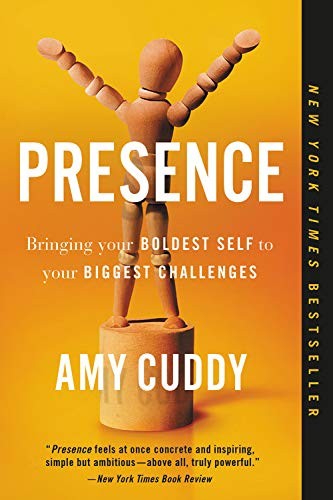
Presence is Amy Cuddy's case that the key to performing well in high-stakes situations is not to fake confidence but to access genuine self-belief — and that the body, surprisingly, is a reliable on-ramp to that state. Cuddy became widely known from a 2012 TED Talk on power posing, which the book expands substantially. The core claim is that before a job interview, negotiation, or presentation, two minutes of expansive posture — standing tall, taking up space — can shift your psychological state in ways that affect how you perform and how others perceive you.
The science behind power posing became contested after the book's publication. A replication attempt in 2015 found that the hormonal effects Cuddy had reported — reduced cortisol, increased testosterone — were not reproduced reliably. Cuddy has responded that even if the hormonal explanation is wrong, evidence for behavioral and psychological effects remains. Readers should come to the book aware of that controversy rather than treating every claim as settled. The practical advice is plausible even if the mechanistic explanation is disputed.
What it gets right
- 1.
Presence is not a performance of confidence. It's the state of being fully aligned with your values and beliefs in a high-stakes moment — and it's accessible with preparation.
- 2.
Expansive posture — standing tall, taking up space — can shift psychological state before a high-pressure interaction, independent of whether hormonal effects replicate reliably.
- 3.
Self-affirmation before a stressful event — reminding yourself of values that matter to you — improves performance more reliably than simply trying to calm down.
What it covers
Who wrote it
Amy Cuddy is a social psychologist and former associate professor at Harvard Business School, where she studied the effects of body language, status, and power on performance and well-being. Her 2012 TED Talk on power posing became one of the most-watched in TED's history. Presence was her first book for a general audience. She has written for the New York Times, the Harvard Business Review, and other publications, and speaks widely on the psychology of high-stakes performance. She holds a PhD from Princeton.
