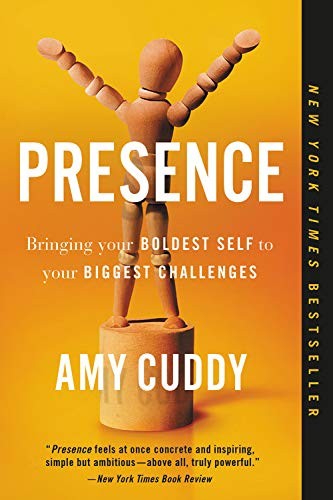
Presence by Amy Cuddy is a 2015 psychology book about confidence, body language, self-perception. Presence is not a performance of confidence. It's the state of being fully aligned with your values and beliefs in a high-stakes moment — and it's accessible with preparation.
Summary
Presence is Amy Cuddy's case that the key to performing well in high-stakes situations is not to fake confidence but to access genuine self-belief — and that the body, surprisingly, is a reliable on-ramp to that state. Cuddy became widely known from a 2012 TED Talk on power posing, which the book expands substantially. The core claim is that before a job interview, negotiation, or presentation, two minutes of expansive posture — standing tall, taking up space — can shift your psychological state in ways that affect how you perform and how others perceive you.
The science behind power posing became contested after the book's publication. A replication attempt in 2015 found that the hormonal effects Cuddy had reported — reduced cortisol, increased testosterone — were not reproduced reliably. Cuddy has responded that even if the hormonal explanation is wrong, evidence for behavioral and psychological effects remains. Readers should come to the book aware of that controversy rather than treating every claim as settled. The practical advice is plausible even if the mechanistic explanation is disputed.
The broader argument about presence is more durable than the specific posing claims. Cuddy draws on a wide range of psychological research to make the case that the way we inhabit our bodies shapes our mental state, that self-affirmation before high-pressure situations improves performance, and that authenticity — bringing your actual values into a moment rather than performing a scripted version of yourself — is both more ethical and more effective than strategic impression management. The chapter on imposter syndrome is particularly well written and draws on Cuddy's own experience with serious head trauma that affected her cognitive abilities.
The book is accessible, personal, and built around practical exercises. Readers who approach it as a set of tools to experiment with rather than a settled science textbook will find more value than those expecting replication-ready findings. The writing is warmer and more personal than most business psychology books, which makes it engaging even when the research it cites is less certain than it presents itself.
Talk to Presence like its author wrote you back.
Get the ideas that fit your life — not generic summaries.
- Chat with the book
- Audiobook-style main ideas
- Adapts to your life and goals
- Helps you take action
Key takeaways
- 1.
Presence is not a performance of confidence. It's the state of being fully aligned with your values and beliefs in a high-stakes moment — and it's accessible with preparation.
- 2.
Expansive posture — standing tall, taking up space — can shift psychological state before a high-pressure interaction, independent of whether hormonal effects replicate reliably.
- 3.
Self-affirmation before a stressful event — reminding yourself of values that matter to you — improves performance more reliably than simply trying to calm down.
- 4.
Imposter syndrome is widespread, especially among high achievers. Treating it as a permanent identity rather than a mental event is the main way it limits people.
- 5.
Authenticity in social interactions — bringing your actual self rather than a strategic persona — tends to produce better outcomes than impression management over the medium term.
- 6.
Small behavioral nudges — how you sit, how you walk into a room, how you hold your expression — shape internal state in ways that people underestimate.
- 7.
The goal before a high-stakes situation is not to eliminate anxiety but to keep it from hijacking attention. Reframing anxiety as excitement is one of the most evidence-supported tools for doing this.
- 8.
Other-focused attention reduces self-monitoring during social performance. Thinking about what you can offer or learn shifts you out of self-conscious evaluation.
Discussion questions
Use these on your own, with a book club, or as chat starters in Superbook. Book club version, ready to copy or print →
- 1.
Cuddy distinguishes between performing confidence and accessing genuine self-belief. What does that distinction feel like in your own experience of high-stakes moments?
- 2.
Have you ever used physical preparation — posture, breathing, movement — before a difficult conversation or presentation? What effect did it have?
- 3.
What are the values or qualities you would want to affirm before an important moment? How often do you actually do that consciously?
- 4.
Imposter syndrome tends to intensify in new environments or at higher levels of responsibility. When have you felt it most strongly, and how did you respond?
- 5.
The book's science on power posing has been challenged since publication. How do you evaluate advice that rests on contested research?
- 6.
Cuddy argues that authenticity is more effective than strategic impression management. Where in your professional life do you feel you're performing a persona rather than showing up as yourself?
- 7.
What physical habits do you have before stressful situations — pacing, contracting, checking your phone — and do any of them actually help?
- 8.
Think of someone you find genuinely present in conversation. What specifically do they do or not do that creates that effect?
- 9.
Reframing anxiety as excitement uses the same physiological arousal differently. Have you ever made that shift deliberately, and what happened?
- 10.
Cuddy's personal story of brain trauma and recovery is central to the book. How does her credibility as a subject of her own research affect how you read her advice?
- 11.
What is one situation in the next month where you want to show up differently? What specific preparation would Cuddy recommend for it?
Themes
Frequently asked questions
-
Is the science in Presence reliable?
Partially. The specific hormonal effects of power posing were not reliably replicated, which Cuddy acknowledges. Other claims in the book — about self-affirmation, anxiety reframing, and authenticity — rest on better-replicated research. Read it as a collection of tools to try, not as a settled scientific program.
-
How long does it take to read Presence?
Around five hours. The writing is accessible and personal, and the chapters are relatively short. It's not a demanding read, though some readers wish the research was presented with more uncertainty given subsequent replication failures.
-
What is the most practically useful idea in Presence?
Self-affirmation before high-stakes situations — briefly reflecting on values or qualities that matter to you — is among the more robustly supported interventions in social psychology. That and the anxiety-reframing technique are the two practices most worth experimenting with.
-
Who should read Presence?
People who struggle with imposter syndrome, high performance anxiety, or the feeling that they can't access their best self in important moments. Also useful for managers and coaches who work with people in demanding public-facing roles.
-
What is the difference between Presence and books on body language like those by Joe Navarro?
Navarro's work is about reading others' body language. Cuddy's is about using your own body language to change your internal state. They address different problems — observation versus self-preparation — and complement each other rather than overlap.
Similar books
Quiet: The Power of Introverts in a World That Can't Stop Talking
Susan Cain
Dare to Lead
Brené Brown
Mindset: The New Psychology of Success
Carol S. Dweck
Grit: The Power of Passion and Perseverance
Angela Duckworth
