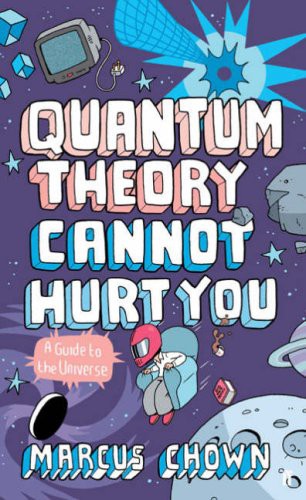
Talk to Quantum Theory Cannot Hurt You like its author wrote you back.
Get the ideas that fit your life — not generic summaries.
- Chat with the book
- Audiobook-style main ideas
- Adapts to your life and goals
- Helps you take action
Quantum Theory Cannot Hurt You, in detail
Marcus Chown, a former radio astronomer and longtime science writer, takes two of the most counterintuitive theories in physics — quantum mechanics and special relativity — and presents them in a single short book aimed squarely at readers who find both intimidating. The title is a promise and a joke: the ideas are strange enough to destabilize your intuitions, but they won't actually harm you, and Chown's method is to make them feel as accessible as possible through humor and analogy.
The book is structured as two halves. The first covers quantum mechanics: wave-particle duality, the uncertainty principle, the probabilistic nature of measurement, superposition, and entanglement. Chown is good at capturing why these ideas were so upsetting to physicists who first encountered them. The world at the quantum scale doesn't behave like a small version of the world we see; it behaves like something genuinely alien, where particles exist in multiple states simultaneously until observed, and where certainty about position and momentum is mathematically forbidden.
The second half covers special relativity: the constancy of the speed of light, time dilation, length contraction, and mass-energy equivalence. Chown uses thought experiments extensively, following in Einstein's own approach to making the abstract vivid. He is particularly good at conveying why the relativistic effects — clocks running slower, lengths shortening — are not illusions or measurement artifacts but genuine consequences of how spacetime works.
Chown's strength is wit and analogy. He writes with self-deprecating humor and a willingness to say "this makes no sense" before explaining why it's true anyway. The book won't satisfy readers who want rigor; the mathematics is minimal and the depth is limited. But as an introduction to two bodies of physics that most people know only by reputation — and that reputation is one of impenetrable difficulty — it succeeds by making them feel approachable rather than frightening.
The big ideas
- 1.
Quantum mechanics describes a world where particles have no definite properties until measured. Before observation, a particle exists in a superposition of possible states.
- 2.
The uncertainty principle is not a limitation of measurement technology but a fundamental feature of nature: knowing a particle's position precisely makes its momentum unknowable, and vice versa.
- 3.
Wave-particle duality means light and matter behave as waves or particles depending on how you observe them. Neither description alone is complete.
