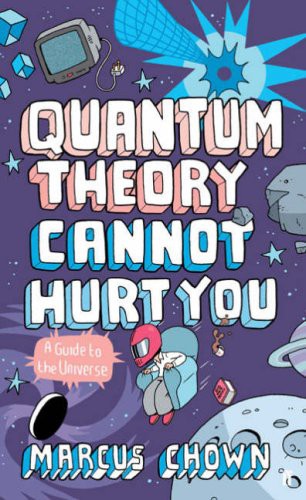
Quantum Theory Cannot Hurt You by Marcus Chown is a 2007 science book about quantum mechanics, relativity, physics. Quantum mechanics describes a world where particles have no definite properties until measured. Before observation, a particle exists in a superposition of possible states.
Summary
Marcus Chown, a former radio astronomer and longtime science writer, takes two of the most counterintuitive theories in physics — quantum mechanics and special relativity — and presents them in a single short book aimed squarely at readers who find both intimidating. The title is a promise and a joke: the ideas are strange enough to destabilize your intuitions, but they won't actually harm you, and Chown's method is to make them feel as accessible as possible through humor and analogy.
The book is structured as two halves. The first covers quantum mechanics: wave-particle duality, the uncertainty principle, the probabilistic nature of measurement, superposition, and entanglement. Chown is good at capturing why these ideas were so upsetting to physicists who first encountered them. The world at the quantum scale doesn't behave like a small version of the world we see; it behaves like something genuinely alien, where particles exist in multiple states simultaneously until observed, and where certainty about position and momentum is mathematically forbidden.
The second half covers special relativity: the constancy of the speed of light, time dilation, length contraction, and mass-energy equivalence. Chown uses thought experiments extensively, following in Einstein's own approach to making the abstract vivid. He is particularly good at conveying why the relativistic effects — clocks running slower, lengths shortening — are not illusions or measurement artifacts but genuine consequences of how spacetime works.
Chown's strength is wit and analogy. He writes with self-deprecating humor and a willingness to say "this makes no sense" before explaining why it's true anyway. The book won't satisfy readers who want rigor; the mathematics is minimal and the depth is limited. But as an introduction to two bodies of physics that most people know only by reputation — and that reputation is one of impenetrable difficulty — it succeeds by making them feel approachable rather than frightening.
Talk to Quantum Theory Cannot Hurt You like its author wrote you back.
Get the ideas that fit your life — not generic summaries.
- Chat with the book
- Audiobook-style main ideas
- Adapts to your life and goals
- Helps you take action
Key takeaways
- 1.
Quantum mechanics describes a world where particles have no definite properties until measured. Before observation, a particle exists in a superposition of possible states.
- 2.
The uncertainty principle is not a limitation of measurement technology but a fundamental feature of nature: knowing a particle's position precisely makes its momentum unknowable, and vice versa.
- 3.
Wave-particle duality means light and matter behave as waves or particles depending on how you observe them. Neither description alone is complete.
- 4.
Quantum entanglement links particles so that measuring one instantly determines the state of the other, regardless of the distance between them.
- 5.
Special relativity rests on one postulate: the speed of light is the same for all observers, regardless of their motion. Everything else follows from this.
- 6.
Time dilation is real, not an illusion. A clock on a fast-moving spacecraft runs slower than a clock at rest. GPS satellites require relativistic corrections to function.
- 7.
Mass and energy are interchangeable. E=mc² means a small amount of mass contains an enormous amount of energy, which nuclear reactions release.
- 8.
Both quantum mechanics and relativity violate everyday intuition, but both are extraordinarily well confirmed by experiment. Physics is stranger than common sense allows.
Discussion questions
Use these on your own, with a book club, or as chat starters in Superbook. Book club version, ready to copy or print →
- 1.
Chown argues that quantum mechanics requires abandoning the idea that the world has a definite state independent of observation. How does that strike you?
- 2.
The uncertainty principle is a fact about nature, not a limit of instruments. What other 'measurement problems' might turn out to be features of reality rather than our tools?
- 3.
Chown uses humor to soften counterintuitive ideas. Does that approach help or does it sometimes undermine the seriousness of the physics?
- 4.
Time dilation and length contraction are real physical effects, not optical illusions. Did the relativity sections change how you think about time?
- 5.
Quantum entanglement implies that two particles can be correlated across any distance instantaneously. Why does this not allow faster-than-light communication?
- 6.
Both quantum mechanics and general relativity are extremely accurate theories, but they contradict each other at extreme scales. What does it mean to have two theories that both work but can't both be fundamentally right?
- 7.
Chown writes for readers who are intimidated by physics. Did the humor make the ideas more accessible, or did it sometimes feel like a substitute for explanation?
- 8.
Special relativity says there is no universal 'now' — simultaneity is relative to the observer. What does that imply about events that seem to happen 'at the same time'?
- 9.
Which idea in the book was hardest to hold onto after you finished reading it?
- 10.
Chown is a science writer, not a physicist. Does that affect how much you trust his explanations, or do you think it makes him better at communicating?
- 11.
Physics uses thought experiments — imaginary scenarios — to develop real theories. Do you think that method works in practice, or does it just produce plausible-sounding results?
Themes
Frequently asked questions
-
Is Quantum Theory Cannot Hurt You a good starting point for physics?
Yes, especially if you've been curious about quantum mechanics and relativity but assumed both were inaccessible. Chown uses analogy and humor rather than mathematics, and the tone is welcoming. It won't give you a working understanding of the physics at a technical level, but it makes the ideas feel less remote.
-
How long does it take to read?
About three to four hours. The two halves — quantum mechanics and relativity — can each be read in a single sitting. The writing moves quickly and the chapters are short.
-
Does the book use mathematics?
Almost none. Chown describes equations and their meaning in words but rarely writes them out. E=mc² appears, and a few other relationships are mentioned, but the book is designed for readers who are allergic to math.
-
What's the most mind-bending idea in the book?
Arguably superposition: the idea that a particle genuinely exists in multiple states simultaneously until observed, and that this isn't a statement about our ignorance but about the nature of the world. Chown handles this clearly and doesn't pretend it makes intuitive sense.
-
Who shouldn't read this book?
Readers who want mathematical depth or who have already worked through an introductory physics textbook will find this too thin. It's aimed at science-curious people with no technical background, not at those who want to build working knowledge of quantum mechanics.