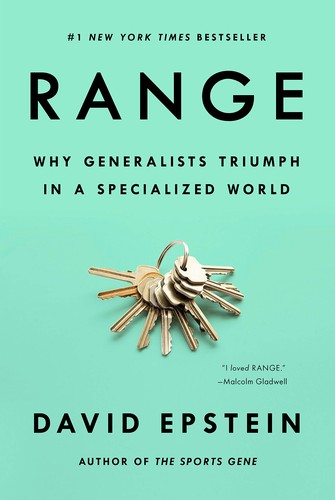
Talk to Range: Why Generalists Triumph in a Specialized World like its author wrote you back.
Get the ideas that fit your life — not generic summaries.
- Chat with the book
- Audiobook-style main ideas
- Adapts to your life and goals
- Helps you take action
What it argues
Range is David Epstein's argument against the ten-thousand-hours gospel. The dominant story in self-help and talent development holds that early specialization and deliberate practice in a single domain is the route to excellence. Epstein doesn't dispute that this works in what he calls "kind" learning environments — chess, golf, classical music — where the rules are stable, feedback is immediate, and patterns repeat. He disputes that it generalizes. Most of the world, he argues, is a "wicked" learning environment where the rules are unclear, feedback is delayed or misleading, and yesterday's patterns don't reliably predict tomorrow's outcomes. In those domains, range beats depth.
The case is built from a wide sweep of research and biography. Roger Federer played multiple sports as a child before settling on tennis late, while Tiger Woods practiced from infancy under a structured training regime. Both succeeded, but Epstein argues Federer's path is more typical of elite performers across domains than the Tiger story popular wisdom has constructed around early specialization. He covers scientists who made their most important discoveries after switching fields, military officers whose broad education outperformed narrowly trained specialists, and studies showing that the most innovative researchers hold patents in multiple fields. The connecting thread: sampling broadly before committing allows people to match skills to contexts they couldn't have anticipated, and gives them the conceptual transfer to solve problems that stump domain experts.
What it gets right
- 1.
Most expertise research was built on 'kind' learning environments with clear rules and fast feedback. Those findings don't transfer well to 'wicked' domains where the rules shift and feedback arrives late or not at all.
- 2.
Early specialization gives an edge in kind environments like chess and classical music, but in most professional domains, late specialization and broad sampling predicts higher performance over a career.
- 3.
The Roger Federer story, not the Tiger Woods story, is more representative of elite performance. Many top performers in complex fields sampled widely before committing.
What it covers
Who wrote it
David Epstein is an investigative reporter and science writer whose previous book, The Sports Gene (2013), examined the role of genetics and environment in athletic performance. He was a senior writer at Sports Illustrated and ProPublica and holds graduate degrees in environmental science and journalism from Columbia University. Range, published in 2019, became a New York Times bestseller and prompted a widely read public exchange with Malcolm Gladwell about the merits of specialization. Epstein's work focuses on how research findings get distorted when they travel from academic journals to popular advice.
