Range: Why Generalists Triumph in a Specialized World by David Epstein is a 2019 science book about learning, expertise, generalism. Most expertise research was built on 'kind' learning environments with clear rules and fast feedback. Those findings don't transfer well to 'wicked' domains where the rules shift and feedback arrives late or not at all.
Summary
Range is David Epstein's argument against the ten-thousand-hours gospel. The dominant story in self-help and talent development holds that early specialization and deliberate practice in a single domain is the route to excellence. Epstein doesn't dispute that this works in what he calls "kind" learning environments — chess, golf, classical music — where the rules are stable, feedback is immediate, and patterns repeat. He disputes that it generalizes. Most of the world, he argues, is a "wicked" learning environment where the rules are unclear, feedback is delayed or misleading, and yesterday's patterns don't reliably predict tomorrow's outcomes. In those domains, range beats depth.
The case is built from a wide sweep of research and biography. Roger Federer played multiple sports as a child before settling on tennis late, while Tiger Woods practiced from infancy under a structured training regime. Both succeeded, but Epstein argues Federer's path is more typical of elite performers across domains than the Tiger story popular wisdom has constructed around early specialization. He covers scientists who made their most important discoveries after switching fields, military officers whose broad education outperformed narrowly trained specialists, and studies showing that the most innovative researchers hold patents in multiple fields. The connecting thread: sampling broadly before committing allows people to match skills to contexts they couldn't have anticipated, and gives them the conceptual transfer to solve problems that stump domain experts.
Epstein also challenges the idea that outside-domain analogies are a sign of shallow thinking. Researchers who could map a problem onto a structure from a different field — a cardiologist who recognized a pattern from architecture, an engineer who borrowed from biology — consistently outperformed specialists working within their field's standard toolkit. He calls this "lateral thinking with withered technology," borrowing a phrase from Nintendo designer Gunpei Yokoi: the most creative solutions often come from people who understand an old principle deeply enough to apply it somewhere new, rather than chasing the frontier of a single discipline.
The book is most useful for people early in their careers who feel pressure to specialize before they've figured out what they're good at, and for managers and educators who design training systems. Epstein is honest that range doesn't always win: in genuinely kind learning environments, early specialization still has an edge. The practical message is subtler than the subtitle suggests — less "be a generalist" and more "match your learning strategy to the type of environment you're actually in, and don't mistake the Tiger path for the only path."
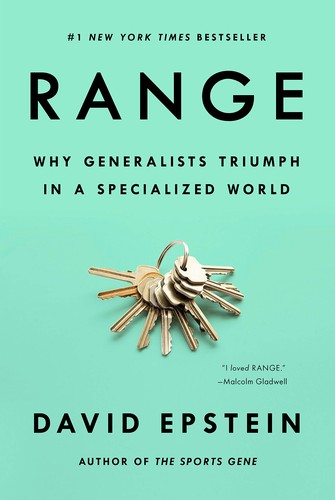
Talk to Range: Why Generalists Triumph in a Specialized World like its author wrote you back.
Get the ideas that fit your life — not generic summaries.
- Chat with the book
- Audiobook-style main ideas
- Adapts to your life and goals
- Helps you take action
Key takeaways
- 1.
Most expertise research was built on 'kind' learning environments with clear rules and fast feedback. Those findings don't transfer well to 'wicked' domains where the rules shift and feedback arrives late or not at all.
- 2.
Early specialization gives an edge in kind environments like chess and classical music, but in most professional domains, late specialization and broad sampling predicts higher performance over a career.
- 3.
The Roger Federer story, not the Tiger Woods story, is more representative of elite performance. Many top performers in complex fields sampled widely before committing.
- 4.
Conceptual transfer — applying a principle from one domain to solve a problem in another — is one of the most reliable markers of high performance. Specialists often can't see it because they're too close to their own toolkit.
- 5.
Researchers who hold patents in multiple fields and who cite work outside their domain are consistently more innovative than those who burrow deep into one specialty.
- 6.
Outside interlopers often solve problems that field insiders have stopped noticing. Epstein calls this the outsider advantage: fresh framing beats accumulated local knowledge when the problem itself requires reframing.
- 7.
The 'match quality' problem — finding work that fits your actual strengths and values — takes time and sampling. Quitting and trying something new is often better strategy than doubling down on an early commitment that isn't working.
- 8.
Analogical thinking is a skill, not a trait. People who are explicitly trained to look for structural similarities across different domains make better predictions and solve harder problems than those who rely on within-domain expertise alone.
Discussion questions
Use these on your own, with a book club, or as chat starters in Superbook. Book club version, ready to copy or print →
- 1.
Epstein distinguishes kind from wicked learning environments. Which category does your current work fit? Does your learning strategy match that environment?
- 2.
Think of a moment when knowledge from one area helped you solve a problem in a completely different one. What made that transfer possible?
- 3.
The book argues that quitting an early commitment is sometimes the right move. Have you ever stayed too long in a path because sunk costs felt real? What would the 'match quality' frame have told you?
- 4.
Epstein uses the Roger Federer vs. Tiger Woods contrast throughout. Which story feels more like your own development — early commitment or late convergence?
- 5.
What's the most useful thing you've ever learned from a field completely unrelated to your main work? How did it get there?
- 6.
Institutions and hiring processes reward demonstrated specialization. How do you signal range and transferable thinking in environments designed to filter for depth?
- 7.
Epstein argues that the ten-thousand-hours rule was oversimplified from the start. What other advice about success or skill-building do you suspect has been similarly distorted in popular retelling?
- 8.
The book suggests that diverse early experiences produce more adaptable adults. How does that land against the pressure parents and educators feel to give children structured, early training?
- 9.
When has being an outsider to a domain — not knowing the field's standard assumptions — actually helped you see something insiders missed?
- 10.
Epstein describes researchers who stopped citing outside their field over time, narrowing as their careers advanced. Do you see that pattern in yourself or in people you admire?
- 11.
The subtitle promises generalists triumph. But Epstein is careful to say 'it depends.' What conditions would make early specialization the right choice for someone you know?
- 12.
What would a 'sampling period' look like for the career or skill area you're most invested in right now? Is there still room for one, or has the window closed?
Themes
Frequently asked questions
-
What is Range by David Epstein about?
Range argues that in most complex, unpredictable fields, broad experience and late specialization produce better outcomes than early, narrow focus. Epstein challenges the ten-thousand-hours model with evidence from sports, science, and the military, showing that the most innovative and adaptable people tend to be those who sampled widely before committing.
-
Is Range worth reading?
Yes, especially if you've felt pressured to specialize early or have wondered whether a varied background is a liability. The research is well-sourced and Epstein is fair about where specialization does win. The argument is more nuanced than the subtitle implies, which makes it more durable than most books in this genre.
-
How long does it take to read Range?
About six to six and a half hours at average reading pace for the 340-page book. The chapters are structured around case studies, which makes it easy to read in segments — though the argument builds across them, so skipping around loses some cumulative force.
-
Who should read Range?
People early in their careers who feel behind because they haven't picked a specialty yet. Also useful for managers building teams, educators designing curricula, and anyone who has felt guilty about not going deep enough in one area. Less relevant if your work is genuinely rule-bound and repetitive.
-
What is the most actionable idea in Range?
The 'match quality' concept: finding work that fits your actual strengths takes sampling and time, and staying too long in a poor fit because of sunk costs is a predictable error. The prescription is to treat early career moves as low-cost experiments, not irrevocable commitments.
-
Does Range contradict Grit by Angela Duckworth?
Partly. Grit argues that passion and perseverance in one domain drive achievement; Range argues that committing too early to one domain often leads people to persist in a poor fit. Epstein acknowledges that grit matters once you've found the right match. The books answer different questions: how to persist versus when to pivot.
Similar books
Outliers: The Story of Success
Malcolm Gladwell
Grit: The Power of Passion and Perseverance
Angela Duckworth
Thinking, Fast and Slow
Daniel Kahneman

Mindset: The New Psychology of Success
Carol S. Dweck
Range vs.
Deciding between two books? Range vs Outliers .
