Talk to Reinventing Organizations like its author wrote you back.
Get the ideas that fit your life — not generic summaries.
- Chat with the book
- Audiobook-style main ideas
- Adapts to your life and goals
- Helps you take action
What it argues
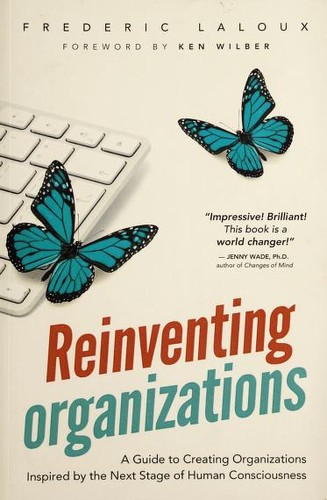
Reinventing Organizations is Frédéric Laloux's attempt to map the next stage of organizational development. Laloux surveyed a dozen companies around the world that had abandoned traditional hierarchies and found they shared three structural breakthroughs: self-management, wholeness, and evolutionary purpose. He named this model "Teal," borrowing from developmental psychologist Ken Wilber's color-coded stages of human consciousness.
The book's historical framing is its most useful section. Laloux walks through five organizational paradigms, each tied to a worldview. Impulsive (Red) organizations — street gangs, warlord armies — use fear and power. Conformist (Amber) organizations — churches, armies, government bureaucracies — use hierarchy and rules. Achievement (Orange) organizations — most modern corporations — use goals, metrics, and management. Pluralistic (Green) organizations — family-owned businesses, early Patagonia — use culture and values. Evolutionary (Teal) organizations are the thesis: they sense and respond like living organisms, grant authority to whoever has the most relevant knowledge, and treat profit as a byproduct rather than a goal.
What it gets right
- 1.
Organizations evolve through developmental stages that mirror shifts in human consciousness, from fear-based Red through rules-based Amber, goal-driven Orange, and values-led Green to self-managing Teal.
- 2.
Teal organizations replace management hierarchy with distributed authority: whoever has the most relevant knowledge makes the decision, subject to a structured advice process rather than a chain of command.
- 3.
The advice process requires that before making any consequential decision, the decision-maker must consult those affected and those with expertise — but is not required to follow their advice.
What it covers
Who wrote it
Frédéric Laloux is a Belgian organizational consultant and former McKinsey partner who spent several years researching organizations that operate without conventional management hierarchies. Reinventing Organizations, self-published in 2014, became an unexpected bestseller in management circles and has been translated into more than twenty languages. Laloux has since stepped back from active consulting to focus on what he describes as inner work. He released a shorter illustrated companion edition in 2016. His work draws heavily on Ken Wilber's integral theory and Spiral Dynamics developmental psychology.
