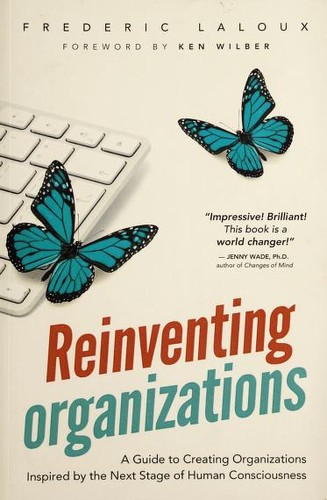
Reinventing Organizations by Frédéric Laloux is a 2014 business book about organizational design, self-management, leadership. Organizations evolve through developmental stages that mirror shifts in human consciousness, from fear-based Red through rules-based Amber, goal-driven Orange, and values-led Green to self-managing Teal.
Summary
Reinventing Organizations is Frédéric Laloux's attempt to map the next stage of organizational development. Laloux surveyed a dozen companies around the world that had abandoned traditional hierarchies and found they shared three structural breakthroughs: self-management, wholeness, and evolutionary purpose. He named this model "Teal," borrowing from developmental psychologist Ken Wilber's color-coded stages of human consciousness.
The book's historical framing is its most useful section. Laloux walks through five organizational paradigms, each tied to a worldview. Impulsive (Red) organizations — street gangs, warlord armies — use fear and power. Conformist (Amber) organizations — churches, armies, government bureaucracies — use hierarchy and rules. Achievement (Orange) organizations — most modern corporations — use goals, metrics, and management. Pluralistic (Green) organizations — family-owned businesses, early Patagonia — use culture and values. Evolutionary (Teal) organizations are the thesis: they sense and respond like living organisms, grant authority to whoever has the most relevant knowledge, and treat profit as a byproduct rather than a goal.
The case studies are real companies: Buurtzorg, a Dutch home-care nursing organization that replaced layers of management with self-organizing teams; FAVI, a French automotive supplier that eliminated time clocks and annual budgets; Patagonia; and Morning Star, the tomato processor where workers negotiate agreements directly with colleagues. Laloux documents how each organization handles hiring, compensation, conflict, decision-making, and dismissal without a formal management layer.
The book is earnest to a fault. Laloux believes deeply in this model and the writing shows it. Critics note that the sample is self-selected, that several featured companies have since restructured, and that Teal practices may work better in knowledge-intensive, low-regulation industries than in high-stakes manufacturing or public sector environments. Still, the underlying question — whether the command-and-control organization is the only viable form — is worth taking seriously, and Laloux marshals more concrete evidence for an alternative than most.
Talk to Reinventing Organizations like its author wrote you back.
Get the ideas that fit your life — not generic summaries.
- Chat with the book
- Audiobook-style main ideas
- Adapts to your life and goals
- Helps you take action
Key takeaways
- 1.
Organizations evolve through developmental stages that mirror shifts in human consciousness, from fear-based Red through rules-based Amber, goal-driven Orange, and values-led Green to self-managing Teal.
- 2.
Teal organizations replace management hierarchy with distributed authority: whoever has the most relevant knowledge makes the decision, subject to a structured advice process rather than a chain of command.
- 3.
The advice process requires that before making any consequential decision, the decision-maker must consult those affected and those with expertise — but is not required to follow their advice.
- 4.
Wholeness practices invite employees to show up as full human beings rather than playing a professional role. This includes physical environments, meeting rituals, and language that signals authenticity over performance.
- 5.
Evolutionary purpose means the organization listens for what the world needs from it rather than imposing a strategy from the top. It treats purpose as something to be sensed and served, not planned and projected.
- 6.
Buurtzorg's self-organizing nursing teams eliminated three layers of management and cut Dutch home-care costs significantly while improving patient outcomes and worker satisfaction.
- 7.
Conflict resolution in Teal organizations relies on structured peer processes rather than escalation to management — similar to nonviolent communication frameworks applied at the organizational level.
- 8.
Traditional management practices like job titles, annual performance reviews, and centralized decision-making are not neutral efficiency tools — they encode assumptions about human nature that Teal organizations explicitly reject.
Discussion questions
Use these on your own, with a book club, or as chat starters in Superbook. Book club version, ready to copy or print →
- 1.
Laloux argues that an organization can only function at the stage its leadership has grown into. What does that imply for change efforts led from below?
- 2.
The advice process replaces hierarchical approval with broad consultation. Where in your own organization would this work, and where would it break down?
- 3.
Laloux's Teal companies are mostly in low-regulation, knowledge-work industries. Does the model translate to healthcare, finance, or government? What would have to change?
- 4.
Several of the featured companies have partially reversed their Teal practices since the book was written. What does that suggest about the conditions Teal requires to be stable?
- 5.
Wholeness practices can look performative when introduced into a culture that doesn't yet trust them. How do you tell the difference between authentic wholeness and wellness theater?
- 6.
Morning Star employees negotiate personal commitments with colleagues rather than receiving job descriptions from managers. What would you find liberating about that arrangement, and what would you find difficult?
- 7.
Laloux treats Orange management as an adolescent stage humanity is growing out of. Is that a useful framing, or does it unfairly dismiss the genuine achievements of professional management?
- 8.
If your organization shifted to self-management tomorrow, which existing structures would dissolve easily and which would create chaos?
- 9.
The book conflates organizational structure with personal consciousness development. Are those actually related, or is one a metaphor for the other?
- 10.
Laloux says Teal organizations attract people who are ready for that level of autonomy and repel those who aren't. What does that mean for diversity and inclusion efforts?
- 11.
What is the evolutionary purpose of the organization you work in or lead? How different is it from what the organization officially says its purpose is?
- 12.
Buurtzorg's success depends partly on the Netherlands' healthcare system. How much of what looks like organizational innovation is actually just a favorable context?
Themes
Frequently asked questions
-
Is Reinventing Organizations worth reading?
For anyone frustrated with bureaucracy or interested in alternative organizational models, yes. The book is long and the case studies are detailed enough to be genuinely useful. The philosophical framing is earnest to the point of being occasionally tedious, but the practical examples are grounding.
-
How long does it take to read Reinventing Organizations?
The full version runs about 360 pages, so roughly five to six hours at an average pace. The illustrated edition is much shorter and covers the key frameworks well if you want the argument without the full case studies.
-
What is the main idea of Reinventing Organizations?
That organizations evolve through developmental stages, and the next stage — Teal — replaces hierarchy with self-management, allows people to show up as whole humans, and serves an evolutionary purpose rather than a predetermined strategy.
-
Who should read Reinventing Organizations?
Leaders who feel that their existing management structures are costing more than they're producing, and anyone designing or rebuilding an organization. It's less useful for people managing within a large stable hierarchy they have no ability to change.
-
What happened to the companies featured in the book?
Several have evolved significantly. FAVI was sold and partially reverted. Others like Buurtzorg continue to operate in ways broadly consistent with Laloux's description, though critics argue the model depends heavily on specific leaders and contexts that don't transfer easily.