Talk to Rich Dad Poor Dad like its author wrote you back.
Get the ideas that fit your life — not generic summaries.
- Chat with the book
- Audiobook-style main ideas
- Adapts to your life and goals
- Helps you take action
Rich Dad Poor Dad, in detail
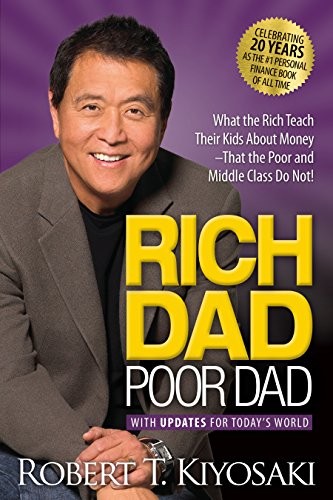
Rich Dad Poor Dad is Robert Kiyosaki's semi-autobiographical argument that the financial education most people receive — from schools, from parents, from conventional wisdom — prepares them for the wrong life. Kiyosaki contrasts two father figures: his biological father (the "poor dad"), a highly educated government employee who worked hard and died broke, and his friend's father (the "rich dad"), a businessman with little formal education who built wealth through ownership and investment. The book has sold over 40 million copies since its publication and launched a publishing empire, though Kiyosaki has attracted sustained criticism over factual accuracy and financial advice that cuts against mainstream financial guidance.
The core framework is the distinction between assets and liabilities, defined in Kiyosaki's non-standard way: assets put money in your pocket, and liabilities take money out. Under this definition, a primary residence is a liability (it requires ongoing expenses and doesn't generate income), not an asset as accountants would classify it. The wealthy buy assets — businesses, real estate, stocks — that generate income without requiring their time. The poor and middle class buy liabilities — cars, large homes, gadgets — and call them assets.
Kiyosaki's prescription centers on financial literacy and the "cash flow quadrant" framework he develops more fully in subsequent books: employees and self-employed people trade time for money; business owners and investors generate cash flow from systems and capital. The wealthy operate in the business owner and investor quadrants. The path to the right side of the quadrant involves reducing fear of failure, learning tax law, understanding investing, and building businesses rather than climbing corporate ladders.
The book reads as inspiration more than instruction — Kiyosaki's advice is deliberately vague on specific implementation, and critics note that his actual financial history is disputed. The real estate investing he advocates requires significant capital, expertise, and tolerance for risk that the book treats too lightly. Still, as a mindset-level introduction to the difference between earned income and passive income, and to the habit of thinking about assets and cash flow rather than salary, it has introduced millions of readers to concepts they encountered nowhere else.
The big ideas
- 1.
The wealthy acquire assets; the middle class acquire liabilities they mistake for assets. Knowing the difference between the two is the foundation of financial literacy.
- 2.
Your house is not necessarily an asset. If it costs more than it generates each month, by Kiyosaki's definition it is a liability — regardless of what accounting convention says.
- 3.
Most people work for money. The goal is to have money work for you — through investments, businesses, and passive income streams that don't require your direct time.
