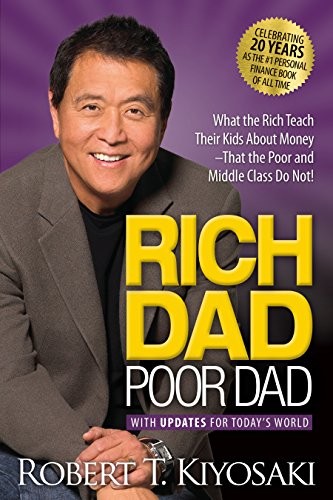
Rich Dad Poor Dad by Robert T. Kiyosaki is a 1997 self-help book about financial education, assets vs. liabilities, entrepreneurship. The wealthy acquire assets; the middle class acquire liabilities they mistake for assets. Knowing the difference between the two is the foundation of financial literacy.
Summary
Rich Dad Poor Dad is Robert Kiyosaki's semi-autobiographical argument that the financial education most people receive — from schools, from parents, from conventional wisdom — prepares them for the wrong life. Kiyosaki contrasts two father figures: his biological father (the "poor dad"), a highly educated government employee who worked hard and died broke, and his friend's father (the "rich dad"), a businessman with little formal education who built wealth through ownership and investment. The book has sold over 40 million copies since its publication and launched a publishing empire, though Kiyosaki has attracted sustained criticism over factual accuracy and financial advice that cuts against mainstream financial guidance.
The core framework is the distinction between assets and liabilities, defined in Kiyosaki's non-standard way: assets put money in your pocket, and liabilities take money out. Under this definition, a primary residence is a liability (it requires ongoing expenses and doesn't generate income), not an asset as accountants would classify it. The wealthy buy assets — businesses, real estate, stocks — that generate income without requiring their time. The poor and middle class buy liabilities — cars, large homes, gadgets — and call them assets.
Kiyosaki's prescription centers on financial literacy and the "cash flow quadrant" framework he develops more fully in subsequent books: employees and self-employed people trade time for money; business owners and investors generate cash flow from systems and capital. The wealthy operate in the business owner and investor quadrants. The path to the right side of the quadrant involves reducing fear of failure, learning tax law, understanding investing, and building businesses rather than climbing corporate ladders.
The book reads as inspiration more than instruction — Kiyosaki's advice is deliberately vague on specific implementation, and critics note that his actual financial history is disputed. The real estate investing he advocates requires significant capital, expertise, and tolerance for risk that the book treats too lightly. Still, as a mindset-level introduction to the difference between earned income and passive income, and to the habit of thinking about assets and cash flow rather than salary, it has introduced millions of readers to concepts they encountered nowhere else.
Talk to Rich Dad Poor Dad like its author wrote you back.
Get the ideas that fit your life — not generic summaries.
- Chat with the book
- Audiobook-style main ideas
- Adapts to your life and goals
- Helps you take action
Key takeaways
- 1.
The wealthy acquire assets; the middle class acquire liabilities they mistake for assets. Knowing the difference between the two is the foundation of financial literacy.
- 2.
Your house is not necessarily an asset. If it costs more than it generates each month, by Kiyosaki's definition it is a liability — regardless of what accounting convention says.
- 3.
Most people work for money. The goal is to have money work for you — through investments, businesses, and passive income streams that don't require your direct time.
- 4.
Financial education is not taught in schools. Kiyosaki argues this is deliberate — the system benefits from people who remain employees — and that self-education is therefore essential.
- 5.
Fear of losing money is the primary reason people don't build wealth. The rich treat losses as tuition; the middle class treat losses as catastrophe and therefore avoid the game.
- 6.
Tax advantages accrue to business owners and investors, not employees. Understanding how wealthy people use corporations and real estate to reduce taxes is part of financial literacy.
- 7.
The income statement and balance sheet framework — money in, money out, assets, liabilities — gives a simple lens for evaluating every financial decision.
- 8.
The rich don't work for a paycheck. They build and buy systems that generate income, then use that income to acquire more assets.
Discussion questions
Use these on your own, with a book club, or as chat starters in Superbook. Book club version, ready to copy or print →
- 1.
Kiyosaki defines assets and liabilities in a non-standard way — by cash flow rather than accounting convention. Do you find this framing useful, misleading, or both?
- 2.
Think about your largest financial holding — your home, your retirement account, your car. Does it put money in your pocket or take money out each month?
- 3.
The book argues that employees and the self-employed trade time for money in a fundamentally limited way. Do you agree with that framing of employment? Where does it break down?
- 4.
Kiyosaki is vague on specific implementation throughout. Is that a feature (it forces you to figure out the path for yourself) or a flaw (it leaves readers inspired but without usable guidance)?
- 5.
The book has been criticized for overstating the achievability of its path and for factual inaccuracies in the story. Does that criticism change how you read it, or does the core framework stand independently of the biography?
- 6.
What financial concepts did you first encounter in this book that you had not learned from school, parents, or conventional sources?
- 7.
Kiyosaki argues that fear of losing money keeps people poor. What specific fears about money shape your financial decisions right now?
- 8.
The cash flow quadrant argument suggests that the path to wealth requires moving from employee or self-employed to business owner or investor. Is that transition realistic for most people, or does it describe a narrow path available to relatively few?
- 9.
Have you ever identified an opportunity that required taking financial risk and passed on it because of fear? Looking back, was the fear justified by the actual downside?
- 10.
Rich Dad Poor Dad recommends real estate as a vehicle for wealth building. Given what you know about your local housing market, leverage, and management complexity, does that still seem like the right asset class for most people?
- 11.
The book was first published in 1997. Has the income inequality landscape changed enough since then that its prescriptions need to be updated?
- 12.
What does 'financial education' mean to you now compared to what it meant before you read this book?
Themes
Frequently asked questions
-
Is Rich Dad Poor Dad worth reading?
As a mindset introduction to the difference between assets and passive income versus earned income, yes. As a practical investment guide, no. The book is better understood as a reframe of how to think about money and work than as actionable financial advice. Read it alongside more rigorous books like The Millionaire Next Door or The Intelligent Investor.
-
Is Rich Dad Poor Dad accurate?
The biography is disputed. Critics including journalist John T. Reed have challenged whether the 'rich dad' character is real or composite, and some of Kiyosaki's specific financial advice has been criticized as oversimplified or misleading. The conceptual frameworks are his own and stand or fall on their merits, not on the accuracy of the story.
-
What is the most important concept in Rich Dad Poor Dad?
The asset-liability distinction. Kiyosaki argues that financial literacy starts with understanding that an asset puts money in your pocket and a liability takes money out — and that most people accumulate liabilities while thinking they are accumulating assets. That reframe, whatever its limitations, has changed how millions of people think about their finances.
-
Who should read Rich Dad Poor Dad?
People who grew up without financial education in their homes or schools and are looking for a starting framework. The book is best as a first book on money, not a definitive guide. Readers who want specific, evidence-based guidance should supplement it with books that address actual investment strategy.
-
Does the real estate advice in Rich Dad Poor Dad still apply?
With significant caveats. The book was written during a period of lower interest rates and different real estate market conditions. Leveraged real estate investing as Kiyosaki describes requires capital, expertise, time, and tolerance for illiquidity that many readers underestimate. The conceptual argument for income-producing real estate is sound; the ease of execution is overstated.
Similar books
Rich Dad Poor Dad vs.
Deciding between two books? Rich Dad Poor Dad vs The Richest Man in Babylon or Rich Dad Poor Dad vs The Psychology of Money .
