Talk to Roar like its author wrote you back.
Get the ideas that fit your life — not generic summaries.
- Chat with the book
- Audiobook-style main ideas
- Adapts to your life and goals
- Helps you take action
Roar, in detail
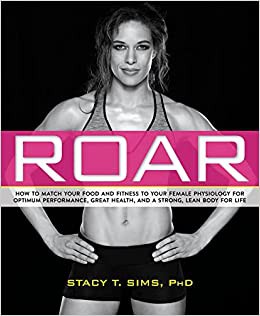
Roar is exercise physiologist Stacy Sims's argument that women are not small men, and that decades of sports science research conducted primarily on male subjects has produced nutrition and training advice that is systematically wrong for women. Sims spent years as a researcher at Stanford and AUT (Auckland University of Technology) studying female physiology and how the menstrual cycle affects performance, recovery, and nutritional needs. The book translates that research into practical guidance for active women at every level.
The core insight is hormonal: estrogen and progesterone fluctuate across the menstrual cycle in ways that profoundly affect fuel utilization, hydration, training adaptation, and recovery. In the follicular phase (the first half of the cycle, dominated by estrogen), women burn more carbohydrate, recover faster, and adapt better to hard training — this is the time for high-intensity work and personal records. In the luteal phase (the second half, dominated by progesterone), the body is more catabolic, burns more protein, retains more heat, and performs less well at high intensity but tolerates moderate endurance work better. Training and nutrition that ignores these phases is essentially fighting the body's biology.
The nutrition section covers hydration (women are more susceptible to hyponatremia from overdrinking), fueling for performance (women need carbohydrates before high-intensity sessions more than men do), protein timing, and the specific micronutrient needs that differ for women, including iron, calcium, and vitamin D. Sims is particularly critical of low-calorie or low-carbohydrate approaches for active women, arguing that underfueling is the primary dietary problem she sees clinically and that the consequences — hormonal disruption, bone loss, performance decline — are underappreciated.
The book also covers pregnancy, perimenopause, and menopause, applying the same hormonal framework to these phases. Sims's approach is evidence-based and practical, and the book fills a genuine gap: despite the growth of women's participation in sport, female physiology-specific sports science has lagged, and popular resources have largely extrapolated from male data. Roar is the most scientifically grounded book of its kind for active women who want guidance calibrated to how their bodies actually work.
The big ideas
- 1.
Women's exercise physiology differs from men's in ways that make much standard sports nutrition and training advice either suboptimal or actively harmful for female athletes.
- 2.
The menstrual cycle creates two distinct physiological phases with different fuel preferences, recovery capacities, and training adaptability — scheduling training and nutrition to match these phases improves results.
- 3.
During the follicular phase (high estrogen), women perform better at high-intensity efforts and recover faster; during the luteal phase (high progesterone), intensity should typically be moderated.
