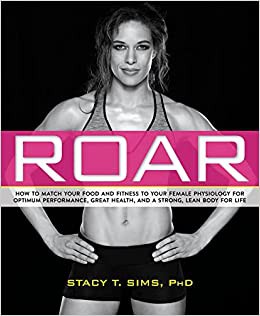
Roar by Stacy Sims is a 2016 health book about women's health, exercise physiology, hormones. Women's exercise physiology differs from men's in ways that make much standard sports nutrition and training advice either suboptimal or actively harmful for female athletes.
Summary
Roar is exercise physiologist Stacy Sims's argument that women are not small men, and that decades of sports science research conducted primarily on male subjects has produced nutrition and training advice that is systematically wrong for women. Sims spent years as a researcher at Stanford and AUT (Auckland University of Technology) studying female physiology and how the menstrual cycle affects performance, recovery, and nutritional needs. The book translates that research into practical guidance for active women at every level.
The core insight is hormonal: estrogen and progesterone fluctuate across the menstrual cycle in ways that profoundly affect fuel utilization, hydration, training adaptation, and recovery. In the follicular phase (the first half of the cycle, dominated by estrogen), women burn more carbohydrate, recover faster, and adapt better to hard training — this is the time for high-intensity work and personal records. In the luteal phase (the second half, dominated by progesterone), the body is more catabolic, burns more protein, retains more heat, and performs less well at high intensity but tolerates moderate endurance work better. Training and nutrition that ignores these phases is essentially fighting the body's biology.
The nutrition section covers hydration (women are more susceptible to hyponatremia from overdrinking), fueling for performance (women need carbohydrates before high-intensity sessions more than men do), protein timing, and the specific micronutrient needs that differ for women, including iron, calcium, and vitamin D. Sims is particularly critical of low-calorie or low-carbohydrate approaches for active women, arguing that underfueling is the primary dietary problem she sees clinically and that the consequences — hormonal disruption, bone loss, performance decline — are underappreciated.
The book also covers pregnancy, perimenopause, and menopause, applying the same hormonal framework to these phases. Sims's approach is evidence-based and practical, and the book fills a genuine gap: despite the growth of women's participation in sport, female physiology-specific sports science has lagged, and popular resources have largely extrapolated from male data. Roar is the most scientifically grounded book of its kind for active women who want guidance calibrated to how their bodies actually work.
Talk to Roar like its author wrote you back.
Get the ideas that fit your life — not generic summaries.
- Chat with the book
- Audiobook-style main ideas
- Adapts to your life and goals
- Helps you take action
Key takeaways
- 1.
Women's exercise physiology differs from men's in ways that make much standard sports nutrition and training advice either suboptimal or actively harmful for female athletes.
- 2.
The menstrual cycle creates two distinct physiological phases with different fuel preferences, recovery capacities, and training adaptability — scheduling training and nutrition to match these phases improves results.
- 3.
During the follicular phase (high estrogen), women perform better at high-intensity efforts and recover faster; during the luteal phase (high progesterone), intensity should typically be moderated.
- 4.
Women are at higher risk of hyponatremia from overdrinking during endurance events; hydration strategy should be based on thirst rather than fixed fluid targets.
- 5.
Underfueling — insufficient total calories and carbohydrate specifically — is the primary nutritional problem Sims observes in active women, with downstream effects on hormones, bone density, and performance.
- 6.
Protein timing immediately after training (within thirty minutes) is more important for women's muscle recovery than for men's, due to the catabolic environment of the luteal phase.
- 7.
Iron deficiency is common in active women due to menstrual losses and is a frequent cause of unexplained fatigue and performance decline that goes undiagnosed.
- 8.
Perimenopause and menopause require adjustments to training and nutrition — higher protein, more resistance training, and modified recovery strategies — because hormonal changes alter the physiological context.
Discussion questions
Use these on your own, with a book club, or as chat starters in Superbook. Book club version, ready to copy or print →
- 1.
Sims argues that most sports science research has been done on men and the results have been applied to women without validation. How should that change how you interpret nutritional and training research?
- 2.
Have you ever tracked your training performance relative to your menstrual cycle? Does the idea of phase-based training feel practical or overly complicated?
- 3.
She argues that underfueling is the primary nutritional problem for active women. Is that consistent with the fitness culture messaging you've encountered, which often emphasizes eating less?
- 4.
The book covers hormonal contraceptives and their effects on training adaptation — some blunt the hormonal cycle that Sims's approach is built around. How do you weigh that trade-off?
- 5.
Sims is critical of low-carbohydrate approaches for active women. How does that square with the low-carb trend in fitness culture, which has had significant female followings?
- 6.
She covers the specific needs of women in perimenopause and menopause — a topic rarely addressed in mainstream fitness books. Does the absence of this material in other resources reflect the fitness industry's age and gender biases?
- 7.
Iron deficiency is common in active women and frequently missed. Have you ever been tested for it? What would it take to make routine micronutrient testing a standard part of athletic care?
- 8.
Roar is written for active women, but much of the hormonal information is relevant to any woman. Does the athletic framing make it more or less accessible to women who don't identify as athletes?
- 9.
Sims argues for phase-based nutrition — eating differently in the first and second halves of your cycle. How practical is that level of dietary customization in real life?
- 10.
The book challenges the direct application of male-centered research to women. What other domains of health or medicine do you think have similar gaps?
- 11.
She covers the physiology of female athletic performance in a way that is both validating and practically demanding. Does reading this make you feel more or less capable as an athlete?
- 12.
What aspect of the book is most relevant to your current training or health situation? What would acting on it actually require?
Themes
Frequently asked questions
-
Is Roar only for competitive athletes?
No. While Sims draws heavily on research with competitive athletes, the principles about hormonal phases, fueling, and recovery apply to any active woman — from recreational exercisers to weekend warriors. The more advanced programming sections are calibrated to competitive sport, but the nutritional and hormonal framework is universally applicable.
-
What is phase-based training in Roar?
The practice of adjusting training intensity and volume to match the two phases of the menstrual cycle. The follicular phase (days 1-14 roughly) supports high-intensity, strength-focused training; the luteal phase (days 14-28) is better suited to moderate-intensity, endurance-based work.
-
Does Roar recommend low-carbohydrate diets for women?
No — emphatically the opposite. Sims argues that active women need adequate carbohydrates, particularly around high-intensity training sessions, and that the low-carbohydrate trend has been particularly harmful for women athletes, producing hormonal disruption, bone loss, and performance decline.
-
How does Roar apply to women using hormonal contraceptives?
Hormonal contraceptives suppress the natural menstrual cycle and flatten the hormonal variation that Sims's phase-based approach is designed around. She covers the evidence on how different contraceptives affect training adaptation — some effects are positive, some negative — and suggests adapting the framework to a stable hormonal environment rather than a cycling one.
-
What is the most important nutritional takeaway from Roar?
That underfueling is the primary dietary problem for active women. Sims argues that most active women eat too little — particularly carbohydrates before high-intensity efforts — and that this underfueling drives hormonal disruption, poor recovery, and performance decline that is often attributed to overtraining or poor genetics.