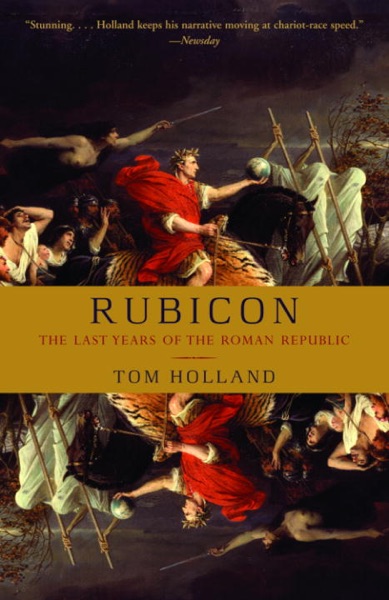
Talk to Rubicon: The Last Years of the Roman Republic like its author wrote you back.
Get the ideas that fit your life — not generic summaries.
- Chat with the book
- Audiobook-style main ideas
- Adapts to your life and goals
- Helps you take action
Rubicon: The Last Years of the Roman Republic, in detail
Rubicon tells the story of the Roman Republic's last century — from the Gracchi in the 130s BCE through the assassination of Julius Caesar in 44 BCE and the civil wars that followed — with the narrative energy of a thriller and the sourcing of serious scholarship. Tom Holland's central question is how the most successful republican government in the ancient world consumed itself from within. The answer involves ambition, debt, the distorting effects of empire on domestic politics, and the consistent willingness of leading men to destroy the institutions they professed to honor.
Holland structures the story around a series of escalating crises. The Gracchi brothers tried to address the land inequality that military expansion had created and were killed for it. Marius revolutionized the army by professionalizing it, which created soldiers loyal to their general rather than the state. Sulla marched on Rome with those soldiers — twice — and established the precedent that violence against republican institutions was recoverable. Caesar simply drew the logical conclusion: if the rules would bend for Sulla, they would bend for anyone with sufficient legions and audacity.
The book is especially good on the texture of late Republican politics: the patronage networks, the electoral corruption, the way the Senate's claim to authority increasingly depended on the cooperation of men it could not control. Cicero emerges as a fascinating tragic figure — brilliant, eloquent, genuinely committed to republican government, and ultimately incapable of making that commitment effective against men willing to do what he was not. Pompey, Crassus, Caesar, and Mark Antony are all rendered vividly without the characters becoming simple.
Holland writes popular history at its best: accessible, well-paced, never condescending about complexity. The book doesn't pretend the Republic's fall was inevitable, but it does show how each failure made the next failure easier. Reading it alongside accounts of other republics in crisis is difficult to avoid.
The big ideas
- 1.
The Roman Republic did not fall suddenly but was hollowed out over a century by repeated violations of its norms — each one making the next more acceptable.
- 2.
Marius's army reforms, which created professional soldiers loyal to their generals rather than the state, were the structural change that made Caesar possible. The Republic's military became its political undoing.
- 3.
Sulla's march on Rome set the decisive precedent: a general could use his legions against the Republic itself and survive politically. The only lesson ambitious successors took was that Sulla hadn't gone far enough.
