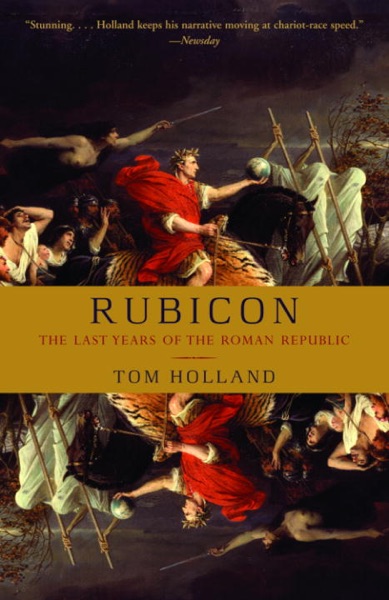
Rubicon: The Last Years of the Roman Republic by Tom Holland is a 2003 history book about republican collapse, political ambition, roman republic. The Roman Republic did not fall suddenly but was hollowed out over a century by repeated violations of its norms — each one making the next more acceptable.
Summary
Rubicon tells the story of the Roman Republic's last century — from the Gracchi in the 130s BCE through the assassination of Julius Caesar in 44 BCE and the civil wars that followed — with the narrative energy of a thriller and the sourcing of serious scholarship. Tom Holland's central question is how the most successful republican government in the ancient world consumed itself from within. The answer involves ambition, debt, the distorting effects of empire on domestic politics, and the consistent willingness of leading men to destroy the institutions they professed to honor.
Holland structures the story around a series of escalating crises. The Gracchi brothers tried to address the land inequality that military expansion had created and were killed for it. Marius revolutionized the army by professionalizing it, which created soldiers loyal to their general rather than the state. Sulla marched on Rome with those soldiers — twice — and established the precedent that violence against republican institutions was recoverable. Caesar simply drew the logical conclusion: if the rules would bend for Sulla, they would bend for anyone with sufficient legions and audacity.
The book is especially good on the texture of late Republican politics: the patronage networks, the electoral corruption, the way the Senate's claim to authority increasingly depended on the cooperation of men it could not control. Cicero emerges as a fascinating tragic figure — brilliant, eloquent, genuinely committed to republican government, and ultimately incapable of making that commitment effective against men willing to do what he was not. Pompey, Crassus, Caesar, and Mark Antony are all rendered vividly without the characters becoming simple.
Holland writes popular history at its best: accessible, well-paced, never condescending about complexity. The book doesn't pretend the Republic's fall was inevitable, but it does show how each failure made the next failure easier. Reading it alongside accounts of other republics in crisis is difficult to avoid.
Talk to Rubicon: The Last Years of the Roman Republic like its author wrote you back.
Get the ideas that fit your life — not generic summaries.
- Chat with the book
- Audiobook-style main ideas
- Adapts to your life and goals
- Helps you take action
Key takeaways
- 1.
The Roman Republic did not fall suddenly but was hollowed out over a century by repeated violations of its norms — each one making the next more acceptable.
- 2.
Marius's army reforms, which created professional soldiers loyal to their generals rather than the state, were the structural change that made Caesar possible. The Republic's military became its political undoing.
- 3.
Sulla's march on Rome set the decisive precedent: a general could use his legions against the Republic itself and survive politically. The only lesson ambitious successors took was that Sulla hadn't gone far enough.
- 4.
Cicero represents the dilemma of republican defenders who believed in institutions but were unwilling — or unable — to match their opponents' ruthlessness. Eloquence and legal argument cannot defeat armies.
- 5.
The Senate's authority depended on consensus among men who stopped sharing one. When leading men decided their personal advancement outweighed the collective interest, no institution was strong enough to compel otherwise.
- 6.
Empire distorted the Republic. The wealth, soldiers, and patronage networks that conquest produced gave individual commanders resources that dwarfed the state's capacity to check them.
- 7.
Caesar's crossing of the Rubicon in 49 BCE was the culmination of decades of precedent-breaking, not an isolated act of personal ambition. The Republic had already effectively ended before the Ides of March.
- 8.
The Republic's collapse raises questions about what makes any republican system durable: rules, norms, shared interests, or the willingness to enforce consequences. Late Rome suggests all four matter and none is sufficient alone.
Discussion questions
Use these on your own, with a book club, or as chat starters in Superbook. Book club version, ready to copy or print →
- 1.
Holland shows that each violation of republican norms made the next one easier. Where do you see similar normalization of norm-breaking in contemporary political systems?
- 2.
The army reforms that created soldiers loyal to their generals rather than the state were driven by practical military needs. How do you weigh short-term effectiveness against long-term institutional risk?
- 3.
Cicero believed deeply in republican institutions but couldn't match his opponents' willingness to use force. Is that kind of principled commitment admirable, delusional, or both?
- 4.
Holland argues the Republic was hollowed out gradually rather than destroyed in a moment. Which moment do you think was actually decisive, and could anything have been done differently?
- 5.
Empire gave Roman commanders resources that dwarfed the state. What are the modern equivalents of that concentration of wealth and power outside democratic control?
- 6.
Caesar is often presented as a genius reformer rather than a destroyer of democracy. Does Holland's account complicate or support that rehabilitation?
- 7.
The Senate kept functioning through decades of violence and unconstitutional acts. Why did an institution that had lost effective authority continue to matter symbolically?
- 8.
What does Rubicon suggest about the durability of republican government? Are there conditions under which republican systems are inherently fragile?
- 9.
Pompey, Crassus, and Caesar formed the First Triumvirate to share power outside the formal system. How does that compare to informal power-sharing arrangements in modern democracies?
- 10.
Holland writes popular history for general readers. Does accessibility require simplifying complexity, or can narrative and scholarship coexist? How does this book balance them?
- 11.
The book ends with Caesar's assassination and the civil wars that followed. What does the aftermath tell us about whether the assassins understood what they were doing?
- 12.
If you were advising a Roman senator in 100 BCE on how to preserve the Republic, what changes would you recommend, and what would be politically possible?
Themes
Frequently asked questions
-
Is Rubicon suitable for readers new to Roman history?
Yes. Holland provides enough background to follow the story without prior knowledge of the Republic. The narrative approach makes the politics and personalities accessible. Readers who already know the period well will find the synthesis and prose rewarding even if the facts are familiar.
-
How does Rubicon compare to other books on Caesar and the Republic?
It covers more ground than books focused narrowly on Caesar (like Adrian Goldsworthy's biography), tracing the structural causes of decline from the Gracchi onwards. It's less academic than Lily Ross Taylor's Party Politics in the Age of Caesar but more analytical than purely popular accounts.
-
What is the main argument of Rubicon?
That the Roman Republic's fall resulted from a century of incremental norm erosion rather than a single decisive cause. Each generation of leading men was willing to go slightly further than the last in subordinating republican institutions to personal ambition, until Caesar simply drew the logical conclusion.
-
Does Rubicon cover Augustus and the Empire?
No. It ends with the chaos following Caesar's assassination in 44 BCE. Tom Holland's follow-up Dynasty covers the Julio-Claudian emperors from Augustus through Nero.
-
Who should read Rubicon?
Anyone interested in Roman history, the dynamics of republican collapse, or narrative history at its most readable. It works well alongside contemporary political analysis for readers who want to think about what makes democratic institutions durable or fragile.
Similar books
Sapiens: A Brief History of Humankind
Yuval Noah Harari
Guns, Germs, and Steel
Jared Diamond

The Decline and Fall of the Roman Empire
Edward Gibbon
The Path to Power
Robert A. Caro
