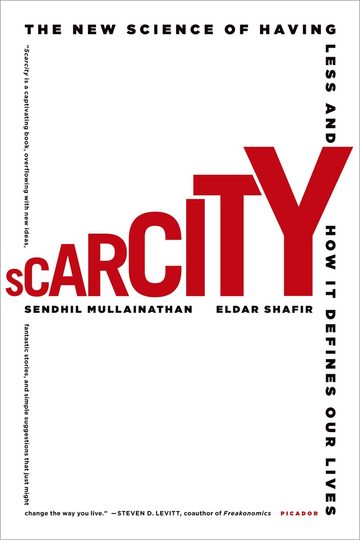
Talk to Scarcity: Why Having Too Little Means So Much like its author wrote you back.
Get the ideas that fit your life — not generic summaries.
- Chat with the book
- Audiobook-style main ideas
- Adapts to your life and goals
- Helps you take action
Scarcity: Why Having Too Little Means So Much, in detail
Scarcity is Sendhil Mullainathan and Eldar Shafir's argument that the experience of having too little — of any resource — produces a predictable cognitive syndrome with consequences that extend far beyond the original deficit. A person short on money thinks about money constantly; a person short on time thinks about deadlines. This focused attention is partly adaptive (scarcity tunnels you toward what matters most) and partly destructive (it crowds out everything else). Mullainathan and Shafir call the cognitive cost of scarcity a tax on mental bandwidth.
The bandwidth concept is the book's most original contribution. Drawing on psychology and behavioral economics experiments, the authors show that poverty, time pressure, and loneliness all reduce cognitive capacity in measurable ways — affecting fluid intelligence test scores, self-control, and decision quality. The Indian sugarcane farmers who were tested before and after their annual harvest scored significantly higher on cognitive tests after receiving their income than before, not because they were different people but because the cognitive load of financial scarcity was removed. The poor are not making poor decisions because they lack intelligence or values; they are making decisions under conditions that would impair anyone's thinking.
The authors are careful to extend this beyond poverty. Busy professionals who are perpetually time-scarce show the same cognitive patterns: tunneling on the urgent, neglecting the important, making decisions that create future problems (the "borrowing" pattern, where solving today's crisis depletes tomorrow's resources). The feeling of being perpetually behind — common in knowledge work, parenting, and caregiving — is itself a form of scarcity with real cognitive effects.
The policy implications Mullainathan and Shafir draw are mostly about designing systems that account for impaired bandwidth rather than assuming people have unlimited cognitive resources. Reminders, defaults, simplified forms, timing of outreach — small design changes that reduce the decision burden on people already operating under scarcity. The book is more cautious about prescription than many behavioral economics books, which is a strength.
The big ideas
- 1.
Scarcity — of money, time, food, or social connection — captures attention and focuses cognition on the scarce resource. This is partly useful (focus) and partly costly (tunnel vision).
- 2.
Scarcity imposes a cognitive bandwidth tax. People experiencing scarcity perform measurably worse on fluid intelligence and self-control tasks than when the same scarcity is removed.
- 3.
The tunneling effect of scarcity means important things outside the tunnel get neglected. Time-scarce people miss medical appointments; money-scarce people miss bill payments — not because they don't care but because they're not in the tunnel.
