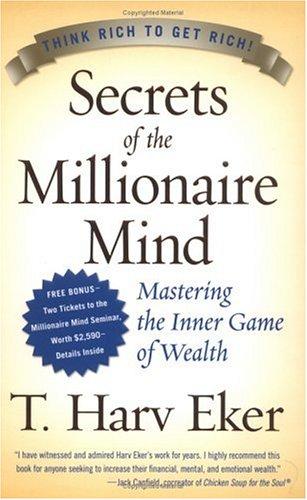
Talk to Secrets of the Millionaire Mind like its author wrote you back.
Get the ideas that fit your life — not generic summaries.
- Chat with the book
- Audiobook-style main ideas
- Adapts to your life and goals
- Helps you take action
Secrets of the Millionaire Mind, in detail
Secrets of the Millionaire Mind is T. Harv Eker's argument that most people are financially stuck because of a "money blueprint" — a set of beliefs and emotional associations about money formed in childhood — that operates automatically and overrides conscious financial decisions. The central claim is that your results with money are an expression of your inner programming, not your knowledge, effort, or circumstance, and that changing the programming is the prerequisite for changing the results.
Eker structures the book around seventeen wealth files: specific beliefs and attitudes he contrasts between wealthy and poor or middle-class thinkers. Rich people believe they create their own circumstances; poor people believe circumstances happen to them. Rich people think big; others play small to avoid criticism. Rich people are committed to being rich; others only wish for it. Each wealth file is presented as a direct restatement of thinking patterns that Eker argues can be consciously changed.
The book's first section describes the money blueprint concept in more detail and invites readers to identify their own programming through exercises. The second section covers the seventeen wealth files in quick succession, each with a short contrast, a declaration, and a call to action. The format is breezy rather than analytical, and the book reads more like a motivational seminar transcript than a researched argument.
Honest engagement requires noting the book's limitations. The wealth files are stated as universal contrasts between rich and poor thinking, but many of the generalizations are unsupported by evidence and occasionally flip into oversimplification. Eker's personal story of going from near-bankruptcy to millionaire in two and a half years is the anchor of his credibility, and readers are largely asked to take it as proof of concept. The framework is most useful as a prompt for introspection about one's own financial beliefs rather than as a reliable model of how wealth is created.
The big ideas
- 1.
Your money blueprint — the beliefs and emotional associations around money you formed growing up — controls your financial behavior more than your knowledge or effort.
- 2.
The way you think about money is largely inherited from the adults around you in childhood. Recognizing those patterns is the first step to changing them.
- 3.
Rich people believe they create their financial circumstances; people who stay financially stuck tend to believe that external forces determine their outcomes.
