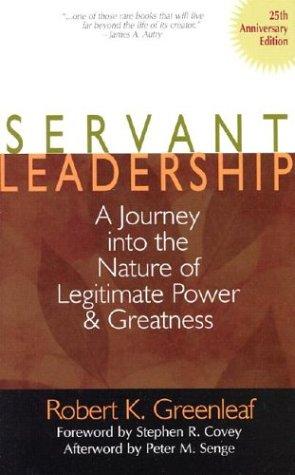
Talk to Servant Leadership like its author wrote you back.
Get the ideas that fit your life — not generic summaries.
- Chat with the book
- Audiobook-style main ideas
- Adapts to your life and goals
- Helps you take action
What it argues
Servant Leadership is Robert Greenleaf's foundational essay collection arguing that the best leaders start not with the desire to lead but with the desire to serve — and that this reversal of priority produces qualitatively different leadership. Greenleaf, who spent decades as an executive at AT&T and later as a management consultant, developed the servant leadership concept in a 1970 essay, and this book collects that essay along with subsequent writings on the idea.
The servant leader, Greenleaf argues, is distinguished by a fundamental question: "Do those served grow as persons? Do they, while being served, become healthier, wiser, freer, more autonomous, more likely themselves to become servants?" This question separates genuine servant leadership from its imitations. Leaders who serve in order to accumulate influence, or who serve their team while failing the broader institution, or who serve individuals in ways that weaken collective capacity — these are not servant leaders.
What it gets right
- 1.
The servant leader serves first, leads second. The test is whether those being served grow as people — become more capable, more autonomous, more likely to serve others in turn.
- 2.
Servant leadership is not about being nice or accommodating. It requires holding people to high standards while remaining fundamentally oriented toward their growth rather than their utility.
- 3.
Institutions are servants, not masters. Greenleaf argues that every institution — church, business, university, government — derives its legitimacy from the quality of service it renders to society.
What it covers
Who wrote it
Robert K. Greenleaf (1904–1990) spent thirty-eight years at AT&T, retiring in 1964 as Director of Management Research. He then pursued a second career as a consultant and writer, founding the Center for Applied Ethics (now the Greenleaf Center for Servant Leadership) in 1964. His 1970 essay "The Servant as Leader" introduced the servant leadership concept and influenced a generation of management thinkers. Servant Leadership, published in 1977, collected his major essays on the theme. His work influenced many later writers including Max DePree, Ken Blanchard, and Larry Spears.
