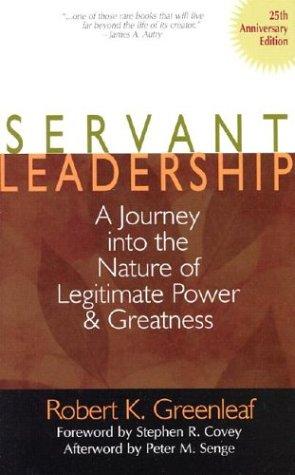
Servant Leadership by Robert K. Greenleaf is a 1977 business book about servant leadership, leadership philosophy, institutions. The servant leader serves first, leads second. The test is whether those being served grow as people — become more capable, more autonomous, more likely to serve others in turn.
Summary
Servant Leadership is Robert Greenleaf's foundational essay collection arguing that the best leaders start not with the desire to lead but with the desire to serve — and that this reversal of priority produces qualitatively different leadership. Greenleaf, who spent decades as an executive at AT&T and later as a management consultant, developed the servant leadership concept in a 1970 essay, and this book collects that essay along with subsequent writings on the idea.
The servant leader, Greenleaf argues, is distinguished by a fundamental question: "Do those served grow as persons? Do they, while being served, become healthier, wiser, freer, more autonomous, more likely themselves to become servants?" This question separates genuine servant leadership from its imitations. Leaders who serve in order to accumulate influence, or who serve their team while failing the broader institution, or who serve individuals in ways that weaken collective capacity — these are not servant leaders.
Greenleaf's framework is deliberately philosophical rather than practical. He writes about institutional failure, the loneliness of leadership, the responsibility of trustees, and the moral demands of organizational power. The book is most useful as a foundation for thinking about what leadership is for, not as a guide to what leaders should do on Tuesday. It raises questions that purely technique-oriented management books don't ask: What kind of society do our organizations produce? Who is served by the institution, and at whose expense?
The book has been enormously influential in both religious and secular organizational contexts, and the servant leadership concept has been widely adopted — sometimes in ways that retain the language without the substance. Greenleaf's original essays are more demanding than the popularized versions suggest.
Talk to Servant Leadership like its author wrote you back.
Get the ideas that fit your life — not generic summaries.
- Chat with the book
- Audiobook-style main ideas
- Adapts to your life and goals
- Helps you take action
Key takeaways
- 1.
The servant leader serves first, leads second. The test is whether those being served grow as people — become more capable, more autonomous, more likely to serve others in turn.
- 2.
Servant leadership is not about being nice or accommodating. It requires holding people to high standards while remaining fundamentally oriented toward their growth rather than their utility.
- 3.
Institutions are servants, not masters. Greenleaf argues that every institution — church, business, university, government — derives its legitimacy from the quality of service it renders to society.
- 4.
The best test of servant leadership is not the leader's intentions but the leader's impact: are the people and the institution stronger for having been served?
- 5.
Trustees bear a unique responsibility: to hold the institution to its purpose while protecting it from those who would use it for narrow ends. This requires independence of judgment that boards often lack.
- 6.
Leadership is lonely precisely because it requires holding a vision and a set of values under pressure to compromise both. The servant leader accepts that loneliness as part of the role.
- 7.
Coercive power is a failure of leadership. Institutions that must coerce have lost the trust that makes genuine service possible — and that trust is hard to rebuild.
- 8.
The servant leader is concerned with the health of society, not just the success of their organization. This is the broadest version of the servant leadership idea, and the most demanding.
Discussion questions
Use these on your own, with a book club, or as chat starters in Superbook. Book club version, ready to copy or print →
- 1.
Greenleaf's test of servant leadership is whether those being served grow as persons. Apply this to your own leadership: are the people you lead growing in capability and autonomy because of your leadership?
- 2.
How does servant leadership differ from being accommodating or avoiding hard decisions? What does it require that those things don't?
- 3.
Greenleaf wrote this in the context of the 1960s and 70s institutional crisis. What's the equivalent institutional crisis today, and does his framework still apply?
- 4.
He argues that every institution derives its legitimacy from the service it renders. What's the service your organization renders, and is it actually delivered to the people it claims to serve?
- 5.
What's the difference between serving your team and serving your organization? Can you do both? When do they conflict?
- 6.
Greenleaf says leadership is lonely in a specific way — the way of holding values under pressure. When have you felt that loneliness? What did you do with it?
- 7.
The popularized version of servant leadership emphasizes humility and care. Greenleaf's original is more demanding. What does the original ask that the popular version avoids?
- 8.
Greenleaf writes about trustees as the ultimate holders of institutional purpose. What does good trusteeship look like in an organization you're part of? Is anyone actually doing it?
- 9.
What's the difference between a leader who serves their team and a leader who is controlled by their team? Where is that line in practice?
- 10.
If you applied the servant leadership framework to your organization's relationship with its customers or the society it operates in, what would change?
- 11.
Greenleaf's ideas have been widely adopted in religious organizations and in some corporate settings. Does the concept mean something different in those two contexts?
Themes
Frequently asked questions
-
Is Servant Leadership still worth reading?
Yes, as a philosophical foundation. Greenleaf writes with more depth and moral seriousness than most management books, and his questions about what leadership is for — rather than just how to do it — remain important. It's a harder read than contemporary management books, which is appropriate given what it's asking.
-
How long does it take to read Servant Leadership?
Around four to five hours for the 335-page book. The essays vary in density; the foundational servant leader essay is the most concentrated and most worth reading slowly.
-
Is 'servant leadership' as it's taught today the same as what Greenleaf meant?
Not exactly. Greenleaf's original concept is more demanding and more institutional than the popularized version. The question of whether those served grow as autonomous, service-oriented people is more rigorous than 'does the leader put the team first.' The popular version is a useful starting point; Greenleaf's original is a more serious ask.
-
Who should read Servant Leadership?
Leaders who want a philosophical framework for thinking about what leadership is for, people in trustee or board roles thinking about institutional responsibility, and anyone frustrated by management books that are long on technique and short on purpose.
-
What's the most important idea in Servant Leadership?
The test: do those being served grow as persons? This question cuts through the technique and the sincerity and asks about actual impact on the people you're supposed to be serving. Applied honestly, it's more challenging than it looks.