Talk to Seven Brief Lessons on Physics like its author wrote you back.
Get the ideas that fit your life — not generic summaries.
- Chat with the book
- Audiobook-style main ideas
- Adapts to your life and goals
- Helps you take action
Seven Brief Lessons on Physics, in detail
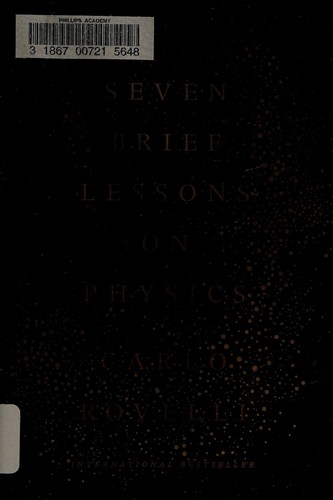
Carlo Rovelli, a theoretical physicist best known for his work on loop quantum gravity, wrote this book originally as a series of essays for an Italian Sunday newspaper. It became an international bestseller, largely because Rovelli writes about physics with a literary sensibility that is unusual in popular science. The book is not a comprehensive introduction to modern physics. It is something more like a love letter to it: seven short meditations on seven ideas that together define the current state of understanding about the universe.
The first lesson covers Einstein's general theory of relativity, which Rovelli calls the most beautiful theory in all of science. Space is not a rigid container but a dynamic field that curves in response to mass. Time passes faster away from massive objects and slower near them. Gravity is not a force but the shape of spacetime. Rovelli conveys why physicists find this beautiful, not just correct.
Subsequent lessons cover quantum mechanics and its paradoxes, the architecture of the cosmos, the elementary particles and forces of the standard model, black holes and thermodynamics, and the probability of our existence. The final essay is more philosophical: Rovelli reflects on what it means for humans — beings made of quantum fields, inhabiting curved spacetime, existing briefly in a universe trending toward entropy — to be curious at all.
The book is brief. Most readers finish it in a single sitting. But Rovelli writes with density rather than padding, and each lesson carries more weight than its length suggests. He doesn't resolve the tensions between quantum mechanics and general relativity; he presents them honestly as the central open problem in physics. His voice is personal, occasionally lyrical, and consistently substantive. Whether or not readers absorb every idea, they are likely to finish the book with a genuine sense of why physicists find their subject worth spending a life on.
The big ideas
- 1.
General relativity describes gravity not as a force but as the curvature of spacetime caused by mass. Einstein derived it almost entirely from the requirement of mathematical beauty.
- 2.
Quantum mechanics describes a world that is fundamentally granular, probabilistic, and entangled. It is the most precisely confirmed theory in science.
- 3.
The two great theories of modern physics — general relativity and quantum mechanics — are mathematically incompatible. Reconciling them is the central unsolved problem in physics.
