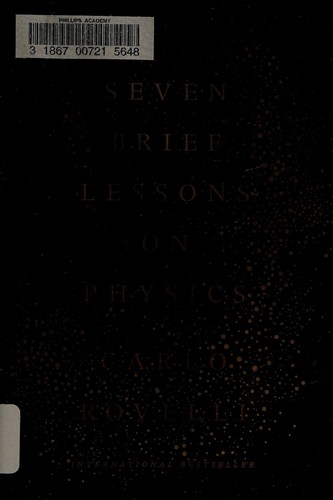
Seven Brief Lessons on Physics by Carlo Rovelli is a 2014 science book about physics, general relativity, quantum mechanics. General relativity describes gravity not as a force but as the curvature of spacetime caused by mass. Einstein derived it almost entirely from the requirement of mathematical beauty.
Summary
Carlo Rovelli, a theoretical physicist best known for his work on loop quantum gravity, wrote this book originally as a series of essays for an Italian Sunday newspaper. It became an international bestseller, largely because Rovelli writes about physics with a literary sensibility that is unusual in popular science. The book is not a comprehensive introduction to modern physics. It is something more like a love letter to it: seven short meditations on seven ideas that together define the current state of understanding about the universe.
The first lesson covers Einstein's general theory of relativity, which Rovelli calls the most beautiful theory in all of science. Space is not a rigid container but a dynamic field that curves in response to mass. Time passes faster away from massive objects and slower near them. Gravity is not a force but the shape of spacetime. Rovelli conveys why physicists find this beautiful, not just correct.
Subsequent lessons cover quantum mechanics and its paradoxes, the architecture of the cosmos, the elementary particles and forces of the standard model, black holes and thermodynamics, and the probability of our existence. The final essay is more philosophical: Rovelli reflects on what it means for humans — beings made of quantum fields, inhabiting curved spacetime, existing briefly in a universe trending toward entropy — to be curious at all.
The book is brief. Most readers finish it in a single sitting. But Rovelli writes with density rather than padding, and each lesson carries more weight than its length suggests. He doesn't resolve the tensions between quantum mechanics and general relativity; he presents them honestly as the central open problem in physics. His voice is personal, occasionally lyrical, and consistently substantive. Whether or not readers absorb every idea, they are likely to finish the book with a genuine sense of why physicists find their subject worth spending a life on.
Talk to Seven Brief Lessons on Physics like its author wrote you back.
Get the ideas that fit your life — not generic summaries.
- Chat with the book
- Audiobook-style main ideas
- Adapts to your life and goals
- Helps you take action
Key takeaways
- 1.
General relativity describes gravity not as a force but as the curvature of spacetime caused by mass. Einstein derived it almost entirely from the requirement of mathematical beauty.
- 2.
Quantum mechanics describes a world that is fundamentally granular, probabilistic, and entangled. It is the most precisely confirmed theory in science.
- 3.
The two great theories of modern physics — general relativity and quantum mechanics — are mathematically incompatible. Reconciling them is the central unsolved problem in physics.
- 4.
The standard model of particle physics describes all known matter and forces except gravity using a small set of quantum fields and symmetries.
- 5.
Black holes are regions of spacetime curved so strongly that not even light can escape. At their centers, the laws of physics as currently understood break down.
- 6.
Entropy and the second law of thermodynamics determine the direction of time. The arrow of time is a statistical consequence of the universe's low-entropy starting conditions.
- 7.
Human beings are made of the same quantum fields and particles as everything else. The question of consciousness and free will has not been resolved by physics but cannot be separated from it.
Discussion questions
Use these on your own, with a book club, or as chat starters in Superbook. Book club version, ready to copy or print →
- 1.
Rovelli calls general relativity the most beautiful theory in science. What makes a scientific theory beautiful, and does beauty matter for truth?
- 2.
Rovelli writes for a general newspaper audience. Does that origin show in the book, and is it a strength or a limitation?
- 3.
The book is explicit about what physics does not yet know — the unification of general relativity and quantum mechanics being the main gap. Does emphasizing the open questions make physics feel more exciting or more uncertain?
- 4.
Rovelli's final essay turns philosophical: he reflects on human curiosity in a universe indifferent to us. Did you find that turn satisfying or out of place in a physics book?
- 5.
The standard model describes almost all known physics but doesn't include gravity and doesn't explain dark matter. How do you feel about the idea that our best theory is still fundamentally incomplete?
- 6.
Rovelli suggests that time's direction is a statistical consequence of low initial entropy, not a fundamental feature of physical law. What are the implications of that for how we think about the past and future?
- 7.
The book is very short for its subject matter. Did Rovelli cover enough for you to understand the ideas, or did the brevity frustrate?
- 8.
Rovelli uses the word 'beautiful' repeatedly about physical theories. Is beauty a meaningful criterion in science, or does it risk leading physicists in the wrong direction?
- 9.
Black holes are predicted by the equations but their centers are where the equations break down. What does it mean for a theory to predict something it can't actually describe?
- 10.
Rovelli is Italian and writes with a continental philosophical sensibility. Does that make the book feel different from Anglo-American popular science?
- 11.
If you could spend an hour asking a physicist one question about the universe, what would it be, and did this book suggest that question or a different one?
Themes
Frequently asked questions
-
Is Seven Brief Lessons on Physics worth reading for a non-scientist?
Yes, particularly because it is very short and written with unusual literary care. Rovelli doesn't talk down to the reader or oversimplify. The book will leave some ideas only partially explained, but it offers a genuine sense of why modern physics is both strange and beautiful, which many longer introductions fail to convey.
-
How long does it take to read?
Between one and two hours, depending on how carefully you read. Most readers can finish it in a single sitting. It works well on a long flight or a quiet afternoon.
-
What is the book about, exactly?
Seven short essays on the major theories of modern physics: general relativity, quantum mechanics, the cosmos, the standard model of particles, black holes, the probability of our existence, and a closing reflection on what it means to be a curious creature in a physical universe.
-
How does this book compare to Rovelli's other books?
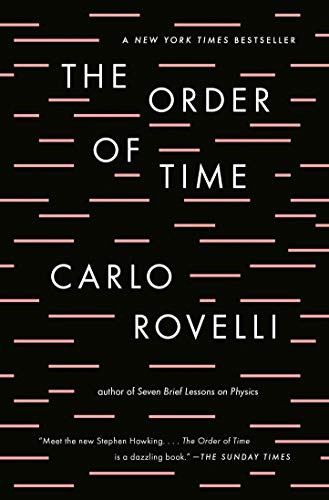
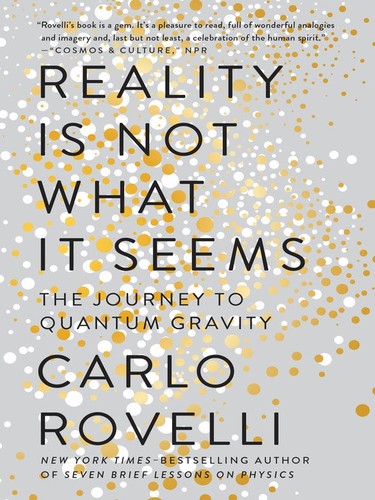
It is shorter and more introductory than The Order of Time or Reality Is Not What It Seems. Those books go deeper into specific topics — time and loop quantum gravity respectively. Seven Brief Lessons is the right starting point for readers new to Rovelli or to physics generally.
-
Who should read this book?
Anyone curious about physics who wants something short enough to actually finish and well-written enough to want to. It is especially good for readers who have always intended to learn about relativity and quantum mechanics but have been put off by longer or more technical introductions.