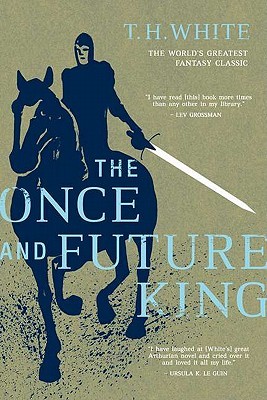
Talk to The Once and Future King like its author wrote you back.
Get the ideas that fit your life — not generic summaries.
- Chat with the book
- Audiobook-style main ideas
- Adapts to your life and goals
- Helps you take action
The Once and Future King, in detail
T.H. White's The Once and Future King is the definitive retelling of the Arthurian legend in the twentieth century, and it is a much stranger, sadder, and more ambitious book than its reputation as a children's classic suggests. White began the project in the late 1930s with The Sword in the Stone — a comic, tender account of the young Arthur's education by Merlin, who teaches him about the nature of war and civilization by turning him into various animals — and ended with a last section, The Book of Merlyn, written during the Second World War and so soaked in despair that his publisher initially refused to include it.
The four volumes trace the entire arc of Arthur's story: from the educated, hopeful boy who pulls the sword from the stone and tries to build a civilization on justice rather than force, through the creation of the Round Table and Camelot's high noon, into the long collapse driven by Guinevere's affair with Lancelot and the machinations of Mordred. White is always writing about the Europe he watched destroying itself in the 1930s and 1940s. Arthur's project — can you found a civilization that uses organized force to prevent the chaos of might-makes-right? — is the central political question of the twentieth century dressed in chain mail.
What makes the book endure is the characters. White's Lancelot is one of the finest portraits in English literature of a man who knows his own worst qualities and cannot stop himself from acting on them. His Guinevere is sharper and more self-aware than she is in most versions. And Arthur is a man who gets the education Merlin intended for him and still cannot prevent the catastrophe, because the catastrophe isn't a failure of intelligence but a failure of the human heart, which refuses to be reasoned into better behavior.
The book is uneven. The first volume is playful and accessible; the later sections are darker, more discursive, and occasionally given to White's own extended editorializing. Readers who come expecting the Disney film will be disoriented by the time the final act arrives. But for readers who want the full account — the comedy, the chivalry, and the wreckage — this is one of the places to start.
The big ideas
- 1.
Arthur's Round Table is a genuine philosophical project — an attempt to use force to prevent force — and the novel's tragedy is that the project fails not because it was wrong but because people are what they are.
- 2.
White's Lancelot is the most psychologically complete character in the book: a man who knows he is capable of both sainthood and ruin and who chooses both, in sequence, without being able to stop himself.
- 3.
The Merlin-as-educator sections are not whimsical escapism but the book's actual argument about what education is for — understanding the world from positions other than your own, which is ultimately what Arthur fails to make his people do.
