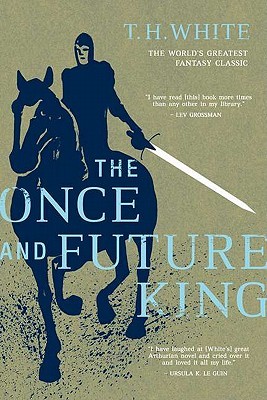
The Once and Future King by T.H. White is a 1958 classics book about the failure of idealism, war and civilization, education and its limits. Arthur's Round Table is a genuine philosophical project — an attempt to use force to prevent force — and the novel's tragedy is that the project fails not because it was wrong but because people are what they are.
Summary
T.H. White's The Once and Future King is the definitive retelling of the Arthurian legend in the twentieth century, and it is a much stranger, sadder, and more ambitious book than its reputation as a children's classic suggests. White began the project in the late 1930s with The Sword in the Stone — a comic, tender account of the young Arthur's education by Merlin, who teaches him about the nature of war and civilization by turning him into various animals — and ended with a last section, The Book of Merlyn, written during the Second World War and so soaked in despair that his publisher initially refused to include it.
The four volumes trace the entire arc of Arthur's story: from the educated, hopeful boy who pulls the sword from the stone and tries to build a civilization on justice rather than force, through the creation of the Round Table and Camelot's high noon, into the long collapse driven by Guinevere's affair with Lancelot and the machinations of Mordred. White is always writing about the Europe he watched destroying itself in the 1930s and 1940s. Arthur's project — can you found a civilization that uses organized force to prevent the chaos of might-makes-right? — is the central political question of the twentieth century dressed in chain mail.
What makes the book endure is the characters. White's Lancelot is one of the finest portraits in English literature of a man who knows his own worst qualities and cannot stop himself from acting on them. His Guinevere is sharper and more self-aware than she is in most versions. And Arthur is a man who gets the education Merlin intended for him and still cannot prevent the catastrophe, because the catastrophe isn't a failure of intelligence but a failure of the human heart, which refuses to be reasoned into better behavior.
The book is uneven. The first volume is playful and accessible; the later sections are darker, more discursive, and occasionally given to White's own extended editorializing. Readers who come expecting the Disney film will be disoriented by the time the final act arrives. But for readers who want the full account — the comedy, the chivalry, and the wreckage — this is one of the places to start.
Talk to The Once and Future King like its author wrote you back.
Get the ideas that fit your life — not generic summaries.
- Chat with the book
- Audiobook-style main ideas
- Adapts to your life and goals
- Helps you take action
Key takeaways
- 1.
Arthur's Round Table is a genuine philosophical project — an attempt to use force to prevent force — and the novel's tragedy is that the project fails not because it was wrong but because people are what they are.
- 2.
White's Lancelot is the most psychologically complete character in the book: a man who knows he is capable of both sainthood and ruin and who chooses both, in sequence, without being able to stop himself.
- 3.
The Merlin-as-educator sections are not whimsical escapism but the book's actual argument about what education is for — understanding the world from positions other than your own, which is ultimately what Arthur fails to make his people do.
- 4.
White wrote the final sections during World War II, and the despair is not literary decoration; the book is a sustained meditation on whether civilization can be built on rational principles given what humans are.
- 5.
Guinevere's culpability in the fall of Camelot is treated with unusual honesty — not as villainy but as the ordinary human incapacity to subordinate personal longing to institutional necessity.
- 6.
The Might versus Right question that drives Arthur's project is presented without resolution; the book doesn't believe the problem has a solution, only that it is worth your whole life trying to solve it.
- 7.
White's interpolated authorial commentary, which becomes more prominent in later sections, is both the book's most personal element and its most uneven quality; it works when it illuminates, and doesn't when it lectures.
- 8.
The legend of the once and future king — Arthur as the sleeping savior who will return — is treated at the end not as mythology but as a human need, the refusal to accept that good projects end in failure.
Discussion questions
Use these on your own, with a book club, or as chat starters in Superbook.
- 1.
Merlin turns Arthur into animals to teach him about different forms of society and power. Is that pedagogy — learning by becoming something else — presented as effective? Does it work on Arthur?
- 2.
Arthur's central project is using organized force to prevent casual violence. White is writing in the shadow of two world wars. Does the project feel naive, tragic, or something more complicated?
- 3.
Lancelot is described as naturally ugly and seeking holiness as a compensation. Is that psychological portrait convincing, and does it make him more or less sympathetic?
- 4.
The affair between Lancelot and Guinevere destroys Camelot. Does White assign blame, or does the novel treat the destruction as a structural inevitability rather than a moral failure?
- 5.
The first volume (The Sword in the Stone) is famously comic and accessible; the later volumes are darker and more discursive. Is that tonal shift a weakness or a deliberate argument?
- 6.
Mordred is given a backstory that explains, if not excuses, his motivations. Does White want you to sympathize with him, or is he an instrument of fate?
- 7.
How does White's Arthurian compare to other versions you know — Tennyson's Idylls, Malory's Morte d'Arthur, the musical Camelot? What does he keep, what does he change, and why?
- 8.
White's interpolated commentary becomes more frequent and more desperate in the final sections. Does it damage the novel's coherence, or is the author's voice part of the work's meaning?
- 9.
Arthur is given the best education imaginable and still cannot prevent the catastrophe. What is White saying about the limits of education and rational intelligence?
- 10.
The book ends with Arthur on the eve of the final battle, contemplating his legacy. Is that ending earned, and does the novel convince you that Camelot mattered?
- 11.
The 'once and future king' framing — Arthur will return in England's hour of need — is given at the very end. Is it consolation, irony, or both?
- 12.
Which character do you think White identified with most, and what in the text makes you think that?
Themes
Frequently asked questions
-
Is The Once and Future King a children's book?
The first section, The Sword in the Stone, is often read to children and has a comic, accessible tone. The book as a whole is not for children — the later sections deal with sexual betrayal, political tragedy, and White's bleak view of human nature. The Disney film, based on only the first section, is much gentler than the book.
-
Do I need to know the Arthurian legend to read it?
No. White fills in enough background that the story is coherent without prior knowledge. Familiarity with the broad outlines — Round Table, Lancelot, Guinevere, Mordred — adds resonance but isn't required.
-
Is it hard to read?
The first two sections are accessible. The later sections become denser and more discursive, with lengthy authorial digressions. The Book of Merlyn, written during World War II, is the most demanding and was initially excluded from the omnibus edition.
-
Who shouldn't read it?
Readers who want action-driven narrative and consistent pacing. Large sections of the novel are philosophical dialogues or authorial reflection, and the tonal shift from the comic first volume to the tragic later sections can be disorienting.
-
Is there a film or TV adaptation?
Camelot (1967) is a film adaptation of the stage musical, which was itself adapted from the novel. It covers primarily the third book. The Sword in the Stone (1963) is Disney's animated film based loosely on the first book.