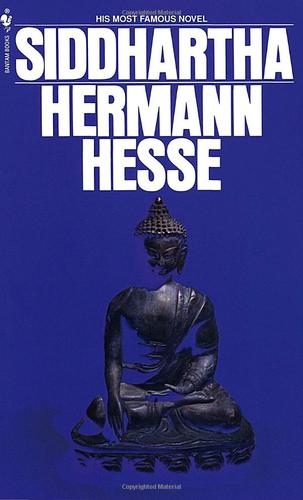
Talk to Siddhartha like its author wrote you back.
Get the ideas that fit your life — not generic summaries.
- Chat with the book
- Audiobook-style main ideas
- Adapts to your life and goals
- Helps you take action
What it argues
Siddhartha is Hermann Hesse's 1922 novel of spiritual seeking, written at a time when Hesse was deeply studying Buddhist and Hindu texts. The protagonist, Siddhartha, is a Brahmin's son in ancient India whose spiritual restlessness drives him first into asceticism with the Samanas, then toward the historical Buddha, then into the sensory world of wealth, pleasure, and love, and finally to enlightenment beside a river under the guidance of a ferryman named Vasudeva. The novel is not a biography of the historical Buddha but a parallel life, drawing on the same cultural world to tell a different kind of spiritual story.
The novel's central argument — if a beautifully written novella can be said to argue — is that the path to enlightenment cannot be taught or transmitted, only walked. Siddhartha listens to the Buddha's teaching, recognizes its truth and beauty, and still departs, because he knows that Gotama's enlightenment was achieved not through doctrine but through direct experience, and that direct experience cannot be handed over. This is not a rejection of the Buddha but an act of deep respect — an insistence on the same autonomy that the Buddha himself exercised.
What it gets right
- 1.
Enlightenment cannot be taught or transmitted — it can only be pointed at; each person must walk the path themselves, acquiring direct experience that no doctrine can substitute for.
- 2.
Every stage of the journey, including the years of worldly desire, suffering, and moral failure, is a necessary part of the education of the soul.
- 3.
The river teaches everything: it holds all times simultaneously, flowing without judgment, never the same and always the same.
What it covers
Who wrote it
Hermann Hesse (1877–1962) was a German-Swiss novelist and poet who won the Nobel Prize in Literature in 1946. Born into a missionary family with deep roots in Indian religious culture, he underwent a spiritual crisis in mid-life and traveled to India in 1911. Siddhartha (1922), Steppenwolf (1927), Narcissus and Goldmund (1930), and The Glass Bead Game (1943) are his most celebrated novels. He became a counterculture icon in the 1960s and 1970s, when Siddhartha and Steppenwolf were widely read by a generation searching for alternatives to Western materialism.
