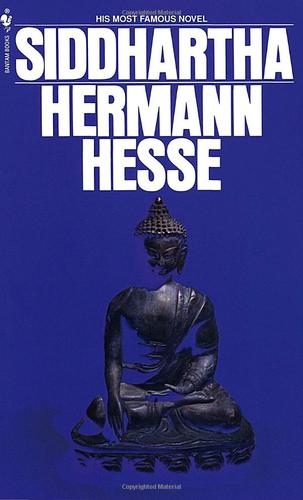
Siddhartha by Hermann Hesse is a 1922 religion & spirituality book about enlightenment, self-discovery, the river. Enlightenment cannot be taught or transmitted — it can only be pointed at; each person must walk the path themselves, acquiring direct experience that no doctrine can substitute for.
Summary
Siddhartha is Hermann Hesse's 1922 novel of spiritual seeking, written at a time when Hesse was deeply studying Buddhist and Hindu texts. The protagonist, Siddhartha, is a Brahmin's son in ancient India whose spiritual restlessness drives him first into asceticism with the Samanas, then toward the historical Buddha, then into the sensory world of wealth, pleasure, and love, and finally to enlightenment beside a river under the guidance of a ferryman named Vasudeva. The novel is not a biography of the historical Buddha but a parallel life, drawing on the same cultural world to tell a different kind of spiritual story.
The novel's central argument — if a beautifully written novella can be said to argue — is that the path to enlightenment cannot be taught or transmitted, only walked. Siddhartha listens to the Buddha's teaching, recognizes its truth and beauty, and still departs, because he knows that Gotama's enlightenment was achieved not through doctrine but through direct experience, and that direct experience cannot be handed over. This is not a rejection of the Buddha but an act of deep respect — an insistence on the same autonomy that the Buddha himself exercised.
The sensory years — Siddhartha's time with the courtesan Kamala, his work as a merchant, his slide into addiction to gambling and pleasure — are not a detour or a fall but a necessary education. The suffering that eventually drives him back to the river comes from living fully in the world of desire and loss, not from avoiding it. His son, who refuses his father's gentle wisdom and eventually leaves as Siddhartha himself once left, is perhaps the novel's most honest moment: the wound cannot be transmitted as scar tissue; it must be earned.
The river is the novel's central symbol. It holds all times simultaneously — past and future flowing together, all moments present in its eternal sound — and in its endless flow Siddhartha eventually hears the single syllable Om, the unity behind multiplicity. The enlightenment Hesse describes is not detachment but the fullest possible inclusion: the smile of the ferryman who has suffered everything and knows everything is not vacant but complete.
Talk to Siddhartha like its author wrote you back.
Get the ideas that fit your life — not generic summaries.
- Chat with the book
- Audiobook-style main ideas
- Adapts to your life and goals
- Helps you take action
Key takeaways
- 1.
Enlightenment cannot be taught or transmitted — it can only be pointed at; each person must walk the path themselves, acquiring direct experience that no doctrine can substitute for.
- 2.
Every stage of the journey, including the years of worldly desire, suffering, and moral failure, is a necessary part of the education of the soul.
- 3.
The river teaches everything: it holds all times simultaneously, flowing without judgment, never the same and always the same.
- 4.
The deepest love — for a child, for a friend — is ultimately a letting go: the same freedom that the lover needs must be granted to the beloved.
- 5.
Unity underlies all apparent multiplicity: the smile of the enlightened person is not the smile of someone who has escaped the world but of someone who has seen through its divisions.
- 6.
Knowledge acquired through doctrine and reasoning cannot substitute for wisdom acquired through living — including living through failure and suffering.
- 7.
The search itself can become an obstacle: the person desperately seeking enlightenment is caught in wanting, and wanting is the very thing that blocks it.
- 8.
Time is the deepest illusion: what we experience as sequence and loss, the fully awakened person perceives as simultaneous and complete.
Discussion questions
Use these on your own, with a book club, or as chat starters in Superbook. Book club version, ready to copy or print →
- 1.
Siddhartha leaves the Buddha, though he recognizes the truth and beauty of his teaching. Do you find that choice admirable or perverse?
- 2.
He argues that direct experience cannot be transmitted through doctrine. Is that true of the most important things you know — were they taught or discovered?
- 3.
The years of worldly pleasure are presented as spiritually necessary. Does Hesse convince you that suffering through experience of desire is genuinely more educational than renunciation?
- 4.
Siddhartha's son refuses his wisdom and leaves, just as Siddhartha once left his own father. How do you read the symmetry of that moment?
- 5.
The river holds all times simultaneously. Is that a metaphysical claim Hesse is making, or a psychological description of a certain quality of awareness?
- 6.
The novel is set in ancient India but Hesse was a 20th-century German writer. What is the effect of that displacement — is it a strength or a limitation?
- 7.
Vasudeva, the ferryman, achieves enlightenment in almost complete silence. Is silence necessary for the depth the novel describes, or can it be found within ordinary speech and activity?
- 8.
Kamala dies shortly after rediscovering Siddhartha. What does her death contribute to the novel's spiritual logic?
- 9.
The smile on Siddhartha's face at the end — which Govinda recognizes without being able to explain it — is described as containing all of human experience. Is that image satisfying or frustrating?
- 10.
Siddhartha is short enough to read in a single sitting. Does its brevity seem like a strength or does it feel like too much is left out?
- 11.
What is the difference between Hesse's vision of enlightenment and what you understand Buddhist or Hindu enlightenment to actually be?
Themes
Frequently asked questions
-
Is Siddhartha a retelling of the Buddha's life?
No. The protagonist's name echoes the historical Buddha's given name, but the story is different. Siddhartha meets Gotama (the historical Buddha) and chooses to depart, following his own path rather than the Buddhist teaching. The novel is about the universality of spiritual seeking, not Buddhism specifically.
-
How long is Siddhartha?
About 100 pages — one of the shortest canonical novels of the 20th century. Most readers finish it in two to three hours. It is often reread at different life stages.
-
Is this book religious or secular?
Both and neither. Hesse draws deeply on Hindu and Buddhist thought but frames the story as a universal human journey rather than a religious text. It does not require any prior knowledge of Eastern religion.
-
Why does Siddhartha leave the Buddha?
Because he recognizes that Gotama's enlightenment was achieved through direct experience, not doctrine, and that experience cannot be transmitted. To follow the teaching without finding his own path would be to miss the very thing the Buddha's life demonstrates.
-
What does the river symbolize?
Unity beneath multiplicity, the simultaneity of all times, and the continuous flow of existence without loss. It is the teacher that Vasudeva learned from and eventually teaches Siddhartha — not through words but through sustained attention to its voice.
Similar books


Siddhartha vs.
Deciding between two books? Siddhartha vs The Alchemist .
