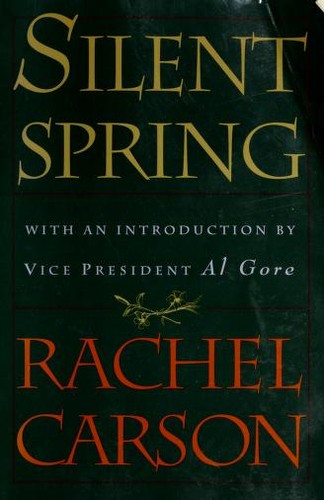
Talk to Silent Spring like its author wrote you back.
Get the ideas that fit your life — not generic summaries.
- Chat with the book
- Audiobook-style main ideas
- Adapts to your life and goals
- Helps you take action
What it argues
Silent Spring, published in 1962, is Rachel Carson's investigation of the effects of synthetic pesticides — particularly DDT and related organochlorines — on birds, fish, insects, and the broader ecological web. Carson was a marine biologist who had written several celebrated natural history books before turning to what she saw as an urgent public health and environmental crisis. The book's opening chapter, a fable about a town where spring arrives without birdsong, establishes the stakes before the scientific argument begins.
Carson's core case is that the indiscriminate aerial spraying programs of the 1950s, used to control agricultural pests and mosquitoes, were disrupting food chains in ways that federal agencies and the agricultural industry had failed to study or disclose. DDT and related compounds accumulate in fatty tissue and biomagnify up the food chain: insects ingest small doses, small birds eat many insects, larger predators eat many small birds. By the time the compounds reach eagles, ospreys, and other top predators, concentrations are high enough to interfere with calcium metabolism and cause eggshell thinning. The result was catastrophic population collapses among birds of prey, documented with field data Carson had gathered from scientists across the country.
What it gets right
- 1.
Pesticides like DDT do not stay where they are applied. They enter waterways, accumulate in soil, and biomagnify through food chains to concentrations far higher than any single application.
- 2.
Broad-spectrum insecticides kill beneficial insects — including natural predators of crop pests — creating the need for more pesticide application in a self-reinforcing cycle.
- 3.
Government agencies and industry presented pesticides to the public as safe without adequate long-term ecological study. The failure was one of transparency as well as science.
What it covers
Who wrote it
Rachel Carson (1907–1964) was an American marine biologist, conservationist, and writer who worked for the U.S. Fish and Wildlife Service for most of her career. She published three celebrated books about the sea — Under the Sea-Wind, The Sea Around Us, and The Edge of the Sea — before turning to pesticide research for Silent Spring. The Sea Around Us won the National Book Award in 1952. Carson died of breast cancer in 1964, two years after Silent Spring was published. She is widely credited as one of the founders of the modern environmental movement, and Time magazine named her one of the hundred most important people of the twentieth century.
