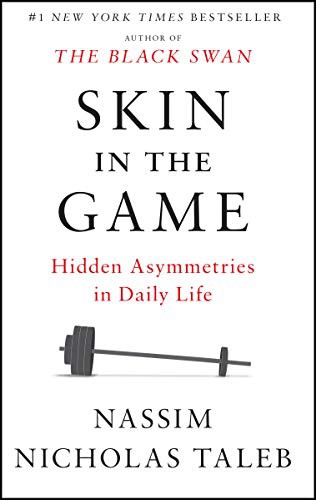
Talk to Skin in the Game: Hidden Asymmetries in Daily Life like its author wrote you back.
Get the ideas that fit your life — not generic summaries.
- Chat with the book
- Audiobook-style main ideas
- Adapts to your life and goals
- Helps you take action
What it argues
Skin in the Game is Taleb's argument that people who don't bear the consequences of their decisions should not be trusted, respected, or given power over others. The title is an old Wall Street phrase meaning you have your own money on the line. Taleb extends it into a general ethical and epistemological principle: any separation between those who make decisions and those who live with their results produces bad outcomes — for the people affected, for the systems involved, and eventually for knowledge itself.
The central asymmetry Taleb targets is between upside and downside. A consultant gives advice, collects a fee, and moves on. A soldier goes to war and stays. An economist models a policy, gets published, and suffers nothing if the policy fails. Taleb argues this asymmetry is not merely unfair — it is corrupting. People who have nothing to lose will recommend riskier, more complex, and more theoretically elegant solutions than the situation calls for. They optimize for appearance rather than results, and over time this degrades the quality of decisions in medicine, finance, politics, and institutions broadly.
What it gets right
- 1.
Skin in the game means bearing the downside of your own decisions. Anyone who gives advice, sets policy, or wields power without exposure to the consequences of failure should be treated with skepticism.
- 2.
Asymmetry between upside and downside is the source of corruption, incompetence, and bad advice. When risk is separated from reward, the incentives are broken.
- 3.
The Intellectual Yet Idiot: a credentialed expert whose real-world track record is invisible or poor, who mistakes complexity for depth and academic prestige for accountability.
What it covers
Who wrote it
Nassim Nicholas Taleb is a Lebanese-American essayist, risk analyst, and former derivatives trader. He is the author of the Incerto series — Fooled by Randomness, The Black Swan, The Bed of Procrustes, Antifragile, and Skin in the Game — a set of interconnected books on uncertainty, probability, and how to act under conditions of incomplete knowledge. Taleb has held positions at several trading firms and universities, including New York University's Tandon School of Engineering. His work draws on probability theory, philosophy, and classical literature, and he is known for his combative public persona and his skepticism of academic and institutional expertise.
