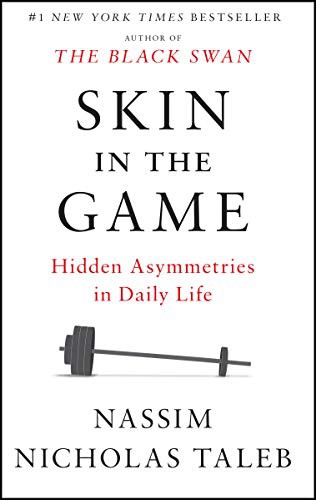
Skin in the Game: Hidden Asymmetries in Daily Life by Nassim Nicholas Taleb is a 2018 philosophy book about risk, accountability, decision-making. Skin in the game means bearing the downside of your own decisions. Anyone who gives advice, sets policy, or wields power without exposure to the consequences of failure should be treated with skepticism.
Summary
Skin in the Game is Taleb's argument that people who don't bear the consequences of their decisions should not be trusted, respected, or given power over others. The title is an old Wall Street phrase meaning you have your own money on the line. Taleb extends it into a general ethical and epistemological principle: any separation between those who make decisions and those who live with their results produces bad outcomes — for the people affected, for the systems involved, and eventually for knowledge itself.
The central asymmetry Taleb targets is between upside and downside. A consultant gives advice, collects a fee, and moves on. A soldier goes to war and stays. An economist models a policy, gets published, and suffers nothing if the policy fails. Taleb argues this asymmetry is not merely unfair — it is corrupting. People who have nothing to lose will recommend riskier, more complex, and more theoretically elegant solutions than the situation calls for. They optimize for appearance rather than results, and over time this degrades the quality of decisions in medicine, finance, politics, and institutions broadly.
Much of the book is a critique of what Taleb calls the Intellectual Yet Idiot: the credentialed class of experts who have accumulated credentials and platforms without accumulating real accountability. He contrasts them favorably with practitioners — traders, barbers, surgeons, pilots — people whose mistakes have immediate, personal consequences. He also develops the idea of the minority rule: a small, intransigent minority can impose its preferences on the majority if the majority is sufficiently indifferent. This explains why one vocal food-allergy customer changes an entire restaurant's menu, and why radical minorities often win political battles against large, passive majorities.
The book is part of Taleb's Incerto series, and it is the most polemical of the five. The argument is scattered across chapters that combine philosophy, probability theory, trading anecdotes, and classical references, and it rewards readers already familiar with Taleb's earlier work. Those coming in cold may find the style combative and discursive. But the core idea — that accountability and exposure to consequences is the mechanism that makes people honest, competent, and trustworthy — is a genuinely useful lens for evaluating institutions, advice, and people.
Talk to Skin in the Game: Hidden Asymmetries in Daily Life like its author wrote you back.
Get the ideas that fit your life — not generic summaries.
- Chat with the book
- Audiobook-style main ideas
- Adapts to your life and goals
- Helps you take action
Key takeaways
- 1.
Skin in the game means bearing the downside of your own decisions. Anyone who gives advice, sets policy, or wields power without exposure to the consequences of failure should be treated with skepticism.
- 2.
Asymmetry between upside and downside is the source of corruption, incompetence, and bad advice. When risk is separated from reward, the incentives are broken.
- 3.
The Intellectual Yet Idiot: a credentialed expert whose real-world track record is invisible or poor, who mistakes complexity for depth and academic prestige for accountability.
- 4.
The minority rule: a small, committed, inflexible minority can determine outcomes for a much larger indifferent majority. Minorities set standards; majorities ratify them.
- 5.
Practitioners are more trustworthy than theorists on practical matters because practitioners pay for their errors immediately. A pilot who crashes dies; a flight simulator designer does not.
- 6.
Via negativa: we learn more from what doesn't work than from what does. Longevity is often the best proof of robustness; theories that survive are rarer and more useful than theories that proliferate.
- 7.
Soul in the game matters beyond skin: true commitment means exposure to downside, but also genuine care for the outcome — not just financial exposure.
- 8.
Ethics in practice means symmetry: do not impose on others what you would not accept for yourself. The golden rule and its inverse are the foundation of Taleb's moral framework.
Discussion questions
Use these on your own, with a book club, or as chat starters in Superbook. Book club version, ready to copy or print →
- 1.
Think of a major decision in your life that was shaped by advice from someone with no personal stake in the outcome. How did it go, and what would have changed if they bore the same risk as you?
- 2.
Taleb says credentials and track records are different things. Who in your field is trusted mostly on credentials? Is that trust earned?
- 3.
The minority rule says a small inflexible group often sets the terms for everyone. Where have you seen this play out — in a workplace, a family, a community?
- 4.
Taleb is harsh about consultants, economists, and journalists. Is that fair? Are there domains where people without skin in the game can still give reliable advice?
- 5.
He distinguishes between those who talk and those who do. Where in your own life are you more of a talker than a doer on something that matters?
- 6.
What risks are you currently bearing that someone else is benefiting from? What risks is someone else bearing that you benefit from?
- 7.
Taleb argues that systems without skin in the game become fragile over time. Can you identify a system — a company, a government policy, a social institution — where this dynamic is visibly at work?
- 8.
The book is polemical and sometimes unfair in its characterizations. Where did you find yourself pushing back? Does the argument survive your objections?
- 9.
Via negativa suggests removing things is often wiser than adding them. What in your life or work should you subtract rather than add to?
- 10.
Taleb values the practitioner over the theorist. Are there domains where you think the opposite is true — where practice without theory leads people astray?
- 11.
If the people advising your government, hospital, or company were required to live under the policies they recommend, which policies do you think would change?
- 12.
Taleb's golden rule is: do not impose on others what you would not accept for yourself. Name a situation where you or someone you know violated that rule without noticing.
Themes
Frequently asked questions
-
What is Skin in the Game about?
Taleb argues that anyone making decisions on behalf of others must bear the personal consequences of those decisions, or the incentives are broken. The book applies this principle to finance, medicine, politics, and ethics, and uses it to critique credentialed experts who advise without accountability.
-
Is Skin in the Game worth reading?
Yes, if you're already sympathetic to Taleb's style. The central idea is sharp and genuinely useful. If you find his combative tone or the loose, essayistic structure frustrating, start with The Black Swan first. Skin in the Game works best as a capstone to the Incerto series, not as an entry point.
-
Do I need to read Taleb's other books first?
Not strictly, but Skin in the Game assumes familiarity with concepts from Antifragile and The Black Swan. Readers who come in cold may find some arguments underdeveloped. Reading Fooled by Randomness or The Black Swan first gives you the foundation.
-
What is the minority rule in Skin in the Game?
A small, inflexible minority can impose its preferences on a larger, indifferent majority if the cost of accommodating the minority is low enough. Taleb uses this to explain how niche dietary restrictions become universal menus, how radical political movements shift consensus, and why intransigence can be a strategic asset.
-
Who should read Skin in the Game?
People who work in advisory roles — consultants, policy makers, analysts, doctors — and want to think rigorously about accountability and incentives. Also useful for anyone trying to evaluate whom to trust when making high-stakes decisions. Less useful if you want a systematic how-to rather than a philosophical provocation.
Similar books
Thinking, Fast and Slow
Daniel Kahneman
The Black Swan: The Impact of the Highly Improbable
Nassim Nicholas Taleb
Antifragile: Things That Gain from Disorder
Nassim Nicholas Taleb
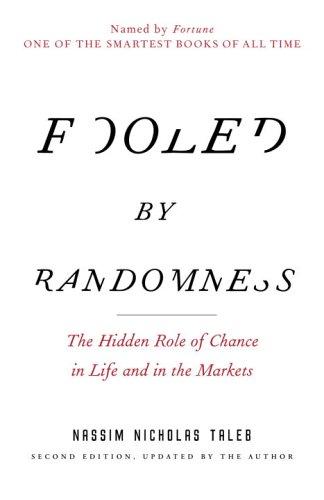
Fooled by Randomness
Nassim Nicholas Taleb
